Engineering Material Selection Logic for FDM Filaments: Start with Temperature, Load Type, and Post-Processing Conditions
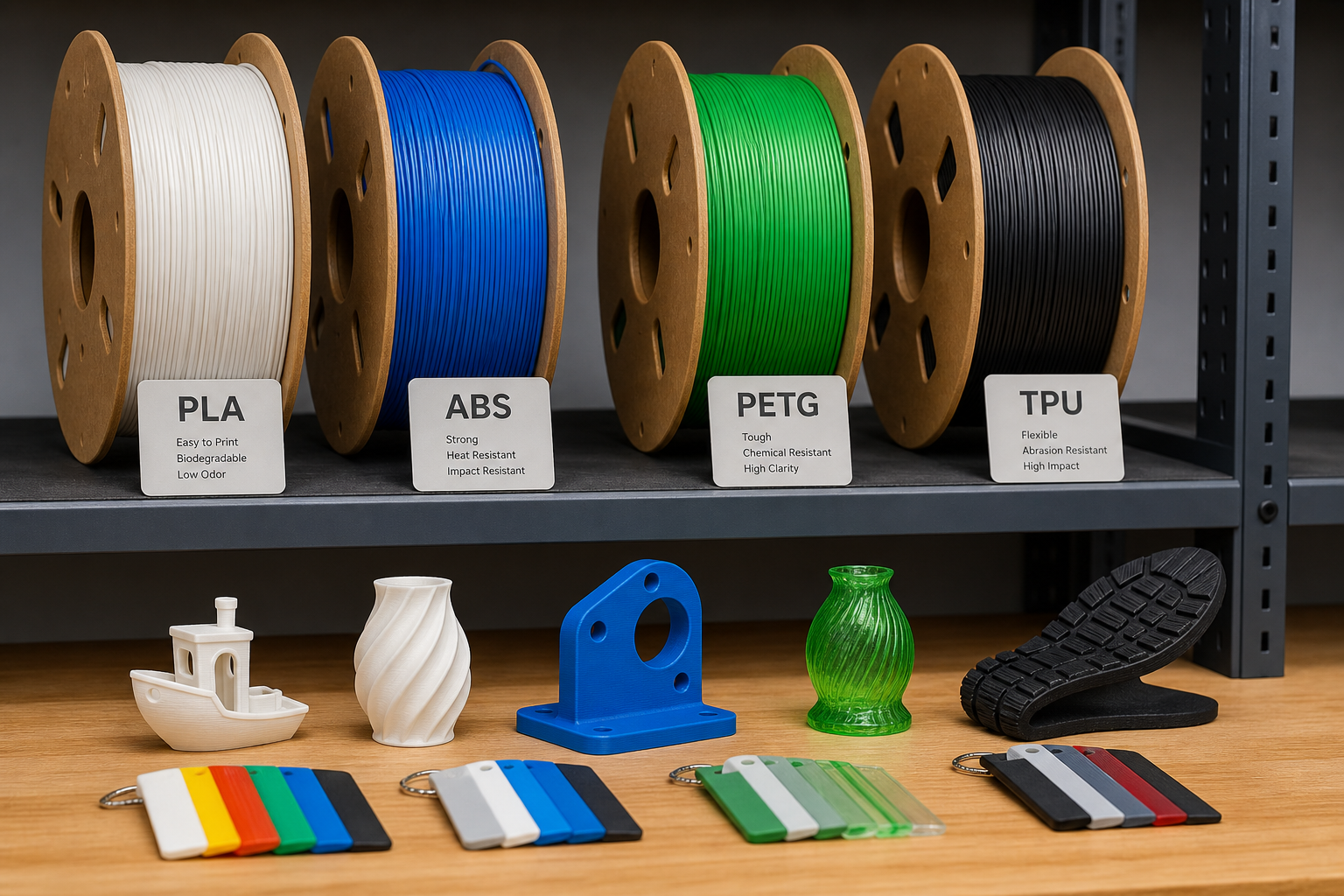
Choosing an FDM filament is not fundamentally about which material is stronger, but which material is most suitable for the target operating conditions. Engineering selection usually starts with three sets of parameters: first, service temperature, which determines whether the material will soften at 80°C, 100°C, or even higher; second, the loading mode, since tensile, bending, impact, and fatigue loads place very different demands on the material; and third, post-processing and assembly requirements, such as whether the part needs sanding, bonding, tapping, painting, or resistance to screw preload. Taking common FDM materials as examples, PLA prints with excellent stability and high dimensional accuracy, but has a low heat deflection temperature; ABS offers better temperature resistance and toughness, but is prone to shrinkage and warping; PETG balances strength and printability, making it suitable for structural parts; TPU is used for components that require elasticity, cushioning, and wear resistance. For service platforms, engineers often first confirm whether the product is a prototype, a jig/fixture, or a final-use part, and then match it to a material performance map rather than simply choosing the lowest-cost option.
- Material selection priorities: service temperature, load type, assembly method, and post-processing requirements
- PLA is suitable for low-temperature, accuracy-first scenarios; ABS is better for higher heat resistance and toughness requirements
- PETG is commonly used for structural parts that need both strength and easy printing; TPU is ideal for elastic and shock-absorbing components
PLA: High Dimensional Accuracy, Wide Printing Window, but Heat Resistance Is a Hard Constraint
PLA is one of the easiest materials to use in FDM. Its typical melt temperature is around 180°C to 220°C, and a heated bed at 50°C to 60°C is usually sufficient for stable printing. Its advantages are low shrinkage and minimal warping, which means small snap-fit parts, appearance models, and display prototypes often achieve better edge definition and hole consistency. In engineering use, PLA typically has a tensile strength of about 50 to 65 MPa and an elastic modulus of about 3.0 to 3.5 GPa, giving it higher stiffness than ABS and PETG. It is therefore suitable for parts that must retain their shape. Its weakness is equally clear: the heat deflection temperature is usually only around 55°C to 60°C. Standard PLA can soften and deform when left in a car under summer sun, placed near heat sources, or installed close to motors or power supplies. In one industrial enclosure pilot project, a cable-retaining clip printed in PLA lost clamping force after four hours of continuous operation at 60°C, and the design was ultimately switched to PETG to meet the requirement.
- Typical print settings: nozzle 180°C to 220°C, bed 50°C to 60°C, fan 80% to 100%
- Advantages: high dimensional accuracy, low warping, stable printing, suitable for visual prototypes and low-load structural parts
- Limitation: limited heat resistance; long-term operating temperature should generally stay below about 50°C
ABS: Better Heat Resistance and Impact Strength, but Higher Demands on the Printing Environment
ABS has long held an important place in engineering applications because of its more balanced overall performance. Typical ABS tensile strength is about 35 to 45 MPa, its impact toughness is generally better than PLA, and its heat deflection temperature can reach 90°C to 105°C, making it more suitable than PLA for electrical housings, hand tool enclosures, fixture bases, and automotive interior parts in moderately high-temperature environments. Another major advantage of ABS is that it can be acetone-vapor smoothed, which can significantly improve surface roughness and layer visibility. However, the printing challenges are also significant: shrinkage is relatively large, so an enclosed chamber and heated bed are critical. Nozzle temperature typically needs to be 230°C to 260°C, and the bed is recommended at 90°C to 110°C. If the ambient temperature fluctuates too much, edge lifting, delamination, and cracking can easily occur. In a typical tooling case, an ABS fixture for an electronics assembly line replaced PLA and maintained dimensional stability during an 80°C bake test. To prevent corner lift, however, the chamber temperature was kept above 40°C, and a brim plus support strategy was added.
- Typical print settings: nozzle 230°C to 260°C, bed 90°C to 110°C, enclosed printer recommended
- Advantages: good heat resistance, strong impact performance, suitable for functional parts and moderate-temperature service
- Risks: high shrinkage, easy warping, and greater requirements for machine capability and environmental control
PETG: A Balance of Strength, Toughness, and Printability, Ideal for Most Functional Parts
PETG can be viewed as an engineering filament that is more durable than PLA and easier to print than ABS. Its tensile strength is typically in the 45 to 55 MPa range, with good interlayer adhesion. When it breaks, it is tougher than PLA and less prone to brittle fracture than ABS. Its heat deflection temperature is generally around 70°C to 85°C. While not as high as ABS, it is sufficient for most indoor equipment, fixtures, brackets, and protective covers. PETG has a wide printing window: nozzle temperature is usually 230°C to 250°C, and the heated bed is 70°C to 90°C. It shrinks less during forming, so warping is much less of an issue than with ABS. One point to watch is that PETG tends to string and is relatively sensitive to retraction settings and nozzle temperature. If retraction is too low, fine strands can appear on bridges and detailed edges. In one automation equipment factory, a sensor mounting bracket originally made in PLA showed slight deformation near the motor area during testing. After switching to PETG, the bracket maintained positioning accuracy under a 75°C thermal cycling environment, while the part scrap rate dropped from about 18% to under 5%.
- Typical print settings: nozzle 230°C to 250°C, bed 70°C to 90°C, moderate fan speed is usually sufficient
- Advantages: balanced strength and toughness, low warping, and a strong candidate for first-choice functional parts
- Note: prone to stringing; retraction, speed, and temperature must be tuned carefully
TPU: Outstanding Elasticity, Wear Resistance, and Shock Absorption for Soft Functional Components
TPU is the most representative elastomer in FDM materials, with common hardness grades ranging from Shore A 85 to Shore D 95, of which 95A is the most common printable grade. Unlike rigid filaments, TPU’s core value lies in elastic recovery, wear resistance, and impact energy absorption. As a result, it is widely used for phone cases, bumpers, feet, flexible seals, gripper overmolds, cable sleeves, and contact surfaces for robotic end effectors. Its tensile strength is commonly around 25 to 45 MPa, and elongation at break can reach 300% to 600%. However, print speed usually must be reduced to 20 to 35 mm/s; otherwise, feeding instability, over-extrusion buildup, and retraction failure can occur. Nozzle temperature is commonly set to 210°C to 240°C, with a heated bed at 40°C to 60°C. TPU is highly sensitive to extrusion path, tube friction, and extruder architecture. Direct-drive extruders are typically more stable than remote Bowden systems. In a logistics sorting line case, TPU-printed cushioning pads replaced conventional silicone pads and maintained better dimensional consistency under high-frequency impact, extending the replacement cycle from two weeks to about two months.
- Typical print settings: nozzle 210°C to 240°C, bed 40°C to 60°C, speed 20 to 35 mm/s
- Advantages: high elasticity, wear resistance, and strong shock absorption, ideal for flexible functional parts
- Limitation: slow print speed and high demands on the feed system and retraction tuning
Four-Material Comparison: Fast Matching from Strength, Heat Resistance, Accuracy, to Cost
From an engineering decision-making perspective, PLA, ABS, PETG, and TPU can be treated as four different capability curves. PLA offers the best dimensional accuracy and print success rate, making it ideal for appearance models and low-temperature parts. ABS is stronger in heat resistance and impact performance, so it suits functional housings and moderate-temperature service. PETG is a common compromise for structural parts: it maintains good interlayer bonding while avoiding the pronounced warping of ABS. TPU is fully oriented toward elastic applications and is not suitable for rigid positioning requirements. In terms of cost, PLA is usually the lowest, PETG is slightly higher, and the actual unit part cost of ABS and TPU is often influenced more by the failure rate because of their material properties and print losses. For a small batch of 100 parts, if PLA achieves a 95%+ yield but ABS only reaches 70% to 80% without an enclosed chamber, then even if ABS has a lower nominal material price, the final total cost may still be higher. A common engineering practice is to use PLA for early concept prototypes, PETG or ABS for functional validation, and TPU for elastic components, forming a tiered material selection strategy.
- Best for accuracy and ease of printing: PLA; for overall functionality: PETG; for heat resistance: ABS; for elasticity: TPU
- Cost should be evaluated not only by filament price, but also by failure rate, post-processing, and rework cost
- For small-batch pilot runs, it is recommended to print 5 to 10 parts first for thermal testing, assembly testing, and load testing
Conclusion
PLA, ABS, PETG, and TPU correspond to the four most common engineering needs in FDM printing: rapid verification, heat-resistant functionality, balanced performance, and elastic cushioning. Material selection should not be based solely on whether a material is strong, but on a comprehensive assessment of service temperature, loading mode, structural size, printer capability, and post-processing requirements. If the project focuses on appearance validation and dimensional accuracy, PLA is the most efficient choice. If the part must withstand higher temperatures or some impact, ABS is more suitable. If you want a balance of strength, toughness, and lower printing difficulty, PETG is usually the safest engineering option. If the goal is shock absorption, overmolding, or flexible connections, TPU is almost irreplaceable. For a professional 3D printing service platform such as Blueprints 3D, the real value is not what can be printed, but being able to match material, process, and parameters to the operating conditions in one step, thereby reducing trial-and-error cost and improving small-batch delivery efficiency.
Submit a model, drawing, image or written notes. Engineers will review material, process, finishing and delivery based on actual use.