Introduction: 3D Printing Equipment Investment Decisions Are Shifting from Experience-Based Management to Data-Driven Operations
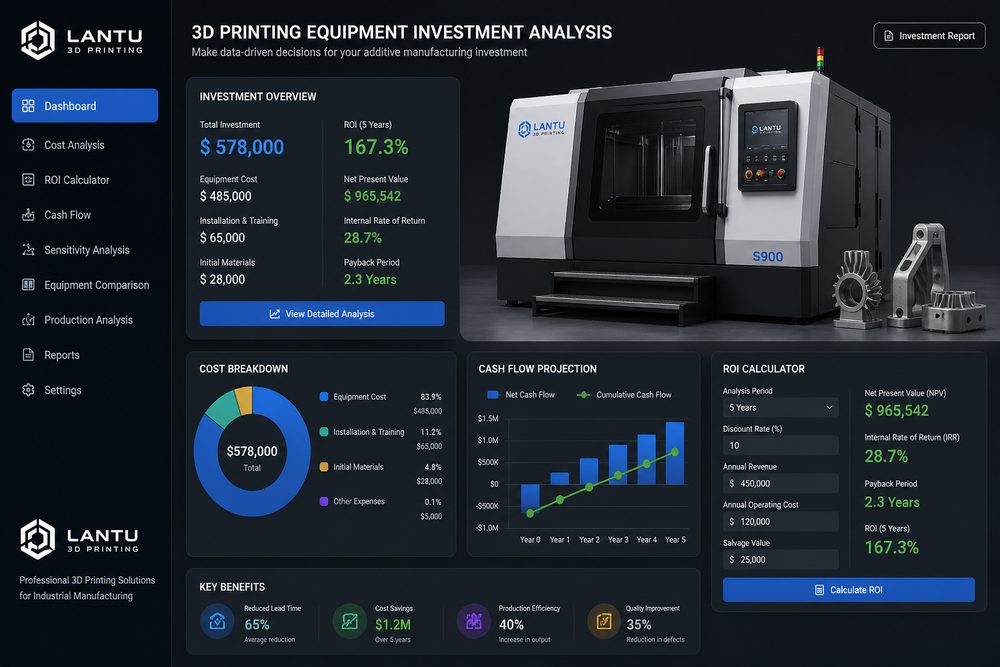
As 3D printing applications continue to expand, many companies face the same question: should they buy equipment to build internal capability, or keep relying on specialized service providers? This decision cannot be made simply by comparing “how much one part costs to print.” Purchasing the machine is only the beginning; facilities, consumables, maintenance, software, staff, and quality-system costs follow afterward.
1. Define Measurable Business Scenarios and Boundary Conditions
The first step in an investment analysis is to calculate the total cost of ownership. In addition to the equipment price, this should include annual maintenance, consumable loss, material shelf life, filtration and safety systems, electricity, floor space, operator wages, training, software licensing, and spare parts. The supporting costs for industrial-grade SLS or metal systems are especially important.
2. Break Down Risk and Delivery Responsibility by Process Stage
The second dimension is capacity utilization. A company can review the number of prototypes produced over the past 12 months, material types, size range, lead-time requirements, and external procurement spending. If the machine is expected to run only a few hours per week, ownership will be difficult to justify on fixed-cost grounds. If there are daily needs for R&D validation, an in-house system becomes more valuable.
3. Lock Parameters, Data, and Acceptance Criteria into the System
The third dimension is capability boundaries. Buying a machine does not automatically mean the company has complete 3D printing capability. Design for manufacturability, slicing parameters, support strategies, post-processing, inspection, and material selection all require experience. Complex materials, large parts, demanding surface finishes, or batch delivery requirements may still be better handled in collaboration with a service platform.
4. Continuous Optimization: From Individual Order Reviews to Organizational Capability Building
Risk analysis is equally critical. Equipment iterations are fast, material ecosystems change quickly, staff turnover can create capability gaps, and environmental and safety compliance also requires investment. It is recommended to run a 3- to 6-month pilot evaluation before purchasing, using external service data to simulate machine load.
Conclusion
Investment in 3D printing equipment is not merely a purchasing decision; it is a decision about building manufacturing capability. A practical approach may be to let in-house equipment handle rapid iteration, while external platforms take on complex processes and delivery assurance, achieving a balance among cost, speed, and quality.
Submit a model, drawing, image or written notes. Engineers will review material, process, finishing and delivery based on actual use.