
Introduction: Where Abrasive Flow Cannot Reach, Electropolishing Completes the Final Step
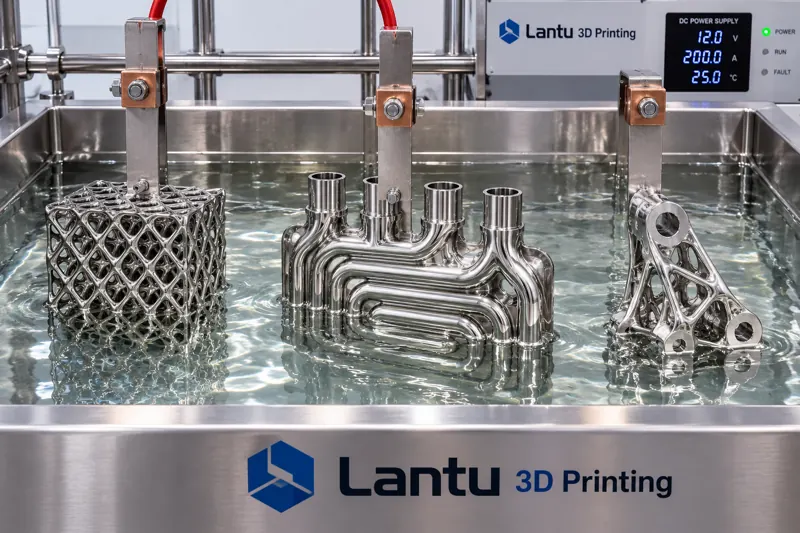
Surface leveling of metal 3D-printed parts usually begins with mechanical methods: blasting to remove adhered powder, abrasive flow machining to finish internal channels, and manual polishing for exposed surfaces. However, production sites repeatedly encounter the same blind spots: the interiors of lattice structures, bends in conformal cooling channels, the back sides of thin-wall grids, and intersecting edges inside complex cavities. Abrasives cannot enter these areas, and tools cannot reach them. Mechanical methods are either ineffective or leave obvious directional marks. Electropolishing (EP) provides a non-contact route: the workpiece is immersed in an electrolyte as the anode. Once current is applied, microscopic surface peaks experience higher current density and dissolve faster, so protrusions are preferentially smoothed. This leveling effect geometrically covers every surface in contact with the electrolyte, including internal cavities that abrasives can never reach.
1. Principle: Where the Selectivity of Anodic Dissolution Comes From
Electropolishing is not simply dissolving away a layer of metal. Within the appropriate electrolyte and current-density range, a high-viscosity diffusion layer, or viscous film, forms on the anode surface. This layer is thicker in microscopic valleys and thinner on microscopic peaks. At the peaks, resistance is lower, current density is higher, and the dissolution rate is faster; in the valleys, the opposite occurs and dissolution is suppressed. This positive feedback reduces the peak-to-valley difference in surface roughness over time, producing a mirror-like finish macroscopically rather than uniform thinning.
Understanding this is critical for process design: electropolishing is a leveling process, not a sizing process. It reduces microscopic peaks and valleys, not macroscopic form or position errors. If a hole has already been machined 0.1 mm oversize, electropolishing will not correct it; instead, overall dissolution will enlarge the deviation further. Therefore, it must be performed after dimensional machining has been completed.
2. Process Window: The Triangle of Current Density, Temperature, and Time
In engineering practice, success is determined by the coupling of three parameters, not by the single-point optimum of any one parameter.
Current density: For common stainless steel systems, the working range is roughly 10–40 A/dm². Below the lower limit, a stable viscous film cannot form, and the surface undergoes uniform corrosion, causing roughness to increase rather than decrease. Above the upper limit, the viscous film breaks down, shifting into pitting and preferential intergranular corrosion, with orange peel and pinholes appearing on the surface. The actual value should be calculated based on the part’s surface area, not its weight or volume. The effective surface area of a lattice part can be 3–5 times that of a solid part, which is one of the most common sources of calculation errors.
Temperature: For every increase of approximately 10°C in electrolyte temperature, the dissolution rate roughly doubles, but the stability of the viscous film decreases at the same time. Most phosphoric acid–sulfuric acid systems are controlled at 40–65°C. Beyond this range, current density must be reduced accordingly to maintain the process window. Temperature non-uniformity can also cause differences in material removal between the upper and lower sections of the same part. Large parts therefore require circulation and agitation, while static tanks are suitable only for small parts.
Time: Material removal is approximately linear with energizing time. For typical stainless steel parts, single-side removal is controlled at 10–40 μm. A practical approach is to first establish a removal-versus-time calibration curve using scrap parts or test coupons, then work backward from the target removal amount to determine the processing time, rather than assigning a fixed number of minutes based on experience. As-built LPBF surfaces often have an Ra of 8–15 μm. If the target is Ra ≤ 1 μm, removal of 25–35 μm is usually required to achieve a stable mirror finish. Removing only 10 μm often reduces Ra merely to 4–6 μm, which looks improved but does not meet the requirement.
3. Special Challenges of 3D-Printed Parts: Porosity, Adhered Powder, and Microstructural Non-Uniformity
Electropolishing experience from castings or forgings cannot be directly transferred to printed parts. The differences come from three sources.
Near-surface porosity: Even after HIP, LPBF parts may still contain subsurface closed pores. After electropolishing dissolves away 20–30 μm of the surface layer, previously covered pores can open up and appear to the naked eye as needle-like pits. This is not a process defect, but rather the exposure of the material’s original condition. The correct sequence is to perform densification and porosity inspection first, determine the depth distribution of pores, and then decide whether the planned removal amount is safe.
Unmelted adhered powder: Semi-melted particles on printed surfaces have varying bond strength with the substrate. During electropolishing, entire particles may detach and leave pits behind. Pre-blasting or wet shot peening can remove weakly bonded particles in advance and significantly reduce this type of defect. Skipping pretreatment and going directly to electropolishing is a major cause of high rework rates in production.
Microstructural and compositional non-uniformity: The rapidly solidified structure of printed parts, interlayer heat-affected zones, and melt-pool boundaries differ in compositional segregation. Electrolytes dissolve these regions at different rates, easily revealing melt-pool track textures. Increasing current density toward the upper end of the process window and appropriately extending time can usually make the texture less visible, but it cannot eliminate it completely. For decorative appearance parts, acceptable standards must be confirmed with the customer in advance.
4. Electrolyte Selection and Safety Boundaries
The mainstream system is a phosphoric acid–sulfuric acid mixture, which offers strong leveling capability and broad applicability. Titanium alloys often use fluoride-containing systems or perchloric acid–alcohol systems, but the latter involve a strongly oxidizing environment and require dedicated safety design and waste-liquid treatment procedures. Selection should consider three constraints at the same time: the passivation tendency of the base material, on-site safety and environmental conditions, and waste treatment capacity. Introducing high-risk chemistries in blind pursuit of a mirror finish often leads to safety and environmental costs that become prohibitive during mass production.
5. Passivation and Post-Cleaning: The Final Step That Determines Corrosion Resistance
The real value of electropolishing is not only brightness, but also the simultaneous formation of a dense, uniform passivation film. Taking 316L as an example, the chromium-to-iron ratio on the polished surface is significantly higher than that of the substrate, the pitting potential increases, and salt spray test life is typically extended by multiples. To preserve this film, however, post-cleaning must be done correctly: immediately after removal from the bath, rinse with flowing deionized water, neutralize residual acid, and then dry. Incomplete cleaning can cause yellow staining and rust return during storage. Medical devices and food-contact components usually also require a blue-dot test or sampled salt spray testing as the release basis for passivation quality.
6. Quality Verification and Engineering Boundaries
Recommended release inspection items include roughness (Ra) sampled in representative areas, before-and-after comparison of weight loss or critical dimensions, visual comparison under a standard light source, and salt spray or blue-dot testing when necessary. The engineering boundaries of electropolishing must also be clearly defined: it does not improve dimensional accuracy, repair macroscopic geometric deviations, or eliminate internal defects. Only by positioning it as a surface functionalization treatment rather than a sizing operation can the correct machining allowance be reserved at the design stage.
Conclusion
Electropolishing fills the capability gap left by mechanical polishing in complex internal cavities and lattice structures. Its value comes from a four-in-one effect: leveling, deburring, roughness reduction, and passivation film formation. The key to engineering implementation is to first ensure a controllable substrate condition through densification and pretreatment, then calibrate the removal-versus-time curve with test coupons, lock current density, temperature, and time within the process window, and finally complete the process with cleaning and passivation verification. When placed in the correct process sequence and paired with reasonable acceptance criteria, electropolishing changes from an optional surface treatment into a necessary release step for complex metal printed parts.
Submit a model, drawing, image or written notes. Engineers will review material, process, finishing and delivery based on actual use.