
Introduction: Two Powder Bed Fusion Routes for Metal Additive Manufacturing
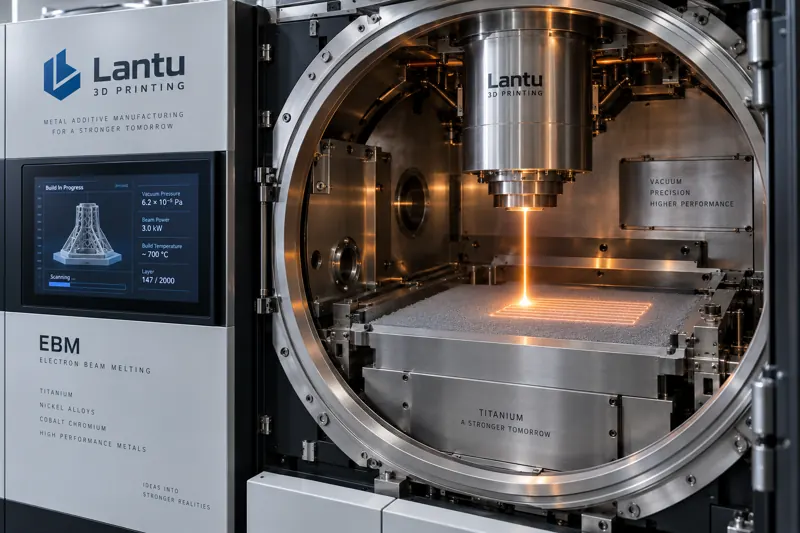
When discussing metal 3D printing, most engineers first think of selective laser melting (SLM/LPBF). However, in fields such as orthopedic implants and large titanium alloy structural parts, another powder bed fusion route—Electron Beam Melting (EBM)—has been in mature industrial use for years. Both processes follow the same additive logic of powder spreading and layer-by-layer melting, but EBM replaces the laser with an electron beam accelerated in vacuum to around 60 kV. This change creates very different thermal behavior: before scanning each layer, EBM uses a defocused electron beam to preheat the entire powder layer to a high temperature close to the material’s phase transition range, greatly reducing residual stress and the risk of thermal cracking.
1. How EBM Works and Why Vacuum Matters
EBM systems maintain a vacuum level of approximately 10⁻³ to 10⁻⁴ Pa inside a sealed chamber. Electrons emitted by the electron gun are accelerated by a high voltage, typically around 60 kV, and rapidly steered by magnetic deflection coils to melt conductive metal powders such as titanium and cobalt-chromium according to sliced contours and hatch paths. Unlike laser melting in an inert gas atmosphere, EBM is performed entirely under vacuum, resulting in extremely low oxygen levels and making it especially suitable for reactive metals. Key process parameters include beam current in the milliamp range, scan speed, layer thickness, typically 50–100 µm, and most importantly, preheating temperature. For Ti-6Al-4V, the preheating temperature is often controlled in the 700–1000 °C range, keeping the powder in a near-solid state above the beta transus region and minimizing the temperature difference during melting.
2. Core Process Advantages of EBM
Low thermal stress is the most defining feature of EBM. Because the entire powder layer is already heated to a high temperature, the thermal gradient between the melt pool and the surrounding material is far smaller than in SLM. Residual stress is often only a fraction of that produced by laser-based processes. As a result, thin-walled parts, slender cantilevers, and stress-sensitive geometries can often be built with fewer supports, and in some cases with no support structures at all. Second, high energy efficiency and strong deposition productivity make EBM economically attractive for larger components, with fast layer scanning, a hot powder bed, and reduced warping. Third, the vacuum environment is inherently clean and helps avoid oxide inclusions. When paired with conductive powders such as titanium, cobalt-chromium, tantalum, and refractory metals, the process offers broad material potential. Fourth, because the powder bed remains hot, partially sintered unmelted powder naturally acts as both support and thermal buffering during the build.
3. EBM Materials and Main Application Areas
Commercial EBM materials are mainly concentrated in titanium and cobalt-chromium alloys. Ti-6Al-4V is the dominant material, widely used for orthopedic implants such as acetabular cups and spinal cages, as well as aerospace titanium structural components, because the vacuum and high-temperature environment aligns well with titanium’s reactivity and phase transformation behavior. Cobalt-chromium alloys are commonly used in dental and wear-resistant applications. In recent years, refractory metals such as tantalum and niobium, as well as titanium aluminide (TiAl) intermetallics, have also entered the EBM processing window. It is important to note that EBM requires electrically conductive powders. Powder particle size distribution, flowability, and electron charging behavior directly affect powder spreading uniformity and surface quality. Compared with SLM, material qualification for EBM relies more heavily on batch-to-batch consistency control.
4. Process Limitations and Practical Countermeasures
EBM is not a universal solution. Its biggest drawback is surface roughness. High-temperature preheating partially sinters the powder, leaving formed parts with adhered powder on the surface. Surface roughness values can often reach tens of microns Ra, much higher than typical SLM results, so blasting, abrasive flow machining, or CNC finishing is usually required for mating surfaces. In addition, the initial investment and maintenance costs of the vacuum chamber and electron gun system are higher than those of many laser-based machines, raising the barrier for scaled production. Electron beam charging effects can also influence boundary definition on thin walls and fine features, while large-angle overhangs may still show balling. Common countermeasures include optimizing preheating power and scan strategies to reduce charging, using graded support and post-processing finishing, and establishing strict powder recycling and moisture control procedures.
5. Choosing Between EBM and SLM/LPBF
In process selection, EBM and SLM are not direct replacements for each other; they are complementary. When a part is stress-sensitive, thin-walled, large in size, made from titanium or cobalt-chromium, and surface roughness can be compensated through post-processing, EBM is often the better choice. It offers stable forming, very low cracking risk, reduced support demand, and high overall efficiency. When the part requires high precision, fine geometric detail, stainless steel or nickel-based superalloy materials, excellent surface quality, and dense small features, SLM/LPBF is usually more suitable. A practical rule of thumb is to prioritize EBM for large titanium alloy structures and implants, while choosing SLM for precision superalloy components and medium-to-small high-accuracy parts. In project evaluation, lantu3D provides process route recommendations based on material system, part size, accuracy requirements, and available post-processing capabilities.
6. Typical Application Scenarios
Orthopedic implants are the most representative EBM application. Near-net-shape porous structures, such as femoral stems and acetabular cups, can achieve the porosity and stiffness gradients required for osseointegration. In aerospace, titanium brackets, engine casings, and load-bearing structural parts benefit from EBM’s low-stress characteristics for large integrated manufacturing. In tooling, EBM can also be used for near-net-shape blanks of conformal cooling molds, followed by CNC machining and polishing. As preheating strategies, scan algorithms, and powder recycling systems continue to mature, EBM is expanding beyond implants into broader structural and refractory metal additive manufacturing applications.
Conclusion
Electron beam melting reshapes the thermal logic of metal powder bed fusion through vacuum processing, an electron gun, and full-layer preheating. It delivers extremely low residual stress and stable forming for large titanium-based components, at the cost of rougher surfaces and higher equipment investment. Understanding the complementary boundary between EBM and SLM is essential for making the right process decision across material, size, precision, and cost. For stress-sensitive, large-format, titanium-based, or reactive metal additive manufacturing needs, EBM is a mature route worth evaluating early.
Submit a model, drawing, image or written notes. Engineers will review material, process, finishing and delivery based on actual use.