
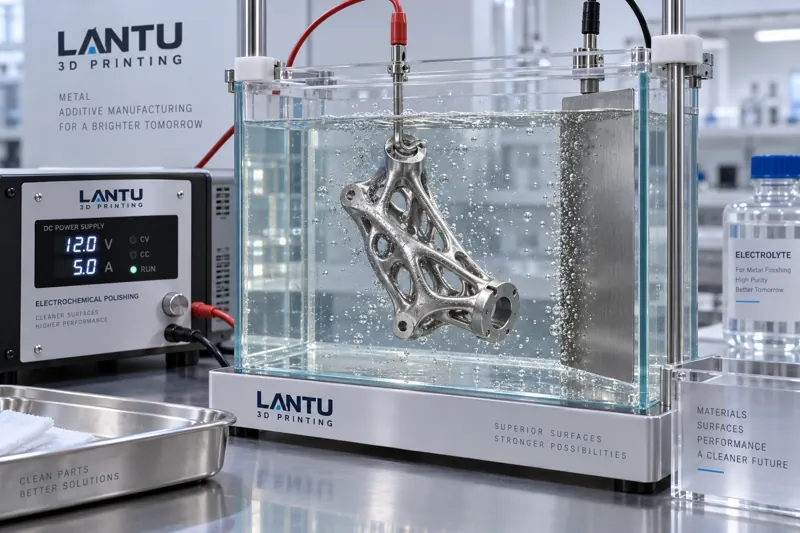
Introduction: Polishing Is the Final Gate for Metal Additive Parts to Become Functional Components
Parts produced by metal powder bed fusion (SLM/LPBF) often come off the machine with obvious layer lines, partially melted particles, and a stepped texture, with surface roughness Ra typically in the range of 8-15 μm. For prototypes used only for structural validation, this is not fatal; but once parts enter fluid, optical, medical, or food-contact applications, rough surfaces directly affect sealing performance, flow resistance, cleanliness, and fatigue life. At this point, polishing is no longer merely an appearance process to make parts “look better,” but a critical operation that determines whether the part can truly be delivered for use.
In addition to laser polishing, abrasive flow polishing, and mechanical sandblasting, electrochemical polishing (ECP, commonly known as electropolishing) and plasma polishing provide a smoothing route centered on “anodic dissolution.” They do not rely on tool contact and are not limited by line-of-sight obstruction, making them especially suitable for complex structures such as internal channels and honeycomb lattices. As a result, they are being incorporated into the standard post-processing chains of more and more additive manufacturing workshops.
1. Working Principle of Electrochemical Polishing: Anodic Dissolution and the Viscous Liquid Film
The essence of electrochemical polishing is controlled anodic dissolution. The part is immersed in an electrolyte as the anode, and when current is applied, metal dissolution occurs on its surface. At the same time, components such as phosphoric acid and sulfuric acid in the solution form a high-viscosity liquid film on the part surface. The thickness of this liquid film is not uniform—at surface peaks, the film is thinner, ion diffusion is faster, and current density is higher, so the protrusions dissolve preferentially, while valleys dissolve more slowly. This ultimately produces a smoothing effect by leveling peaks and valleys.
The core factor determining smoothing quality is the “polarization curve.” Only when the current density falls within the polishing plateau region, where voltage increases while current remains basically stable, can the surface obtain a uniform mirror-like finish. If the current density is too low, the part enters the pitting region and pockmarks appear; if it is too high, it enters the oxygen evolution region, causing the surface to lose gloss or even develop streaks. Therefore, a stable and controllable power supply and agitation flow field are prerequisites for reproducible electrochemical polishing.
2. How Process Parameters Determine the Smoothing Effect
The effect of electrochemical polishing is determined by a set of coupled parameters. Common engineering windows are approximately: current density 10-40 A/dm², bath temperature 40-70°C, processing time 3-15 minutes, and cathode-anode spacing 50-150 mm. These parameters must be adjusted in coordination: increasing current density can accelerate smoothing, but it also makes over-polishing more likely; increasing temperature improves the dissolution rate and electrolyte conductivity, while shortening the stability window of the liquid film.
For additive manufactured parts, there is another variable—residual stress from the build process. Because electrochemical polishing only dissolves the surface layer and does not introduce mechanical compression, it is actually a friendly option for thin-walled parts and channel parts that are sensitive to residual stress. In actual production, the “current density-time-Ra” curve should first be calibrated using small sample coupons before batch processing. For the first part of each batch, it is recommended to measure Ra and weight loss; weight loss is usually controlled within 0.5-2% to avoid dimensional out-of-tolerance issues.
3. Accessibility Advantages for Internal Channels and Complex Surfaces
One of the greatest values of additive manufacturing is the ability to create internal channels and lattice structures that conventional processes cannot machine, but this also creates post-processing challenges: sandblasting has difficulty entering enclosed internal cavities, laser polishing is limited by line-of-sight obstruction, and abrasive flow polishing can easily clog extremely fine channels. This is where electrochemical polishing has an advantage—as long as the electrolyte can fill the passage and form an electrical circuit, the internal surface can be uniformly dissolved without requiring line-of-sight access.
For deep holes and internal channels, engineering practice often uses “through-flow” fixturing: the part is connected to a channel circulation system so that the electrolyte is forced through the internal cavity from the inlet, polishing the inner wall at the same time. Combined with ultrasonic-assisted agitation, mass transfer uniformity in fine channels can be further improved. This approach allows additive parts to retain complex channel designs while achieving verifiable cleanliness and internal wall quality.
4. Selection Comparison with Laser Polishing and Abrasive Flow Polishing
The three mainstream finishing methods each have their own boundaries, and selection should return to the geometry and production volume of the part itself:
Electrochemical polishing: Suitable for conductive materials such as stainless steel, titanium alloys, and cobalt-chromium alloys. It excels at internal cavities and overall uniform smoothing, supports batch processing and simultaneous treatment of multiple parts, but is ineffective for non-conductive materials and requires handling of electrolyte and hydrogen emissions.
Laser polishing: With concentrated energy, local accessibility, and flexible selective processing, it is suitable for targeted smoothing of critical working surfaces. However, point-by-point scanning has relatively low efficiency, and it is often ineffective for the inside of deep cavities.
Abrasive flow polishing: Using viscoelastic abrasive media for reciprocating extrusion, it has strong removal capability for high protrusions in through-holes and intersecting channels, making it suitable for internal channel finishing. However, it requires dedicated fixtures and channel sealing, and offers limited support for blind cavities and complex topologies.
In practice, the three methods are often combined: abrasive flow polishing is used first to remove layer lines, then electrochemical polishing is applied for mirror finishing, and finally laser polishing is used for local treatment of critical working surfaces. Only by understanding the removal mechanism of each method can the right trade-off be made among cost, accessibility, and quality.
5. Material Compatibility and Medical-Grade Surface Integrity
Material compatibility directly determines whether electrochemical polishing can be implemented. 316L stainless steel and cobalt-chromium alloy (CoCrMo) achieve good smoothing results and have mature processes in phosphoric acid-sulfuric acid systems, making them common choices for dental and orthopedic implants. Titanium alloy (Ti6Al4V) requires specialized formulations and temperature control to avoid excessive surface passivation. AlSi10Mg aluminum alloy, due to its silicon-containing phase, can easily develop a silicon-rich layer after polishing and therefore requires additional control.
In medical and food-contact applications, electrochemical polishing is not just about “making the surface brighter,” but is part of surface integrity. A mirror-like surface can significantly reduce bacterial adhesion and particle residues, while removing partially melted particles left from printing and reducing the release risk of implants. Such parts typically require cleaning validation, Ra measurement, and SEM sampling inspection after polishing, along with traceable process parameter records to support quality release.
6. Implementation Points and Common Issues
Fixturing and electrical conduction: The spacing and relative position between the cathode and the part determine current distribution. For complex parts, fixture design often affects uniformity more than the parameters themselves.
Electrolyte management: As metal ions accumulate, polishing efficiency decreases. Metal content must be monitored regularly, and the bath solution must be replenished or replaced to avoid result drift.
Safety and environmental protection: Electropolishing generates hydrogen and acid mist, so ventilation, explosion-proof measures, and waste liquid neutralization and recovery systems must be installed. This is both a compliance requirement and a prerequisite for sustainable processing.
Common defects: Pitting is often caused by excessively low current density; streaks are often caused by uneven flow fields or overly high temperature; edge over-polishing can be suppressed through shielding or fixture adjustment.
Conclusion
Electrochemical polishing and plasma polishing provide metal additive parts with “non-contact, internal-cavity-accessible, batch-capable” smoothing capability. They are not replacements for sandblasting, laser processing, or abrasive flow polishing, but an important part of the post-processing chain for complex parts. To determine whether a polishing process is worth introducing, the key is to look at three points: whether the part is a conductive metal, whether the structure depends on internal cavity accessibility, and whether the surface carries a functional role. Only by clarifying these three questions, then combining sample calibration with cleaning validation, can polishing be transformed from experience-based operation into a reproducible and traceable engineering process.
Submit a model, drawing, image or written notes. Engineers will review material, process, finishing and delivery based on actual use.