
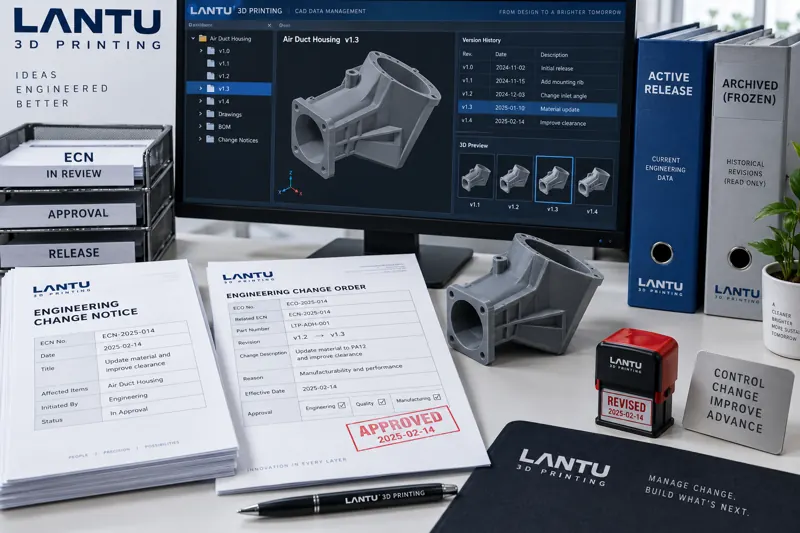
Introduction: Why One Drawing Change Can Scrap an Entire Batch of Parts
In real-world delivery for on-demand manufacturing and additive manufacturing, the most expensive rework is often not a failed print, but “making the part correctly to the old drawing.” A structural component had completed three prototype iterations and entered low-volume production. Without notifying the manufacturer, the customer changed the mounting hole from M5 to M6 and sent the updated 3D model only to the design contact. The production line continued powder spreading, sintering, and stress relief according to the previous program until interference was discovered during assembly. All 40 parts in the batch were scrapped, resulting in direct losses of more than RMB 60,000 and a two-week delivery delay.
The common cause of such losses is not insufficient process capability, but loss of configuration control: the model version, process document version, and inspection standard version are not synchronized. Engineering Change Notices (ECNs) and configuration management turn “who changed what, when it takes effect, and how work in process is handled” from verbal agreement into a traceable closed-loop process.
1. What Configuration Management Actually Controls
Configuration management has three levels. The first is configuration identification, which defines the controlled items: 3D models, engineering drawings, slicing programs, process cards, inspection procedures, and material lot specifications. Each item must have a unique number and version identifier, such as PART-1234-Model-A03. In this example, A03 is the version number that truly governs production, not the file-name suffix.
The second is configuration control, which constrains the process for proposing, reviewing, approving, and releasing changes. Any modification that affects shape, dimensions, material, process parameters, or inspection acceptance criteria is an engineering change and must follow the ECN process. Changes that only correct typos or add notes without affecting physical characteristics are document corrections and can follow a simplified process.
The third is configuration status accounting and auditing, which records the source of each change, its scope of impact, effective batch, and WIP disposition decision, and periodically verifies whether the physical status matches the document status. Without status accounting, traceability is impossible; without auditing, the process will gradually become a formality.
2. Change Classification: Not Every Change Needs the Same Process
If every minor edit is forced into a formal review, the process becomes bloated and will eventually be bypassed. In engineering practice, changes are typically divided into three levels. Level 1 changes affect function, fit, safety, or certification status, such as material-grade substitution, load-bearing wall-thickness adjustment, or tightening of critical fit tolerances. They must be co-signed by design, process engineering, and quality, and the first article must be revalidated. Level 2 changes affect process feasibility but do not change function, such as support layout, build angle, or changing layer thickness from 0.04 mm to 0.03 mm. Approval by the process owner is sufficient. Level 3 changes are documentation changes that do not affect the physical product and can be released after confirmation by the document author.
The key to classification is that criteria must be written into the procedure and supported with examples. Otherwise, reviewers will classify changes subjectively, and the same type of change may be assigned different levels by different people, immediately undermining confidence in the process.
3. Impact Analysis: The Core Action in Change Review
The step most easily compressed in ECN review is impact analysis, yet it is exactly what determines whether a change will create secondary issues. A complete analysis should cover at least five areas. Work in process: how many parts are currently being printed, in post-processing, or already inspected, and whether they need to be frozen or reworked. Inventory materials: whether purchased powder, resin, and standard parts are still applicable, and whether segregation labels are required. Tooling and programs: whether slicing programs, support strategies, fixture positioning, and CNC toolpaths need to be updated in parallel. Inspection resources: whether gauges, scanning paths, and industrial CT evaluation thresholds need to be reset, and whether measurement system analysis must be repeated. Delivery and commercial terms: whether customer confirmation letters, quotation basis, and delivery commitments are affected, and whether a change order must be signed.
Turning these five areas into a fixed form, with each item signed off as “checked, no impact” or accompanied by a defined disposition plan, gives the review real control power. Experience shows that more than 60% of change-related incidents originate from one item being ignored by default—the most common being inspection resources and purchased materials.
4. Effective Point and WIP Disposition
After a change is approved, the hardest part to execute is defining its effective point. There are three common approaches, each suited to different scenarios. Immediate effect applies to safety or functional defect corrections: the version switches as soon as it is released, all WIP is evaluated against the new version, and old-version WIP is directly classified as nonconforming and segregated. Batch-based effect applies to improvement changes: the starting batch is clearly specified, and the current batch is completed and delivered under the old version to avoid mixing parts with two different states within the same order. Effect after consumption applies to material substitution: old-version material is used up before switching, with segregation and identification maintained during the transition and inventory records updated accordingly.
Whichever method is used, the ECN must state the effective conditions and WIP list numbers, and the conclusion must be synchronized with production scheduling and inspection stations. The shop floor’s greatest risk is “both old and new versions running at the same time.” Therefore, at any given moment, only one effective version may be executable; all other versions must be marked as historical archives and non-printable.
5. Special Challenges in Additive Manufacturing
Compared with traditional subtractive manufacturing, change management for 3D printing has three special characteristics. First, the digital file is the production instruction: slicing parameters, build angle, and support strategy directly determine physical performance. These parameters must also be managed as controlled documents, rather than being left as local configurations on one computer. Second, process and material are tightly coupled: changes in particle-size distribution or moisture content of a material lot may require revalidation of the process window even if the model is unchanged. Therefore, material lot changes should trigger process confirmation, not merely an inventory record update. Third, anisotropy creates orientation sensitivity: even if the model is unchanged, a change in build orientation can significantly affect fatigue performance and dimensional behavior. Any change affecting orientation should be treated as a process change.
For additive manufacturing, the controlled-item list should therefore include at least: 3D models, engineering drawings, slicing program packages, support and build-orientation plans, material lots and retest records, heat-treatment and post-processing procedures, inspection procedures, and acceptance criteria.
6. Implementation Path: A Minimum Closed Loop That Small Teams Can Run
A full PLM system is not a prerequisite. Small teams can first establish a minimum closed loop: unified naming rules—part number plus file type plus version number, with descriptive names such as final version or latest version prohibited; a single controlled source—all production files stored in one controlled directory or lightweight system, with all local copies treated as uncontrolled; one ECN form—including change content, reason, level, five impact-check items, effective point, WIP disposition, and signature fields; a version-freeze mechanism—when a new version is released, the old version automatically becomes a read-only archive; monthly status checks—sampling several parts in production and comparing their physical status with the controlled document version, with status-accounting records generated.
The effectiveness of this mechanism can be measured with three indicators: first-article pass rate after change, number of reworked parts caused by version errors, and average cycle time from change proposal to shop-floor implementation. If rework caused by version errors is close to zero after the first year of operation, the configuration is truly under control.
Conclusion
The value of engineering change management is not to add approval steps, but to make every modification identifiable, assessable, and traceable. Change classification focuses effort on truly risky modifications, impact analysis makes hidden costs visible, and clear effective points plus WIP disposition prevent old and new versions from being mixed. For additive manufacturing, slicing parameters, build-orientation plans, and material lots are also controlled items; ignoring them is equivalent to handing configuration control over to shop-floor habits. Running the minimum closed loop first and then continuously improving it with metrics is the shortest path from delivery stability based on individual experience to delivery stability based on system capability.
Submit a model, drawing, image or written notes. Engineers will review material, process, finishing and delivery based on actual use.