
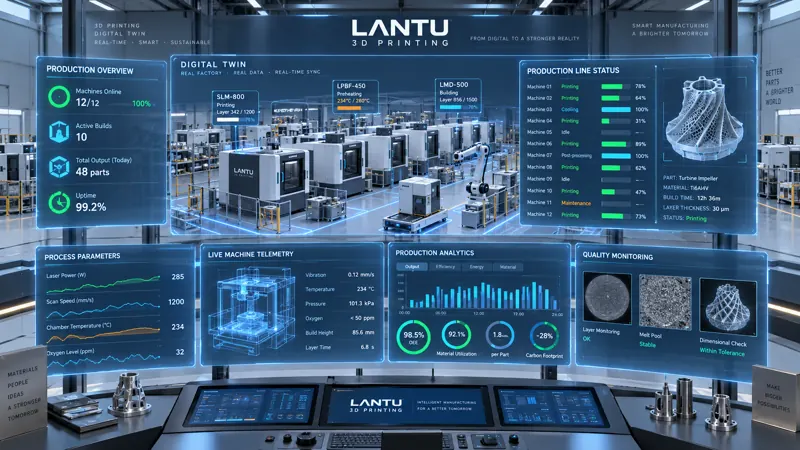
Introduction: From “Printing Blind” to “Visible and Controllable”
In a conventional metal additive manufacturing workshop, an SLM machine may run continuously for dozens of hours, while operators often rely on experience to judge whether the melt pool is stable or whether interlayer warping is occurring. If a build fails midway, the entire batch of parts may be scrapped, resulting in significant material and time costs. The introduction of digital twin technology gives 3D printing production lines real-time visibility for the first time. It synchronizes the status and process of physical equipment in a virtual space, turning invisible melt pool temperature, galvanometer trajectories, and oxygen content into data streams that can be monitored, flagged for warnings, and optimized.
1. What Is a Digital Twin for Additive Manufacturing?
A digital twin is not simply 3D visualization. It is a high-fidelity model built in virtual space that evolves in sync with the physical production line. It consists of three layers: an equipment geometry and motion model (galvanometer scanning paths, powder recoating mechanism, and build cylinder movement), a process physics model (thermal evolution of the melt pool and stress-strain fields), and a production operations model (scheduling, energy consumption, and yield). These layers are connected through real-time data streams, enabling the virtual entity to update its status in milliseconds in step with the actual equipment.
2. Why 3D Printing Especially Needs Digital Twins
Compared with subtractive and formative manufacturing processes, additive manufacturing involves more process variables and more hidden failure modes. In SLM, for example, a single-track melt pool is only 0.1–0.5 mm wide. Any drift in laser power, scanning speed, powder layer thickness (typically 20–60 microns), or shielding atmosphere oxygen content (required to be below 1000 ppm) can be amplified after hundreds of layers into balling, porosity, or cracking. Through online sensing and model-based prediction, digital twins shift quality control from post-process inspection to in-process intervention.
3. Key Points in Data Acquisition and Cyber-Physical Synchronization
The first step in achieving synchronization is high-quality sensing. Coaxial infrared thermal imaging integrated into the optical path (sampling at 1–5 kHz) captures melt pool temperature. Oxygen analyzers monitor oxygen content inside the chamber in real time. Encoders and current feedback track the galvanometer and powder recoating motors. These data are pushed to the twin platform at a frequency of around once per second through protocols such as OPC UA or MQTT. The key is to establish unified timestamps and coordinate systems to ensure strict alignment between the virtual layer and the physical layer in terms of “layer number–position–temperature.” Otherwise, model distortion may mislead decision-making instead of improving it.
4. From Monitoring to Closed-Loop Process Optimization
The advanced value of a digital twin lies in closed-loop control. When the model identifies excessive heat accumulation in a certain area and predicts a risk of warping, it can automatically reduce laser power by 5%–10% in the next layer, locally decrease hatch spacing, or insert thermal isolation scanning paths. This “sense–simulate–act” closed loop significantly improves first-pass yield, especially for deformation-sensitive structures such as complex thin walls and conformal cooling molds. It is important to emphasize that closed-loop strategies must undergo process validation and approval. Algorithms should not be allowed to override frozen process parameters without authorization.
5. Five Essentials for Implementation
First, prioritize data governance: standardize equipment communication protocols and data dictionaries before building models. Second, classify models by level: there is no need to pursue full physics-based simulation from the start; a lightweight twin based on “geometry + key variable monitoring” is a practical first step. Third, normalize calibration: as equipment ages, the twin model must be periodically recalibrated for galvanometer zero position and temperature baselines. Fourth, ensure security and permissions: when the twin platform connects to the factory network, OT/IT isolation must be implemented and write-back permissions for process parameters must be restricted. Fifth, promote human-machine collaboration: the twin is a decision-support tool, and final process changes still require engineer confirmation to avoid batch-level risks caused by “black-box automation.”
Conclusion
Digital twins are moving 3D printing from experience-driven production to data-driven production. For platforms such as lantu3D that cover the full process from design to delivery, connecting equipment status, process data, and quality results in a twin environment means faster anomaly response, more stable batch consistency, and more transparent delivery. Digital twins will not replace engineers; they will ensure every engineering decision is supported by real-time data.
Submit a model, drawing, image or written notes. Engineers will review material, process, finishing and delivery based on actual use.