Introduction: The Design Feedback Loop Is the Core Competitive Advantage of 3D Printing Services
In the 3D printing service industry, equipment is only the foundation; the real differentiating advantage comes from the professionalism of the service process. Among these, the Design Feedback Loop is the key link connecting customer needs with final delivery quality. A well-designed feedback loop not only helps customers avoid design risks, but also accumulates experience with every iteration, continuously improving product quality and design efficiency. For professional 3D printing service providers, building a systematic design feedback mechanism is the core safeguard for customer satisfaction and project success.
Basic Components of the Design Feedback Loop
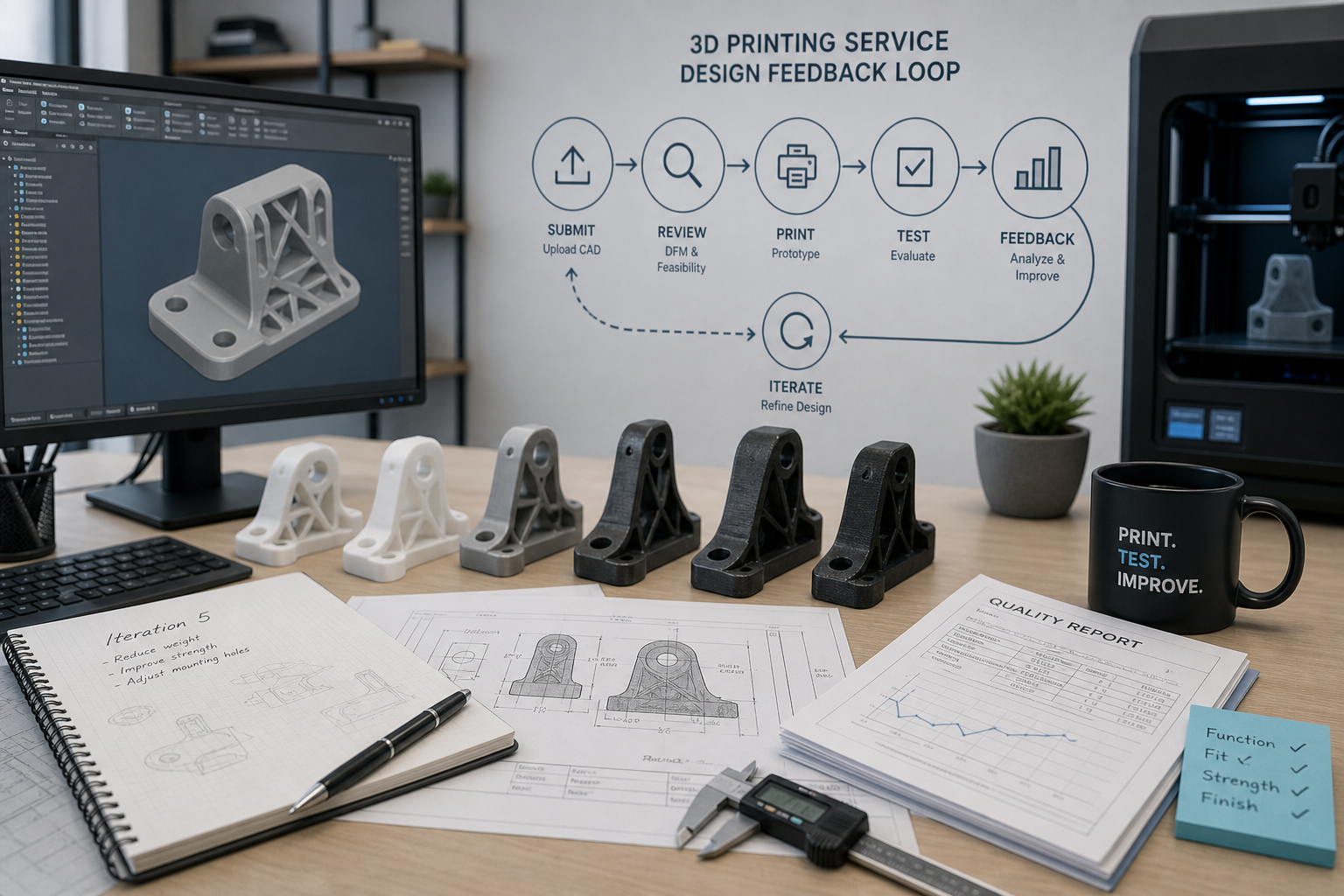
The design feedback loop consists of five core stages: requirement understanding, design review, prototype validation, issue feedback, and solution optimization. These five stages are not linear; instead, they form a continuous iterative cycle. In the requirement understanding stage, professional engineers need to deeply understand the customer's usage scenarios, functional requirements, and performance targets rather than simply receiving a 3D model file. During design review, the model's geometric features, wall thickness distribution, support structures, material selection, and other factors must be comprehensively evaluated. Prototype validation uses actual printing to test design assumptions, issue feedback systematically organizes and communicates real-world results to the customer, and solution optimization makes targeted design improvements based on the feedback data.
First Iteration: From Concept to a Printable Design
Most initial designs provided by customers have manufacturability issues. Common problems include insufficient wall thickness leading to print failure, overly steep overhangs requiring excessive support, detail features exceeding process limits, and unreasonable assembly tolerance design. In the first iteration, engineers need to provide detailed design revision suggestions, including specific dimension adjustments, support optimization plans, material substitution recommendations, and more. Excellent feedback is not simply saying that the design cannot be printed; it provides concrete solutions such as: if the wall thickness is increased from 0.6 mm to 1.2 mm and the overhang angle is optimized to within 45 degrees, support-free printing can be achieved, with the expected success rate rising to over 95 percent. Only quantified, actionable feedback can truly help customers improve design quality.
Second Iteration: Functional Validation and Performance Testing
After the first round of design optimization, the printed prototype must undergo functional validation. The goal at this stage is to confirm whether the design meets real-world usage requirements. For mechanical parts, tests may include assembly accuracy, motion interference, and load-bearing capacity; for appearance parts, surface quality, color matching, and texture effects need to be verified; for functional parts, heat resistance, corrosion resistance, fatigue life, and other properties must be tested. Any problems discovered during testing should be systematically recorded and turned into a structured feedback report. This report is not only the basis for improvement in the current project, but also a reference knowledge base for future similar projects. A professional feedback report should include four core parts: problem description, root cause analysis, improvement recommendations, and expected outcome assessment.
Third Iteration: Fine-Tuning and Preparation for Mass Production
After functional validation is passed, the focus of the third iteration is fine-tuning and preparation for mass production. This includes optimizing printing parameters to stabilize quality, adjusting post-processing workflows to improve consistency, and establishing quality inspection standards to ensure the reliability of batch delivery. For projects about to enter mass production, process validation and first article inspection (FAI) are also required to ensure that every production step is under control. Feedback at this stage focuses more on production efficiency and cost control, such as increasing print density by adjusting part nesting, or reducing post-processing workload by optimizing support strategies. The leap from prototype to mass production requires the feedback loop to function at a higher level.
Knowledge Accumulation and Reuse of Feedback Data
The greatest value of the design feedback loop lies in knowledge accumulation and reuse. Feedback data from every project should be stored in a structured way to form the company's design knowledge base. This knowledge base can be indexed by industry (automotive, medical, consumer electronics, etc.), by process (SLA, SLS, SLM, etc.), and by material (resin, nylon, metal, etc.). When a new similar project comes in, engineers can quickly search historical cases, anticipate potential problems in advance, and bring feedback forward to the design stage, thereby achieving the goal of getting it right the first time. This capability for knowledge reuse is what distinguishes a professional 3D printing service provider from an ordinary print shop—the core...
Submit a model, drawing, image or written notes. Engineers will review material, process, finishing and delivery based on actual use.