Introduction: Cross-border services are a new growth engine for the 3D printing industry
As the global manufacturing sector undergoes digital transformation, cross-border 3D printing services are growing rapidly. Design firms in the United States place orders with 3D printing service providers in China, while medical companies in Europe produce custom implants at printing centers in Asia. This cross-border collaboration model is reshaping the global manufacturing landscape. However, cross-border 3D printing services also face unique challenges: how do you choose the right international logistics solution to balance speed and cost? How do you accurately classify HS codes to ensure tariff compliance? How can free trade agreements be used to reduce tariff costs? How should cross-border payments and exchange rate risks be managed? Building systematic cross-border operations capabilities is a must for 3D printing service providers looking to expand into international markets.
International logistics solutions: the art of balancing speed and cost
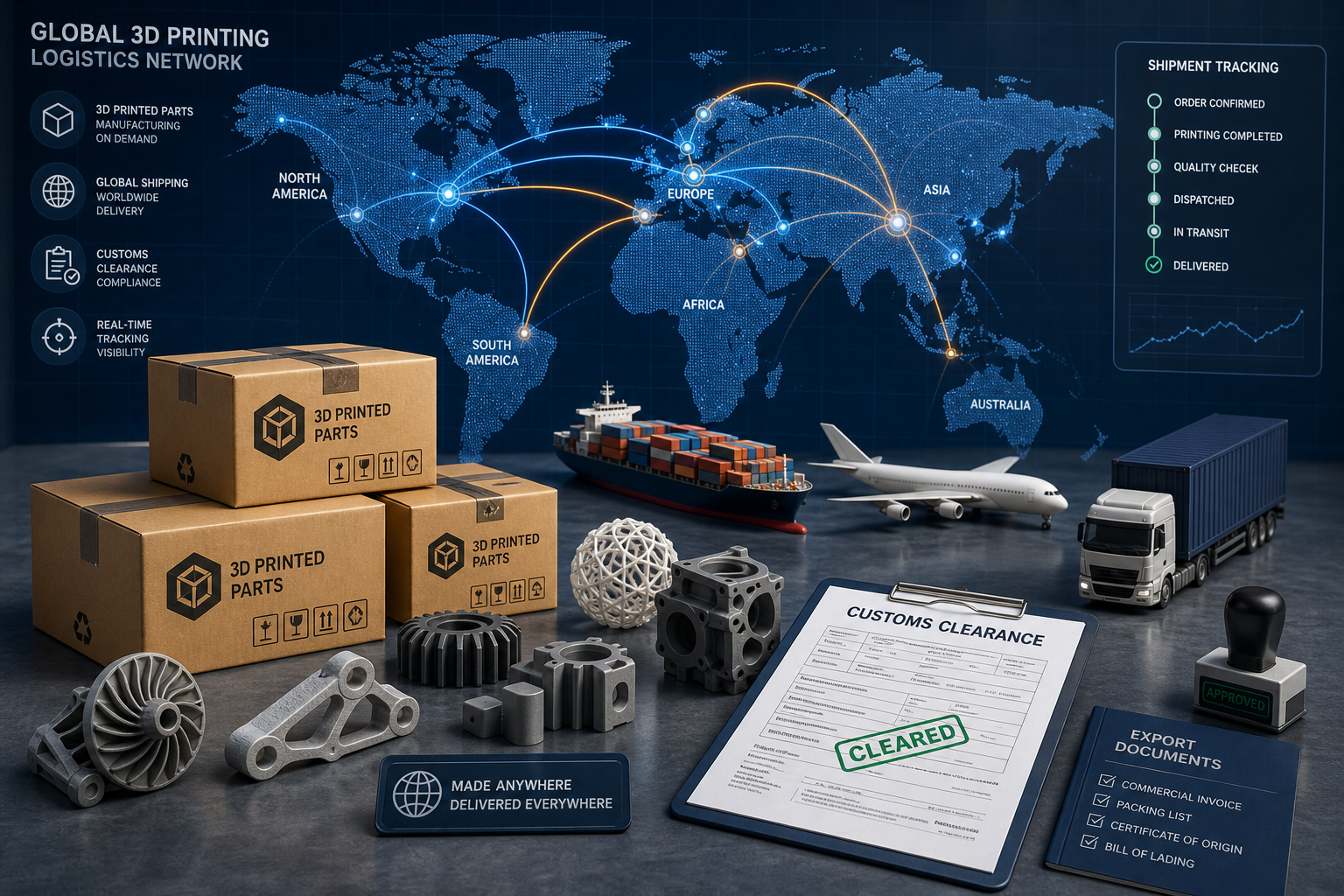
Logistics solutions for cross-border 3D printed parts generally fall into three categories: international express, dedicated line logistics, and postal small parcels. International express services (DHL, FedEx, UPS) are the fastest, with transit times of 3 to 5 days, but they are also the most expensive, making them suitable for high-value, small-volume, urgent orders. Dedicated line logistics (such as China-U.S. lines and China-Europe rail services) offer moderate transit times of 7 to 15 days at a moderate cost, making them suitable for bulk orders. Postal small parcels are the cheapest option, but they are slower, taking 15 to 30 days, and tracking information is limited, making them suitable for low-value, non-urgent orders. When selecting a logistics solution, factors such as part value, volumetric weight, delivery requirements, and customer willingness to pay must be considered comprehensively. For long-term overseas clients, it is also possible to explore an overseas warehouse model: shipping common materials or standard parts to the target market in advance to enable local dispatch and significantly improve the delivery experience.
HS code classification: the foundation of tariff compliance
The HS code (Harmonized System Code) is the global standard for product classification in international trade, and accurate HS code classification is directly related to tariff rates and customs clearance efficiency. HS classification for 3D printed parts can be somewhat complex: should they be classified as "plastic products" or as "mechanical parts"? Should classification be based on material or function? The general principle is to classify by material first (for example, plastic parts fall under Chapter 39, while metal parts fall under Chapters 73 to 83), but if a part constitutes a complete mechanical device or electronic equipment, it should be classified by function. Service providers are advised to build an HS code database, assign standard codes to each type of typical product, and clearly indicate them on invoices. For new products or complex assemblies, you can apply for an advance ruling from customs in advance to avoid disputes and delays during clearance.
Strategies for using free trade agreements
Free trade agreements (FTAs) are an effective tool for reducing tariff costs. China has signed 19 free trade agreements with 26 countries and regions, covering major trading partners. Take the China-ASEAN Free Trade Area as an example: 3D printed products that meet the rules of origin can enjoy zero-tariff treatment. The key to using an FTA is meeting the rules of origin: the product must be manufactured within a member country of the agreement, and the value-added ratio must meet the required threshold (usually more than 40%). For 3D printing services, if the materials used come from China and the processing is also completed in China, the product can usually meet the rules of origin. Service providers need to issue a Certificate of Origin to customers, which is a necessary document for enjoying preferential tariffs. Proactively informing customers about FTA benefits in quotations can significantly improve price competitiveness.
Customs clearance compliance: a critical step in avoiding delays
Customs clearance delays are one of the most common problems in cross-border logistics, usually caused by incomplete documents, inaccurate declarations, or products subject to special regulations. The documents required for customs clearance of 3D printed parts include a Commercial Invoice, Packing List, Bill of Lading, and Certificate of Origin. For special materials (such as metal powders or certain resins), an additional Material Safety Data Sheet (MSDS) or import license may be required. When declaring value, the declaration should be truthful to avoid underreporting, which can lead to customs inquiries or even fines. For high-value or complex products, it may be worth purchasing customs brokerage services. Professional customs brokers are familiar with local regulations and operating procedures and can significantly improve customs clearance efficiency while reducing uncertainty risks.
Submit a model, drawing, image or written notes. Engineers will review material, process, finishing and delivery based on actual use.