Introduction: Why Copper Alloy 3D Printing Is Being Used in Electric Drive Thermal Management
With the gradual popularization of 800V high-voltage platforms and high-power-density electric drive assemblies, the thermal dissipation pressure inside motor controllers, power modules, and battery packs is rising rapidly. Within the same volume, the loss density of power devices increases, and hotspot temperature directly determines device lifetime and derating strategies. Traditional CNC-machined copper cold plates are limited by tool accessibility, so their channels are mostly straight grooves or simple serpentine structures, with limited heat transfer area and obvious local hotspots, making it difficult to conform to the irregular arrangement of power devices. The thermal conductivity of copper and copper alloys is far higher than that of aluminum alloys, but pure copper has high reflectivity under near-infrared lasers and is difficult to form. Copper alloy 3D printing, especially CuCrZr chromium zirconium copper, has therefore become a key route for manufacturing thermal management channels for electric drives, freeing design flexibility from tool constraints.
1. Material Selection: Comparing CuCrZr with Pure Copper and Aluminum
The thermal conductivity of pure copper can reach 380–400 W/(m·K), but during SLM forming, its absorption rate for 1064 nm lasers is low, requiring high power and high preheating; density is difficult to stabilize, and pure copper has relatively low strength, with an annealed yield strength of about 60–70 MPa, making it difficult to withstand cold plate assembly and press-fit loads. CuCrZr, or chromium zirconium copper, has a thermal conductivity of about 320–360 W/(m·K), and after aging treatment, its yield strength can reach 250–400 MPa. It balances thermal conductivity and structural strength, making it the mainstream choice for electric drive cold plates and heat sinks today. Compared with aluminum alloys, which have a thermal conductivity of about 150–200 W/(m·K), copper alloys conduct heat about 1.8–2.2 times better, and can significantly reduce channel cross-section and overall system volume under the same heat dissipation power. It should be noted that copper has a density of about 8.9 g/cm³, roughly 3.3 times that of aluminum. Therefore, for components requiring lightweight design, the weight penalty must be balanced through structural weight reduction and local reinforcement.
2. Channel Design: From Straight Grooves to Conformal and Biomimetic Structures
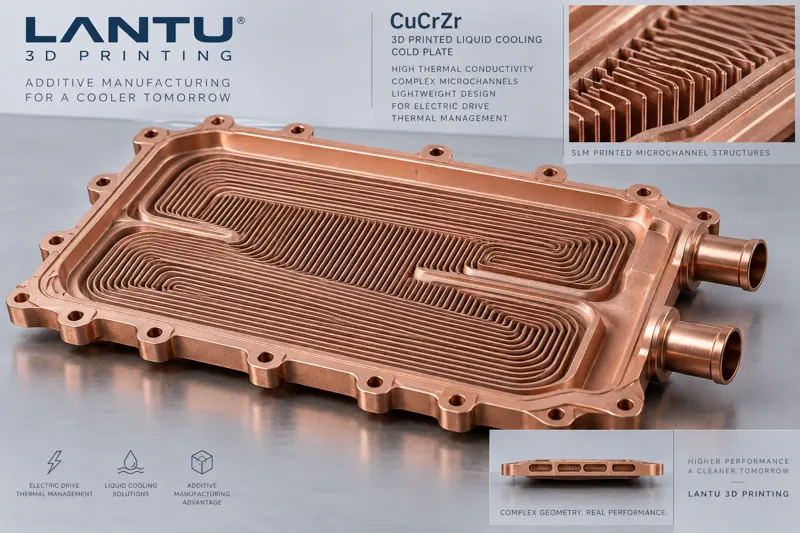
Copper alloy 3D printing frees channels from tool limitations. In engineering, three types of structures are commonly used: serpentine conformal channels, microchannel arrays, and biomimetic fractal channels. Key design points include: controlling the equivalent channel diameter within 1.5–4 mm, because excessively small channels will cause pressure drop to surge and pump power to rise; increasing channel density directly beneath power devices while appropriately widening channels at edges and low-heat-flux zones to achieve demand-based heat transfer; using variable cross-section transitions and rounded connections to reduce vortices and flow stagnation zones; and placing inlets and outlets away from high-heat-flux areas to avoid local dead water zones. With CFD thermal-flow coupled simulation, the temperature field and pressure drop budget can be predicted before printing, reducing the cold plate surface temperature difference from ±8°C in a straight-groove solution to within ±3°C, while keeping system pressure drop within the allowable range of the pump and channels.
3. Process Window: Laser Parameters and Density Control
CuCrZr usually uses gas-atomized powder with a particle size distribution of 15–53 μm. Recommended key SLM parameters are: layer thickness of 0.03–0.06 mm, laser power of 400–800 W, with high-power infrared or green lasers being more favorable for copper forming, scanning speed of 300–700 mm/s, and substrate preheating at 150–250°C to reduce residual stress and cracking risk. Because copper conducts heat extremely quickly, heat is rapidly carried away by the substrate and the already-formed layers, so compensation through scanning strategy is required: using chessboard partition scanning, rotating layers by about 67°, and remelting the contours can raise density to above 99% and control porosity within 0.5%. Density directly determines thermal resistance and pressure-resistant sealing performance. Pores are not only barriers in the heat flow path, but also leakage risks under high pressure. For thin walls and overhanging features, supports must be reasonably designed and machining allowances reserved to prevent deformation from causing failure of the mating surface.
4. Interfaces and Post-Processing: The Real Bottleneck of Thermal Resistance
The heat dissipation bottleneck of copper alloy cold plates often lies not in the material itself, but in the interface. Three points must be controlled in the process: first, the flatness of the mating surface between the printed surface and the power device, which is recommended to be ≤0.05 mm, with CNC finish milling and grinding added if necessary; second, the selection of thermal interface material, or TIM. The thermal conductivity of thermally conductive silicone grease is about 1–5 W/(m·K), while metal solder or sintered silver can reach 20–60 W/(m·K), significantly reducing total thermal resistance in high-heat-flux scenarios; third, powder removal and cleaning of internal channels, using high-pressure flushing together with ultrasonic cleaning to prevent residual powder from blocking microchannels. In addition, when connections with other metal parts are involved, brazing or friction welding may be considered, and attention should be paid to the risk of electrochemical corrosion when copper contacts dissimilar metals. Nickel plating can be applied to the surface when necessary to improve corrosion resistance.
5. Inspection, Acceptance, and Engineering Value
Three items must be verified before delivery: first, channel unobstructedness, confirming that there is no blockage or abnormal flow resistance through the flow rate-pressure drop curve; second, pressure resistance and airtightness, usually tested by holding pressure at 1.5 times the working pressure and recording the pressure drop; third, critical dimensional accuracy, verified using CMM or industrial CT. The dimensional accuracy of CuCrZr printed parts can generally be controlled within ±0.1 mm. During trial assembly, the device junction temperature and cold plate surface temperature difference should be measured and compared with a straight-groove solution. Practical data show that a properly designed copper alloy conformal cold plate can reduce hotspot temperature rise by 15%–30% and lower pump power by 10%–25% under the same heat transfer amount, thereby supporting higher power density designs and extending device service life under high-temperature operating conditions.
Conclusion
Copper alloy 3D printing provides complete design freedom from materials to channels for electric drive thermal management, but its true value comes from the coordination of material selection, channel design, process window, and interface processes. Only by incorporating density, flatness, and interfacial thermal resistance into a unified data chain and establishing reproducible inspection and acceptance standards can copper’s high thermal conductivity advantage be transformed into deliverable and reproducible thermal management performance.
Submit a model, drawing, image or written notes. Engineers will review material, process, finishing and delivery based on actual use.