Special Requirements for 3D Printing in the Aerospace Industry
The aerospace industry is one of the earliest and most demanding fields for 3D printing technology applications. The industry’s extreme pursuit of safety and reliability makes the barrier to entry into this supply chain exceptionally high. A series of compliance requirements such as the AS9100 quality management system, NADCAP special process certification, and airworthiness certification form the high hurdles that 3D printing service providers must overcome. The consequences of aerospace part failure are often catastrophic, so the industry’s requirements for manufacturing process reliability are far higher than those in general industrial sectors. Taking metal 3D printing as an example, the porosity requirement for aerospace parts is usually below 0.2%, and critical areas may even require full density; internal defect inspection must use industrial CT, with inspection accuracy capable of identifying defects larger than 50 microns; and destructive testing must be performed on every batch of parts to verify the consistency of mechanical properties.
Material Certification System and Data Package Management
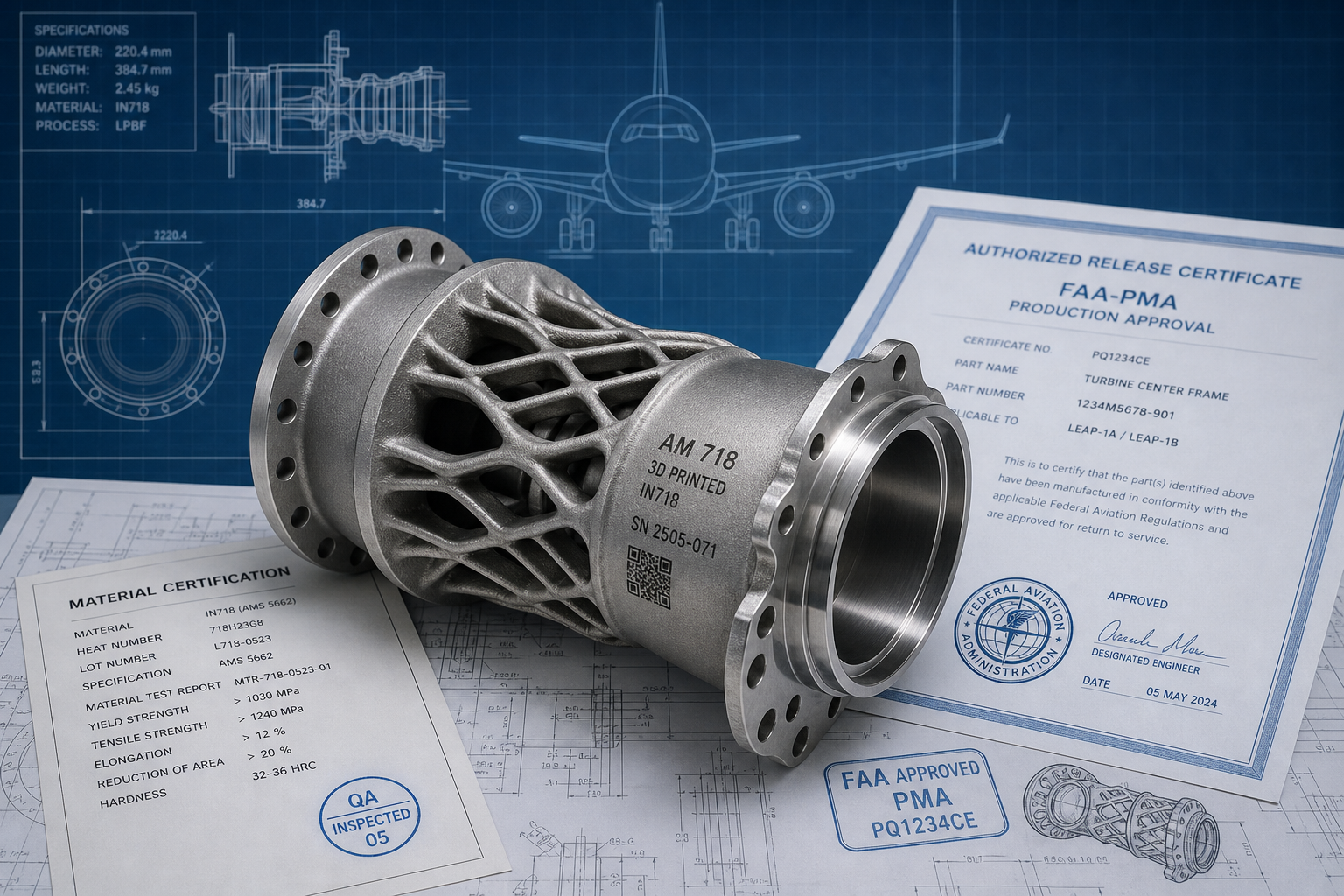
In the aerospace supply chain, material certification is the first step. 3D printing materials cannot rely solely on a supplier’s certificate of conformity; they must also pass material specification certification from aerospace customers. Material certification typically includes chemical composition analysis, mechanical property testing, microstructural analysis, and batch consistency verification. The material data package is the core deliverable of material certification. A complete material data package should include material specifications, process specifications, performance test reports, microstructure characterization, and statistical process control data. For metal powder materials, historical data on powder particle size distribution, sphericity, oxygen content, flowability, and other indicators must also be provided. Building and maintaining a material data package is a long-term effort that requires continuous data accumulation and document management.
Process Qualification and First Article Inspection
Process qualification is the process of proving that a printing process can consistently produce qualified parts. In the aerospace field, process qualification usually follows strict protocols. The qualification process includes defining the process parameter window, conducting process capability studies, completing first article inspection, and establishing a process control plan. First article inspection is a key step in process qualification. It requires full-dimensional inspection and functional verification of the first production part to ensure that all design requirements are met. A first article inspection report typically includes full-dimensional inspection data, material performance test results, nondestructive testing reports, and a statement of conformity. Once first article inspection is passed, the process parameter set is locked, and subsequent production must strictly follow it.
Quality Systems: AS9100 and NADCAP
AS9100 is an aerospace quality management system standard based on ISO 9001, with additional aerospace-specific requirements. Obtaining AS9100 certification is a prerequisite for entering the aerospace supply chain. The certification process includes establishing quality management system documentation, conducting internal audits, undergoing audits by a third-party certification body, and continuing surveillance audits. NADCAP is a special process accreditation program for the aerospace industry, covering 18 technical areas including heat treatment, nondestructive testing, materials testing, and coatings. As a special process, 3D printing’s NADCAP accreditation is still being gradually established. Although obtaining NADCAP certification is difficult and costly, it is also an important way for companies to build differentiated competitive advantages in the aerospace supply chain.
Airworthiness Certification and Part Approval
Airworthiness certification is the final gate for the commercialization of aerospace parts. For 3D-printed parts, the airworthiness certification path usually includes approval of material specifications, approval of process specifications, approval of part manufacturing, and supplemental type certification. The core of part approval is proving equivalence, meaning that the performance of the 3D-printed part is no less than that of the original designed part. Proving equivalence usually requires a large amount of comparative test data, including static strength, fatigue performance, environmental adaptability, and more. For critical structural parts, full-scale structural testing is also required to verify ultimate load-bearing capacity. The entire airworthiness certification process may take 1 to 3 years and cost millions of dollars. However, once approved, the part will secure long-term stable orders, and the return on investment is very considerable.
Traceability Management and Documentation System
The aerospace industry’s requirements for product traceability are extremely stringent. Every part must be traceable back to its original material batch, production equipment, process parameters, operators, inspection results, and delivery records. A complete traceability chain can quickly identify root causes and enable corrective actions when a part has problems. The documentation system is the foundation of traceability management. The amount of documentation generated by aerospace projects is far greater than that of ordinary industrial projects
Submit a model, drawing, image or written notes. Engineers will review material, process, finishing and delivery based on actual use.