Overview of Metal Binder Jetting Technology
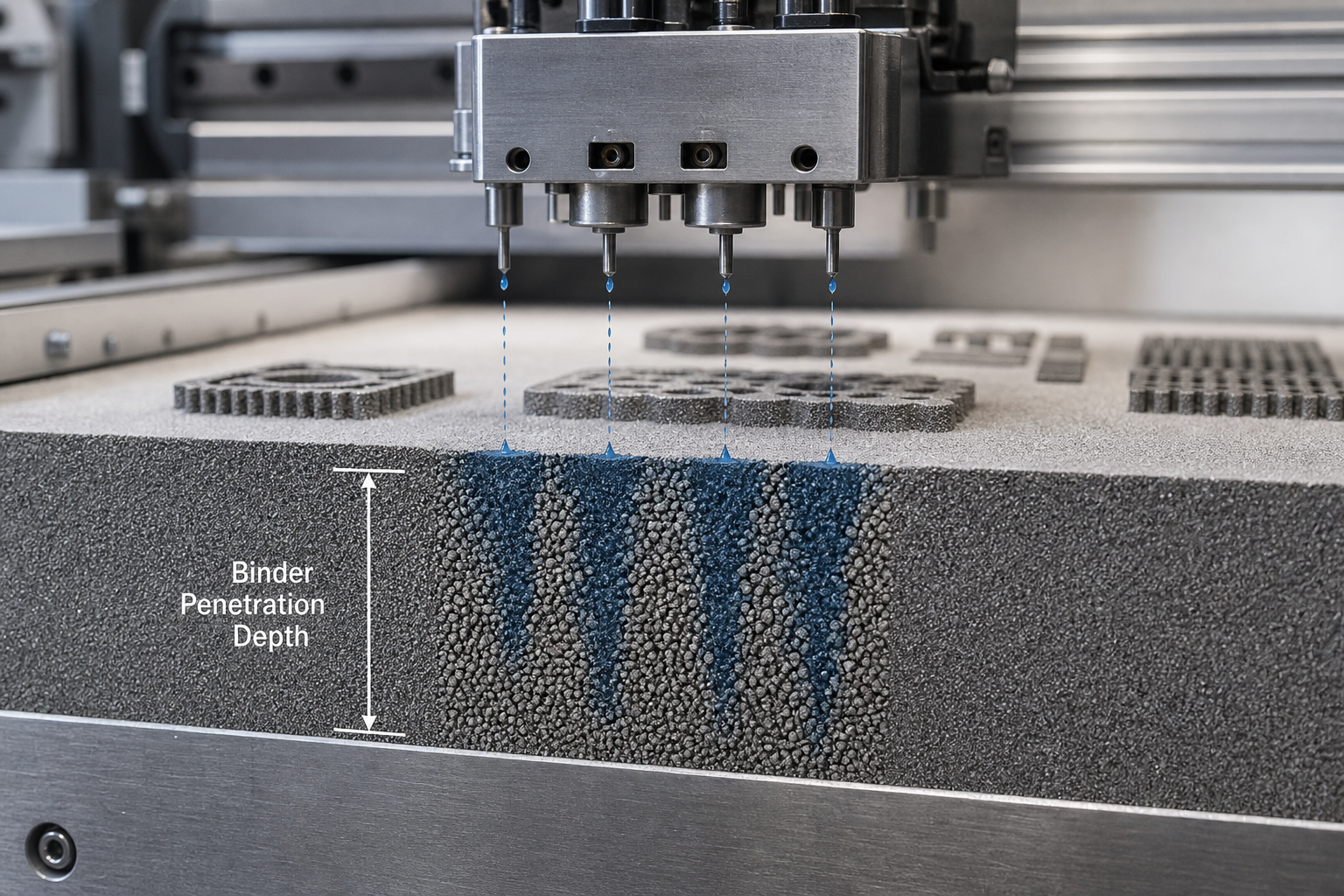
Metal Binder Jetting is an advanced additive manufacturing technology that combines the advantages of traditional powder metallurgy with modern 3D printing. This technology uses a print head to jet binder onto a metal powder bed layer by layer, bonding the powder particles together to form a green body, which is then sintered at high temperature to produce dense metal parts. Compared with laser-based metal 3D printing technologies such as SLM and EBM, binder jetting has significant advantages including lower equipment costs, higher production efficiency, and the ability to produce large-scale parts. However, controlling the binder penetration depth is one of the key challenges in this technology.
Penetration Mechanism and Influencing Factors
The binder penetration process in metal powder beds is a complex physical phenomenon involving capillary action, viscous flow, and chemical reactions. When the binder droplets contact the powder bed, they spread on the surface and penetrate into the pores under capillary forces. The penetration depth is influenced by multiple factors: binder properties include viscosity, surface tension, and curing characteristics; powder characteristics include particle size distribution, shape, and packing density; process parameters include droplet volume, jetting frequency, and layer thickness. Understanding the interactions among these factors is essential for controlling penetration depth.
Penetration Depth Control Methods
Several methods can be used to control binder penetration depth. First, optimize binder formulation to adjust viscosity and surface tension. Adding surfactants can reduce surface tension and increase wettability, while polymer additives can increase viscosity and limit penetration. Second, adjust powder bed temperature. Preheating the powder reduces binder viscosity and increases penetration, while cooling has the opposite effect. Third, optimize jetting parameters. Smaller droplet volumes and lower jetting frequencies allow more precise control of binder distribution. Fourth, use powder bed additives. Adding fine powder or absorbent materials can limit binder spreading. The selection and combination of these methods need to be optimized based on specific materials and application requirements.
Effects on Part Quality
Penetration depth directly affects part quality and performance. Appropriate penetration depth ensures good interlayer bonding and improves part strength and density. Too shallow penetration leads to weak interlayer bonding and may cause delamination during debinding and sintering. Too deep penetration causes excessive binder spreading, reducing dimensional accuracy and surface quality, and may lead to local defects. Experimental studies have shown that optimal penetration depth is typically 1.5-2.5 times the layer thickness. Within this range, parts exhibit good mechanical properties and dimensional accuracy. Monitoring and controlling penetration depth during the printing process is an important aspect of quality assurance.
Future Development Directions
As metal binder jetting technology continues to develop, penetration depth control will become more intelligent and precise. In-situ monitoring technologies such as high-speed cameras and infrared imaging can provide real-time feedback on penetration behavior. Machine learning algorithms can predict optimal parameters based on historical data and adjust process settings in real time. New binder formulations with self-adjusting viscosity characteristics can adapt to different printing conditions. These advancements will further improve the reliability and consistency of metal binder jetting, expanding its applications in aerospace, automotive, medical, and other high-end manufacturing fields.
Submit a model, drawing, image or written notes. Engineers will review material, process, finishing and delivery based on actual use.