Production challenges of mass customization
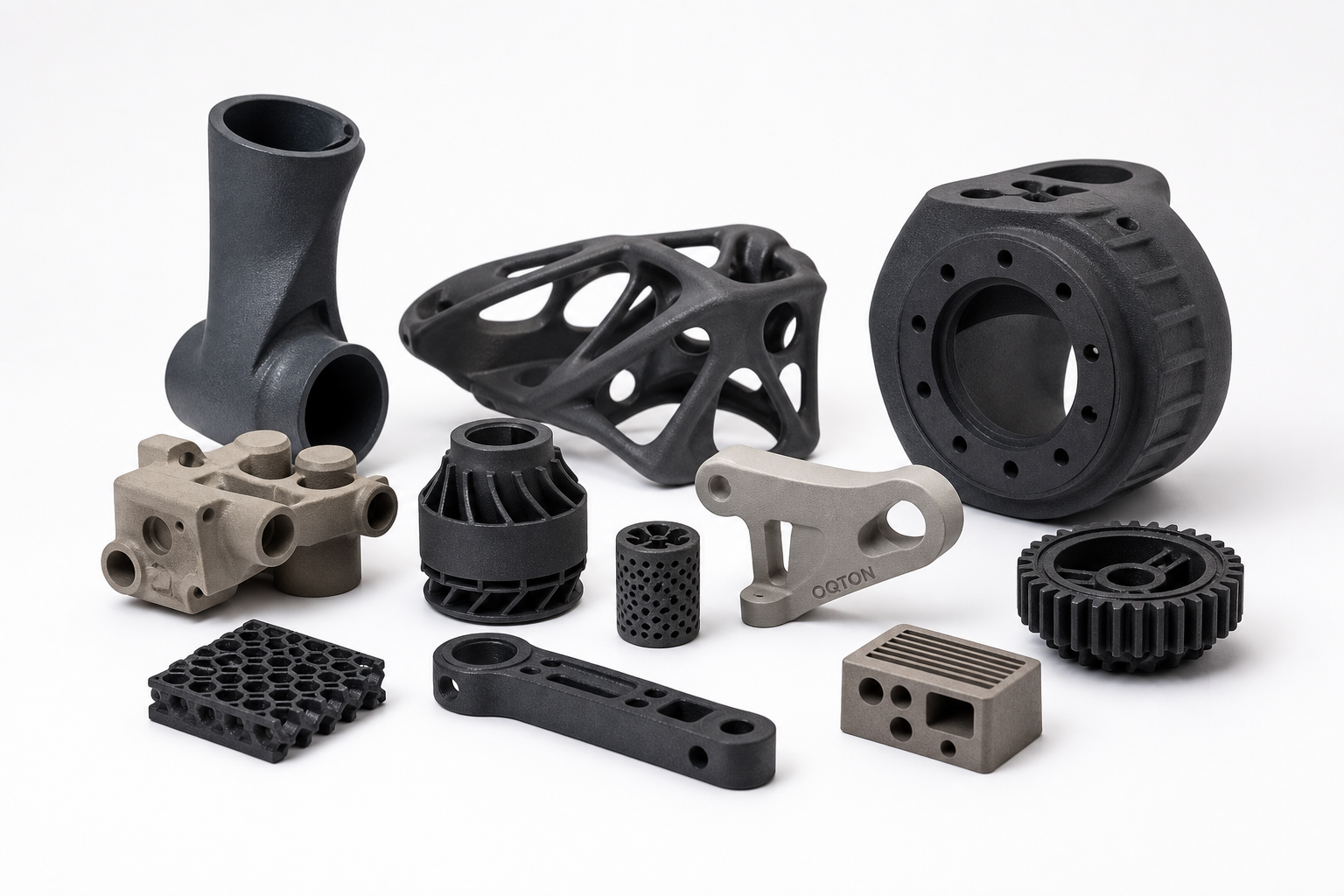
As the manufacturing industry develops in the direction of personalization and customization, small batch and multi-variety production has become the norm. Traditional mass production pursues large quantities of a single variety and reduces costs through economies of scale. Customized production is just the opposite. Each order has many varieties, small quantity, and tight delivery time. 3D printing technology has become an ideal process choice for mass customized production because it does not require molds and has a constant cost per piece. However, the low efficiency of single-piece printing restricts cost competitiveness. The part merging printing strategy came into being. By laying out multiple parts on the same printing platform, it makes full use of the printing space and significantly improves production efficiency and cost-effectiveness.
The core principle of merged printing
The essence of merged printing is to optimize the utilization of printing space. The working cavity size of 3D printing equipment is fixed. How to arrange more parts in a limited space is the key to improving efficiency. Traditional rectangular typesetting is simple but has low space utilization. Intelligent typesetting algorithms can perform optimal layout according to the shape of parts, increasing space utilization by 30-50%. When typesetting, factors such as the minimum spacing between parts, the space requirements of the supporting structure, and the scope of influence of thermal deformation need to be considered. Different materials have different shrinkage rates, and a corresponding safety distance needs to be reserved during typesetting. The orientation of parts placement is also very important, both to ensure printing quality and to take into account space utilization. Merged printing is not only a geometric problem, but also a process optimization problem.
Typesetting algorithms and tools
Intelligent typesetting tools are the core support for implementing merged printing. Modern typesetting software uses advanced algorithms such as genetic algorithms, simulated annealing, and particle swarm optimization to automatically search for optimal layout solutions. Users only need to import part models and quantity requirements, and the software automatically calculates the best layout plan. Advanced features include: support for mixed layout of different parts, automatic rotation to find the optimal orientation, real-time display of space utilization, and estimation of printing time and material consumption. Some software also supports batch planning, automatically allocating parts to different batches based on delivery priority and production capacity. Data-driven typesetting optimization records historical typesetting effects, continues learning and improvement, and gradually improves typesetting efficiency. The cloud typesetting service breaks the limitations of local computing resources, and the typesetting of complex batches can be completed in a few minutes.
Process parameter optimization
Merge printing has changed the process conditions of traditional single-piece printing, and the process parameters need to be adjusted accordingly. The first is printing temperature control. When multiple parts are printed at the same time, the total heat input increases. It is necessary to appropriately lower the printing temperature or increase the cooling intensity to avoid overheating and deformation of the parts. The second is the design of the support structure. When merging and printing, the supports of adjacent parts may interfere with each other, and a more efficient support strategy needs to be adopted, such as tree-shaped supports or tapered supports. The third is printing path planning, optimizing the printing sequence to reduce idle travel time and improve printing efficiency. The fourth is inter-layer time control to ensure that the inter-layer cooling time of each part is sufficient to avoid poor inter-layer bonding. The fifth is post-processing efficiency. Combining printed parts requires unifying the post-processing process to reduce the processing time of a single part. Process optimization requires maximizing efficiency while ensuring quality.
Cost-benefit analysis
The cost-benefit of combined printing is reflected in many aspects. Equipment utilization is improved, and the number of parts that a single piece of equipment can produce per day increases by 50-100%. The material utilization rate is improved, layout optimization reduces the amount of support materials, and the material cost is reduced by 10-20%. Improved labor efficiency, reducing startup preparation and post-processing operations for single-piece printing, and reducing labor costs by 30-50%. Energy efficiency is improved, continuous printing reduces the number of starts and stops of the equipment, and energy consumption is reduced by 15-25%. Taking a customized parts company as an example, after implementing the merged printing strategy, the production cost of a single piece dropped from 85 yuan to 52 yuan, a decrease of 38.8%. The production capacity has been increased from 120 pieces to 210 pieces per day, and the production capacity has increased by 75%. The production cycle has been shortened from an average of 5 days to 3 days, and customer satisfaction has been significantly improved. Merging printing strategies has become the core competitiveness of mass customization production.
Submit a model, drawing, image or written notes. Engineers will review material, process, finishing and delivery based on actual use.