
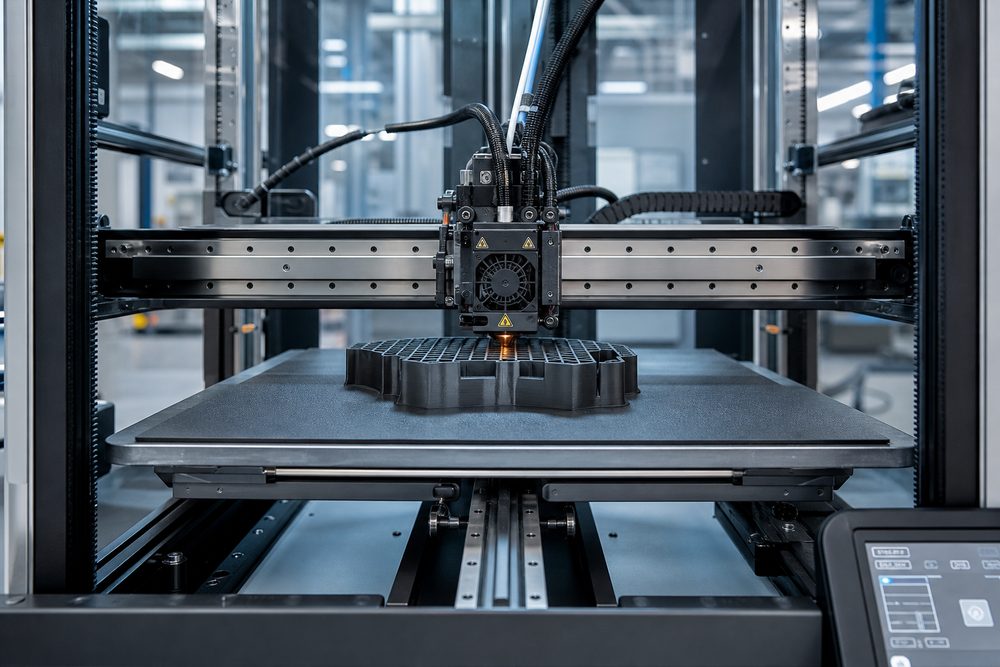
Overview of 3D printing applications in the automotive industry
The automotive industry is one of the earliest industrial fields where 3D printing technology was applied. From concept models, functional prototypes to production tooling, 3D printing plays an important role in the entire process of automobile development. Rapid prototyping is a key link in automotive product development. By rapidly producing prototype parts, performance can be verified and problems discovered in the early stages of design, significantly shortening the development cycle. Compared with traditional machining and mold manufacturing, 3D printing has the advantages of short cycle, low cost, and high degree of design freedom. It is especially suitable for prototyping parts with small batches and complex structures. The automotive industry has strict performance requirements for parts. Choosing appropriate materials and establishing complete testing standards are the keys to ensuring proofing results.
Analysis of material performance requirements of automobile parts
Parts in different parts of the automobile have different requirements for material performance. The components in the engine compartment need to withstand high temperatures (80-150°C) and oil media, and the materials need to have good heat resistance and oil resistance. Chassis structural parts bear dynamic loads, and the materials need to have high strength and good fatigue properties. Interior parts need to meet requirements such as flame retardancy, low odor, and aesthetics, and have high surface quality standards. Exterior trim parts need to be weather-resistant, UV-resistant, and have good dimensional stability. Electrical system parts need to be insulated, flame retardant, and high temperature resistant. Seals and hoses need to be elastic and media-resistant. For different application scenarios, it is necessary to select printing materials with matching performance and conduct full performance verification during the proofing stage.
Suitability assessment of commonly used printing materials
There are many types of 3D printing materials. Materials suitable for automotive prototyping mainly include: engineering resins (such as high-temperature resistant resins, ABS-like resins), which are suitable for appearance parts and low-load functional parts. The advantages are high precision and good surface, but the disadvantages are limited temperature resistance and strength. Nylon material (PA12, PA6) is suitable for structural parts and functional parts. It has high strength, good toughness and temperature resistance up to 120°C. Carbon fiber reinforced nylon is suitable for high-stiffness parts. Its strength and modulus are more than 50% higher than pure nylon, but the price is higher. TPU flexible material, suitable for seals and shock-absorbing parts, has good elasticity and wear resistance. Metal printing materials (aluminum alloy, titanium alloy) are suitable for high-load functional parts, but the cost is high and the cycle is long. Material selection needs to take into account performance requirements, cost budget and lead time.
Proofing test standards and procedures
Establishing a standardized test process is the guarantee for ensuring the quality of proofing. Appearance testing includes dimensional measurement, surface inspection, and assembly match verification. Functional testing designs special testing plans based on the use of parts, such as load-bearing testing, sealing testing, temperature resistance testing, etc. Durability testing evaluates the performance degradation of parts under long-term use conditions, including fatigue testing, aging testing, media immersion testing, etc. Environmental testing simulates the actual use environment, such as high and low temperature cycles, heat and humidity, salt spray, etc. Regulatory compliance testing verifies whether parts meet industry standards, such as flame retardancy, environmental protection, safety and other requirements. Test data must be completely recorded as a basis for design optimization and mass production preparation.
Rapid Prototyping Cycle Management
The development cycle of automobile products is tight, and time management of rapid prototyping is crucial. A typical rapid prototyping process includes: requirement confirmation (1 day), clarifying part usage, performance requirements and testing standards. Plan design (1-2 days), formulate material selection and printing process plan. Printing and production (1-3 days), determined according to part complexity and process. Post-processing (0.5-1 day), including support removal, surface treatment, etc. Test verification (2-5 days), determined according to the number of test items. Report output (1 day), summarizing test data and improvement suggestions. The entire cycle is controlled within 1-2 weeks, and emergency projects can be compressed to 3-5 days. Cycle management requires close cooperation among all links to avoid waiting and rework.
Submit a model, drawing, image or written notes. Engineers will review material, process, finishing and delivery based on actual use.