
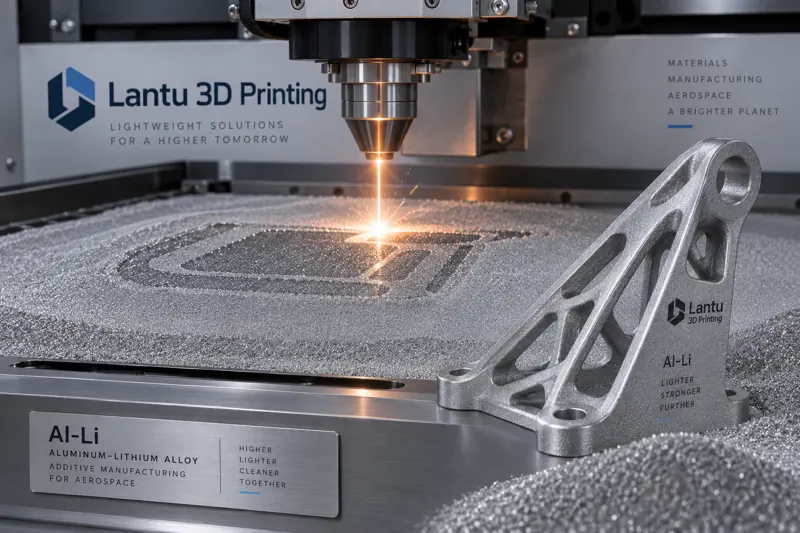
Introduction: Why Aluminum-Lithium Instead of Ordinary Aluminum Alloys
In aerospace and high-end equipment, weight reduction has never been as simple as "using a little less material." Every 1 kg removed from a structural component can bring substantial payload and fuel benefits for launch and transport equipment. Aluminum-lithium alloys entered the field of additive manufacturing against this background: for every 1 wt% lithium added, alloy density decreases by about 3%, elastic modulus increases by about 6%, and considerable specific strength can be achieved through precipitation of the Al3Li strengthening phase. Compared with conventional AlSi10Mg, third-generation aluminum-lithium alloys can provide a 7%–10% weight-reduction margin at the same strength level, which is precisely their value in cabin structures, brackets, and skin-type parts.
However, laser powder bed fusion (LPBF) of aluminum-lithium alloys is not a matter of simply "changing the parameters used for AlSi10Mg." Lithium is highly chemically active and suffers severe burn-off at the high temperatures of the melt pool. The addition of lithium also changes melt viscosity and surface tension, significantly narrowing the process window for balling, porosity, and hot cracking. Following the sequence of "composition—powder—melt pool—defects—post-processing—verification," this article outlines an executable engineering path for LPBF of aluminum-lithium alloys.
1. Composition Design and Lithium Burn-Off: Calculate Clearly Before Printing
The first engineering issue in LPBF of aluminum-lithium alloys is composition drift. Lithium has a boiling point of about 1342°C, far lower than aluminum's 2470°C. Under conditions where the local laser melt-pool temperature can exceed 2000°C, selective evaporation of lithium is unavoidable. Measured burn-off rates are typically 1%–3% by relative content and can be higher in regions with high energy density and repeated remelting. This means:
1. Powder composition requires reserved compensation. If the target is to maintain a post-print Li content of 1.0 wt%–1.3 wt% (the typical range for third-generation aluminum-lithium alloys), the powder-side formulation must be increased relative to the standard composition. The specific compensation amount must be measured and calibrated according to the machine's energy density and scanning strategy, rather than directly adopting wrought-product standards.
2. Key alloying elements must work synergistically. Cu, Mg, and Ag jointly determine the precipitation sequence (δ′/Al3Li, T1/Al2CuLi, θ′/Al2Cu), while Zr or Sc is used to form Al3Zr/Al3Sc dispersoids to suppress recrystallization and refine grains. The extremely high cooling rate of LPBF (10^5–10^6 K/s) suppresses some equilibrium precipitates, so the as-built state is often supersaturated, and strength depends on subsequent heat treatment for release.
3. Impurities must be controlled. Alkali and alkaline-earth metals such as Na, K, and Ca can significantly worsen hot-cracking sensitivity even at ppm levels, while Fe and Si tend to form coarse intermetallic compounds that become crack initiation sites. Powder procurement specifications should set separate limits for these elements, with retained samples taken during incoming inspection.
2. Powder Characteristics: Flowability, Moisture Absorption, and Batch Consistency
The surface oxide film structure of lithium-containing powder differs from that of ordinary aluminum alloys. Lithium preferentially segregates to the surface, forming Li-containing oxide/nitride layers. This film affects both flowability and melt-pool wetting. Key engineering control points include:
Particle size and morphology: A 15–53 µm range is recommended, with the satellite powder ratio kept low. Insufficient sphericity directly causes fluctuations in powder-bed density, which then leads to lack-of-fusion defects. Moisture content and storage: Powder should be stored under an inert atmosphere or vacuum-dried conditions. Excess moisture decomposes in the melt pool to generate hydrogen, making it a direct source of hydrogen pores. A closed loop of drying—moisture-content testing—reinspection after expiration is recommended. Batch consistency: Differences in actual Li content and oxygen content between batches can shift the entire process window. When changing batches, at least one set of process validation specimens must be rerun; parameters must not be reused directly without verification.
3. Melt-Pool Process Window: Higher Energy Density Is Not Always Better
Aluminum-lithium alloys have a very narrow sensitivity range for process parameters. In engineering practice, it is recommended to establish the window around volumetric energy density Ev = P/(v·h·t), but it should not be treated as the only criterion—the effects of scanning speed, overlap ratio, and layer thickness on melt-pool morphology are not equivalent.
Thermal conductivity and preheating: Aluminum-lithium alloys have high thermal conductivity, on the order of about 80–90 W/m·K. Substrate preheating is critical for reducing temperature gradients and suppressing hot cracking. It is usually set in the 150–200°C range and fine-tuned according to crack statistics. Energy input: Too little energy produces lack of fusion and poor interlayer bonding, while too much energy intensifies lithium burn-off, keyhole porosity, and melt-pool instability. The engineering approach is to first conduct single-track experiments to determine the continuous-track range, then use block specimens to establish the density window. Scanning strategy: Partitioned chessboard scanning combined with interlayer rotation, such as 67°, is a common method for controlling residual stress and texture. Stripe width is recommended to be kept at 5–10 mm; excessive width will aggravate temperature gradients.
4. Typical Defects: Porosity, Hot Cracking, and Balling
Hydrogen pores: These are regularly spherical with smooth inner walls and are often related to powder moisture content, ambient humidity, and shielding-gas purity. Countermeasures include powder drying, monitoring oxygen and water content in the chamber, with targets usually controlled at low ppm levels, and reducing severe melt-pool fluctuations. Keyhole pores: These have irregular shapes and are located at the bottom of the melt pool. They are caused by excessive energy density, and the solution is to reduce laser power or increase scanning speed. Hot cracking: Aluminum-lithium alloys have a wide solidification range and large linear shrinkage, making them prone to intergranular hot cracking along columnar grain boundaries. This is one of the most difficult defect types in aluminum-lithium LPBF. Suppression routes include adding Zr/Sc to refine equiaxed grains, adjusting the Cu/Mg ratio to narrow the solidification range, increasing substrate preheating, and optimizing scanning strategies to reduce constraint stress. Balling: This is related to oxygen contamination and deteriorated wettability, appearing as discontinuous melt tracks and rough surfaces. It must be investigated from both atmosphere control and energy input.
5. Post-Processing: Densification, Heat Treatment, and Surfaces
Hot isostatic pressing (HIP): HIP has a clear healing effect on internal closed pores and is commonly used for parts subjected to fatigue loading. Attention must be paid to matching the HIP temperature with the subsequent solution-treatment temperature to avoid incipient melting. Heat treatment: The as-built state usually requires solution treatment plus artificial aging to release strengthening phases. The specific regime should be determined through measured strength-ductility matching and closed-loop feedback from hardness/tensile data. Directly applying a wrought-product T8 regime is not recommended. Stress relief: Stress-relief annealing is usually performed before heat treatment to prevent cracking during heating. Surface: Adhered powder and roughness are inherent features of LPBF aluminum parts. Critical mating surfaces must be machined properly, while non-mating surfaces can use sandblasting plus anodizing to improve corrosion resistance—note that residual powder must be thoroughly removed before anodizing.
6. Verification and Release: Turning "Can Be Made" into "Safe to Use"
The release of aluminum-lithium parts cannot rely only on visual inspection and dimensions. A tiered verification system is recommended: Level 1 covers density, using metallography or the Archimedes method, and composition remeasurement to confirm that residual Li remains within the window; Level 2 covers room-temperature tensile testing and hardness, with specimens taken in both vertical and horizontal directions to reveal anisotropy; Level 3 covers industrial CT or nondestructive testing for critical parts, as well as sampling verification of fatigue and fracture toughness. All results should be archived together with build direction, batch, and parameter version to form a traceable parameter-performance database. This is also what lantu3D has always emphasized: the value of additive manufacturing lies not in "printing it," but in "printing it reproducibly and verifying it."
Conclusion
The engineering challenges of LPBF for aluminum-lithium alloys are concentrated in three areas: composition drift caused by lithium burn-off, hot-cracking sensitivity caused by a wide solidification range, and the combined risk of hydrogen pores and keyhole pores. The executable path is as follows: on the powder side, implement composition compensation and a closed loop for moisture content; on the process side, determine the energy range through melt-track experiments plus density windows, combined with 150–200°C substrate preheating; on the defect side, infer root causes from pore morphology and crack location; on the post-processing side, release performance through HIP plus solution and aging treatment; and finally, use tiered inspection to lock the results into a parameter-performance database. Only after completing this chain can the weight-reduction value of aluminum-lithium alloys truly be delivered.
Submit a model, drawing, image or written notes. Engineers will review material, process, finishing and delivery based on actual use.