Introduction: Opportunities in Aluminum Alloy Additive Manufacturing
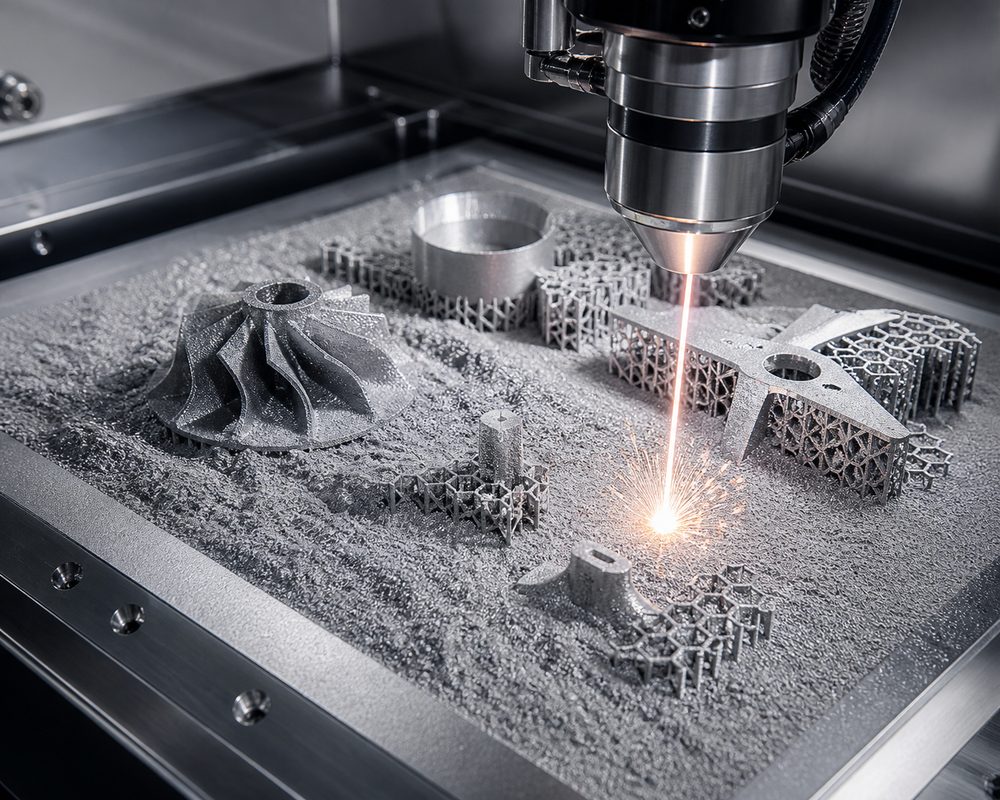
Aluminum alloys, as one of the most widely used lightweight metal materials, play an irreplaceable role in aerospace, automotive manufacturing, electronic equipment, and other fields. Traditional casting and machining processes have issues such as low material utilization and limited design freedom, while Selective Laser Melting (SLM) technology has opened up entirely new possibilities for aluminum alloy part manufacturing. SLM technology enables near-net shaping of complex geometries, significantly improving material utilization, and achieving ultimate lightweighting through design methods such as topology optimization.
SLM Aluminum Alloy Material Systems and Performance Characteristics
Currently, commonly used aluminum alloy materials in SLM processes mainly include AlSi10Mg, Al6061, Al7075, and new high-strength aluminum alloys. AlSi10Mg is the most mature SLM aluminum alloy material, with good flowability and low hot cracking sensitivity. The as-printed tensile strength can reach 350-400MPa, which can be further increased to over 450MPa after heat treatment. AlSi10Mg has a relatively high eutectic silicon content (about 10%), forming fine silicon particles during solidification, effectively improving the material's strength and hardness.
Al6061, as the most widely used wrought aluminum alloy, presents greater challenges in SLM printing, mainly because the formation of Mg2Si strengthening phases requires strict heat treatment processes. In recent years, through optimizing printing parameters and developing specialized powder formulations, the SLM print quality of Al6061 has been significantly improved, with as-printed performance approaching traditional processing levels.
Impact of Printing Process Parameters on Part Performance
The selection of SLM process parameters directly affects the density, mechanical properties, and surface quality of aluminum alloy parts. Laser power typically ranges from 200-400W, with scan speeds between 800-1500mm/s. Specific parameters need to be optimized based on equipment characteristics and part geometry. Higher laser power combined with moderate scan speed can achieve higher density (>99.5%), but excessive energy input leads to keyhole effects and porosity defects.
Scanning strategy has an important impact on residual stress and deformation of parts. Common scanning strategies include checkerboard, stripe scanning, and spiral scanning. For large complex parts, it's recommended to use segmented scanning combined with preheated build plates to effectively reduce residual stress. Inter-layer rotation scanning angles (such as 67° rotation) can eliminate anisotropy in scanning texture, improving consistency in part performance.
Support Structure Design and Removal Strategies
Support structure design for aluminum alloy SLM parts needs to comprehensively consider heat conduction, stress relief, and removal convenience. For features with overhang angles greater than 45°, support structures need to be designed. Support structures typically use block, linear, or conical forms, with tooth structure design at the contact surface affecting support removability. For complex internal cavity structures, soluble support materials (such as aluminum alloy + salt composite supports) can be used, or detachable supports can be designed.
Surfaces left after support removal require post-processing. Common methods include machining, sandblasting, and electropolishing. For parts with high appearance requirements, it's recommended to reserve 0.3-0.5mm machining allowance at support contact surfaces, achieving high-quality surfaces through machining.
Heat Treatment Processes and Performance Enhancement
Heat treatment processes for SLM aluminum alloy parts are a key step in achieving high performance. The standard heat treatment process for AlSi10Mg is: annealing (300°C/2h) can eliminate residual stress and increase elongation to over 12%; solution aging treatment (530°C/6h+160°C/7h) can increase strength to over 450MPa. Hot Isostatic Pressing (HIP) treatment can effectively eliminate internal porosity and improve fatigue performance.
For Al6061, the recommended T6 heat treatment process is: solution treatment (530°C/1h) + artificial aging (160°C/18h), achieving optimal comprehensive mechanical properties. It's worth noting that the microstructure of SLM printed parts differs from traditionally processed parts, requiring targeted optimization of heat treatment parameters.
Aerospace and Automotive Industry Application Cases
In the aerospace field, aluminum alloy SLM parts have been applied to satellite structural components, engine brackets, cabin equipment brackets, etc. Airbus's A350 aircraft uses SLM-manufactured cabin brackets, reducing weight by 30% and shortening manufacturing cycle by 60%. SpaceX's Raptor engine uses SLM aluminum alloy fuel manifolds, achieving integrated design of complex flow channels.
In the automotive industry, aluminum alloy SLM technology is mainly used for custom part manufacturing in high-performance racing cars and luxury models. The Porsche 911 GT2 RS uses SLM-manufactured aluminum alloy exhaust manifolds, reducing weight by 40% with significantly improved performance. The BMW i8 hybrid sports car uses SLM aluminum alloy soft top brackets, achieving perfect integration of lightweighting and functionality.
Quality Control and Testing Methods
Quality control of aluminum alloy SLM parts covers three stages: powder quality, printing process, and finished product testing. Powder quality requires testing particle size distribution (D50: 30-50μm), oxygen content (500mm). The main challenges are: material cost reduction (powder price is currently the main bottleneck), printing efficiency improvement (developing higher power and multi-laser beam systems), and establishment of standardization systems (material standards, process specifications, testing standards).
With improved equipment performance and reduced material costs, aluminum alloy SLM technology will demonstrate its unique value in broader application fields, providing key technical support for the lightweight transformation of manufacturing.
Submit a model, drawing, image or written notes. Engineers will review material, process, finishing and delivery based on actual use.