
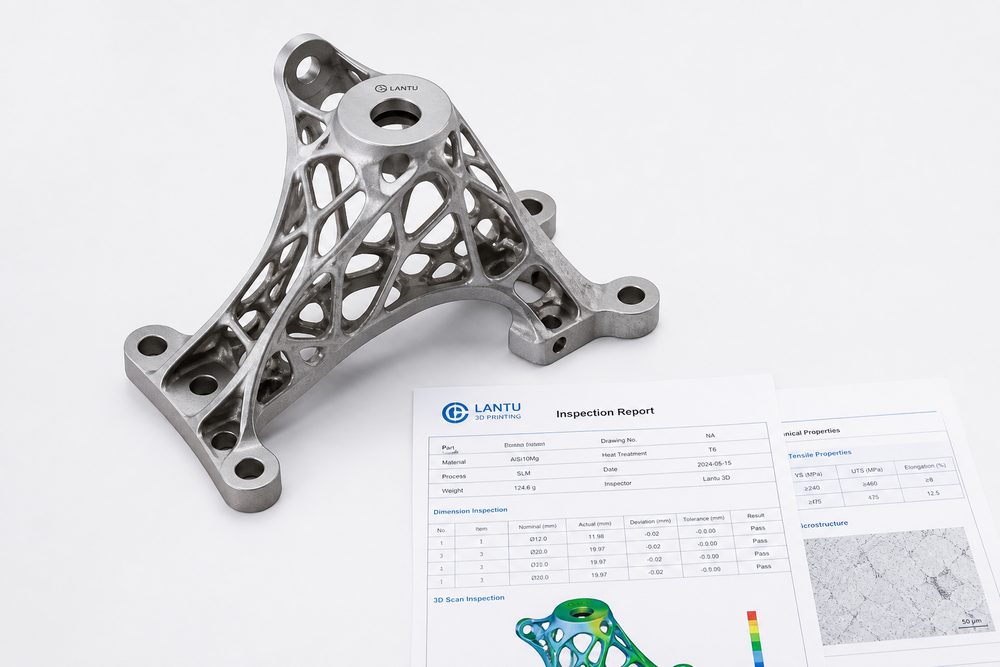
Introduction: Aerospace applications depend on a complete evidence chain
Aerospace is one of the most representative high-value use cases for 3D printing. Lightweight brackets, complex flow channels, sensor mounts, and engine-adjacent components can all use additive manufacturing to reduce weight and shorten development cycles. But the real goal of an aerospace program is not simply to print the part; it is to prove that design, materials, process, inspection, and the service environment are all under control.
1. Lightweight design must serve the load path
Topology optimization and lattice structures can reduce weight, but they cannot be separated from load boundaries, assembly constraints, and maintenance requirements. Engineering teams need to define the direction of force, fastener-hole loads, vibration environment, and safety factors first, and then decide whether to use a hollow structure, ribs, or localized lattice structures. Blindly pursuing complex geometry will increase support, powder removal, and inspection difficulty, and may even reduce reliability.
2. Process validation is the dividing line between a prototype and delivery
At the prototype stage, iterations can move quickly, but airworthy or near-airworthy delivery requires fixed material lots, machine serial numbers, parameter sets, build orientation, and heat-treatment procedures. Common validation activities include density testing, metallography, tensile testing, fatigue testing, CT scanning, and dye penetrant inspection. Only when test coupons are processed under the same conditions as the actual part do the results have engineering value.
3. Post-processing determines final dimensions and performance
Metal aerospace parts usually require stress relief, hot isostatic pressing, machining, sandblasting, or surface strengthening. Machining datums must be reserved during the design stage, and threaded holes, sealing surfaces, and assembly faces cannot rely entirely on print accuracy. For thin-walled parts or components with complex flow channels, distortion compensation before and after heat treatment must also be built into the process route.
4. Digital traceability reduces project risk
Aerospace programs often have long lead times and many stakeholders, and any missing record can affect delivery. It is recommended to establish a complete traceability chain from CAD versions, simulation results, powder lot numbers, build jobs, and inspection reports to packaging and shipment. Blue Map 3D emphasizes treating 3D printing services as a lifecycle management platform, using project milestones and quality documents to make it clear to customers why each step is being done.
Conclusion
The value of aerospace 3D printing lies in lightweighting, part integration, and rapid validation, but real-world implementation depends on a rigorous engineering evidence chain. Companies should build design optimization, process validation, post-processing, and traceability systems as an integrated capability if they want lightweight parts to move from showcase prototypes to reliable delivery.
Submit a model, drawing, image or written notes. Engineers will review material, process, finishing and delivery based on actual use.