
Introduction: When Channels Move Inside the Part, Traditional Polishing No Longer Works
Parts such as conformal cooling molds, hydraulic manifolds, and engine fuel nozzles contain winding, enclosed internal channels. When surface roughness remains high, flow resistance increases significantly, heat transfer efficiency decreases, and localized turbulence may even cause cavitation. Sandblasting and manual polishing can only treat exposed surfaces and are ineffective for internal channels. Abrasive flow and fluid polishing were developed specifically for finishing such complex internal cavities. This article focuses on their principles, process selection boundaries, and key points for quality control.
1. Working Principle of Abrasive Flow Machining (AFM)
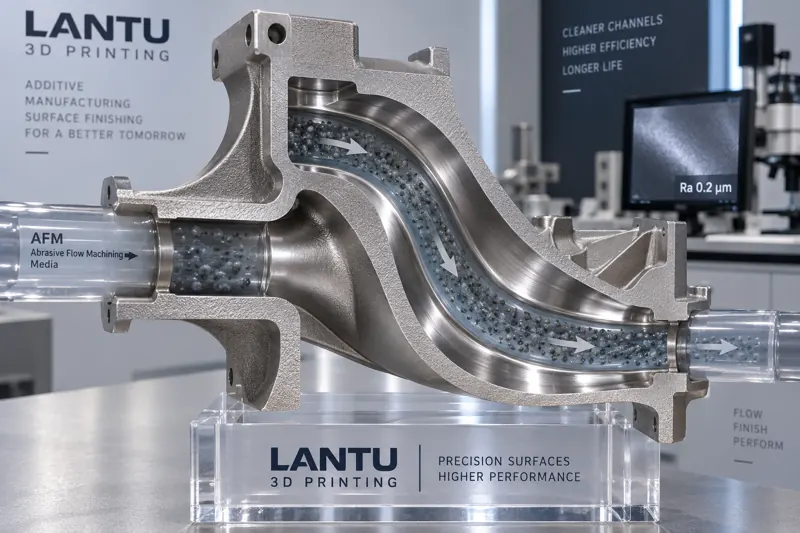
Abrasive Flow Machining (AFM) uses a semi-solid polymer carrier, known as abrasive media, to carry silicon carbide or aluminum oxide abrasive grains. Driven by hydraulic cylinders, the media is repeatedly extruded through the internal cavities of the part. Acting like a flexible file, the media performs uniform micro-cutting on narrow sections, intersecting holes, and irregular channels. Abrasive grit sizes are typically 80–600 mesh, approximately 180–20 μm. Media viscosity is adjusted by the ratio of carrier polymer to filler, which determines penetration capability and cutting force. For 3D printed conformal cooling channels, a single cycle can reduce the internal wall roughness from around Ra 3.2 μm to approximately Ra 0.8 μm.
2. Roles of Electrochemical and Magnetic Abrasive Polishing
Electrochemical polishing (ECP) uses anodic dissolution of metal in an electrolyte to remove microscopic burrs and recast layers from conductive parts such as titanium alloys and stainless steel. It is suitable for thin walls and precision mating surfaces, but it slightly changes dimensions and is ineffective on non-metallic materials. Magnetic Abrasive Finishing uses a magnetic field to drive magnetic abrasives along curved surfaces, making it effective for external curved surfaces and edge deburring. These three processes are not substitutes for one another: AFM is mainly used for internal channels, ECP for finishing conductive parts, and magnetic abrasive finishing for external surfaces. They are often combined within the same post-processing line.
3. Process Parameters and Roughness Control
The result is mainly determined by four parameters: abrasive grit size, media viscosity, extrusion pressure (0.5–8 MPa), and number of cycles, typically 2–20. Finer grit and higher viscosity produce a brighter surface but reduce material removal rate. Excessive pressure may damage thin walls or block micro-holes. In practice, coarse abrasive, such as 220 mesh, is first used to quickly remove the slag or fused layer, followed by fine abrasive, such as 600 mesh, for final polishing. Media temperature rise and contamination must be monitored during the process. As abrasive grains wear, cutting force decreases, so media life should be evaluated using flow meters or weighing methods to avoid the failure mode where the surface becomes shinier but material removal becomes ineffective.
4. Quality Inspection and Typical Applications
Internal channels cannot be measured directly by hand, so verification requires roughness tester probes, endoscopes, or industrial CT sampling. The effect can also be quantified by comparing flow rate and pressure drop: under the same inlet pressure, an increase in flow rate indicates reduced flow resistance. Typical applications include injection mold inserts with conformal cooling, which shorten cycle time and reduce warpage; hydraulic manifolds, which reduce internal leakage; and medical catheter connectors, which require biocompatible surfaces. When delivering metal parts with internal channels, lantu3D offers abrasive flow machining as an optional finishing process and provides process cards based on part geometry and media compatibility, helping avoid excessive polishing that can reduce wall thickness.
Conclusion
Abrasive flow and fluid polishing complete the final piece of 3D printing post-processing: surface consistency inside complex internal cavities. Process selection should follow three questions: whether the part has internal channels, whether it is conductive, and what target roughness is required. Only by controlling cycle count and media condition can printed parts move from simply being manufacturable to being truly usable and durable.
Submit a model, drawing, image or written notes. Engineers will review material, process, finishing and delivery based on actual use.