Introduction: Equipment Price Is Only One Part of Total Cost
A quotation for a 3D printer is easy to obtain, but what truly determines return on investment is sustained orders, material consumption, maintenance, labor, floor space, post-processing, and quality management. Many companies find after purchasing equipment that the machine does not run at full capacity every day, complex projects still need outsourcing, and internal staff must also handle modeling, slicing, cleaning, and inspection. For this reason, equipment investment requires systematic analysis rather than being driven by the appeal of “printing freedom.”
1. First Determine Whether Demand Is Stable and Concentrated
Demand that is suitable for in-house equipment typically has a stable frequency, concentrated materials, a clearly defined size range, and high confidentiality requirements. For example, if there are fixtures, jigs, or validation models every week, and the main materials are nylon or resin, in-house production may make sense. If demand fluctuates significantly, involves many material types, or occasionally requires metal or large-format printing, an external platform may be more flexible. When equipment utilization falls below 30%, depreciation and maintenance will significantly increase the unit cost.
2. The ROI Model Must Include Hidden Costs
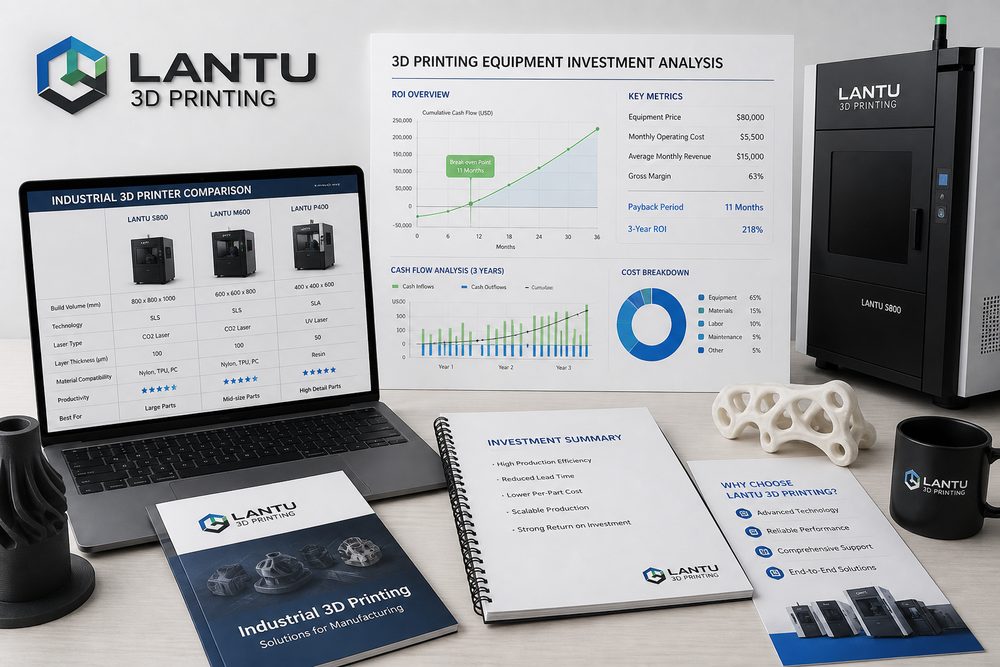
Investment calculations should include equipment depreciation, materials, consumables, maintenance contracts, failure rates, labor, software, floor space, electricity, environmental protection, safety, and post-processing equipment. For resin systems, cleaning, curing, waste liquid treatment, and odor management all require investment. For powder-based systems, powder recycling, dust control, and sieving processes cannot be ignored. Simply dividing the equipment price by the expected number of parts will underestimate the true cost.
3. Capability Boundaries Determine the Outsourcing Ratio
Owning equipment does not mean all projects can be completed internally. Companies should clearly define their internal capability boundaries: maximum size, accuracy, materials, colors, surface finish, strength grade, and certification requirements. When a project exceeds those boundaries, a reliable service platform is still necessary. Full-process platforms such as Blueprint3D can help companies build flexible capacity between in-house production and outsourcing, rather than forcing an either-or choice.
4. Investment Decisions Should Be Implemented in Phases
A more prudent approach is to use external services first and accumulate data over a period of time, tracking material types, order frequency, average lead time, failure causes, and cost structure before deciding whether to purchase equipment. After purchasing, companies should also start with a single application, gradually building a parameter library, inspection standards, and maintenance procedures. This can reduce the risk of a one-time investment mistake.
Conclusion
The core question in 3D printing equipment investment is not whether to buy, but whether the company has stable demand and the operational capability to support it. Through a complete ROI analysis and capability-boundary planning, companies can choose an in-house, outsourced, or hybrid model. Blueprint3D's role is to help customers turn manufacturing needs into executable solutions and match the right resources at different stages.
Submit a model, drawing, image or written notes. Engineers will review material, process, finishing and delivery based on actual use.