
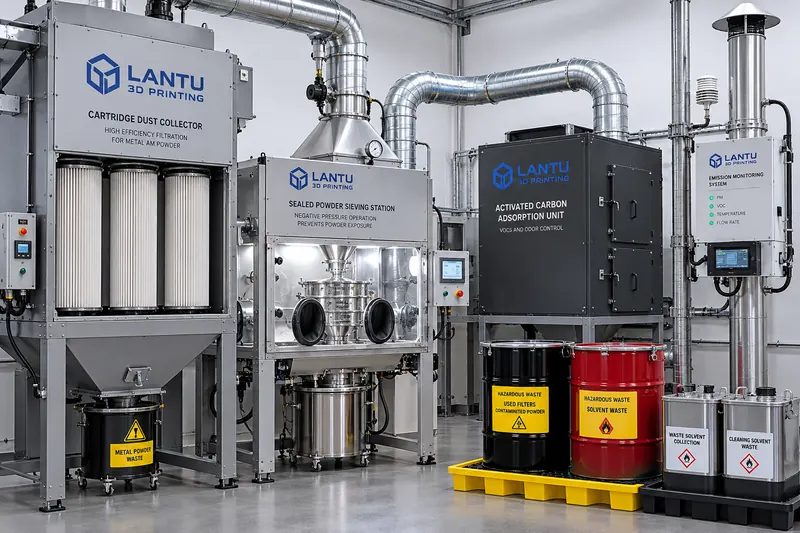
Introduction: The Overlooked End of the Production Line
In day-to-day discussions of 3D printing workshops, attention is almost always focused on build quality, delivery lead time, and unit price. Air emissions, wastewater, and solid waste at the end of the production line are often remembered only during environmental acceptance inspections, customer audits, or complaints from nearby residents. In reality, a fully equipped metal LPBF production line can generate hundreds of kilograms annually in spent filter cartridges, waste powder, discarded supports, and cleaning liquids. Resin production lines likewise produce substantial quantities of organic liquid waste and spent activated carbon with complex compositions. Once these materials are misclassified or stored beyond permitted periods, the risk is no longer merely an environmental-compliance fine; it can directly interrupt operating qualifications. This article breaks down the sources, capture methods, treatment processes, and compliant disposal chain for the three waste streams in 3D printing workshops, and provides practical recordkeeping and operational inspection methods.
1. First Identify the Actual Sources of the Three Waste Streams
Waste from 3D printing does not take a single form. The appropriate treatment route can only be selected after classification by physical state and hazardous characteristics. Air emissions mainly originate from three stages: respirable dust generated during metal powder sieving and depowdering, often in the PM10 or even PM2.5 range; styrene, acrylate, and other VOCs released during washing and curing on SLA/DLP lines; and trace metal-oxide aerosols entrained during inert-gas replacement in metal printing. Wastewater is concentrated in isopropyl alcohol or alcohol-based cleaning liquids for resin parts, rinse water after support removal, and circulating discharge from water-curtain booths or wet scrubbers. It is characterized by high COD, uncured oligomers, and flammability and explosion hazards. Solid waste includes spent filter cartridges and dust collected by dust collectors, rejected reclaimed powder from sieving, supports and failed parts, discarded resin bottles and wiping cloths, and saturated activated carbon. Alloy dust containing nickel, cobalt, or chromium, as well as waste resin, is typically classified as hazardous waste. Establishing separate records for these three categories is the prerequisite for all subsequent control measures.
2. Dust Capture: From Source Enclosure to Staged Filtration
Many workshops install dust collectors yet still exceed dust limits. The issue is often capture efficiency rather than filtration efficiency. The correct sequence is enclosure first, local exhaust second, and selection of air-cleaning equipment last. Sieves, depowdering stations, and powder recovery stations should be built as negatively pressurized enclosed chambers. Maintaining an air velocity of 0.4 to 0.6 m/s at access openings can effectively control escape. Duct velocity should remain at 18 to 20 m/s to prevent metal particles from settling and clogging the system. For filtration, a two-stage arrangement of a cyclone separator plus a cartridge dust collector is recommended. The cyclone first removes most coarse particles to extend cartridge life, while the cartridge stage uses membrane-coated filter cartridges capable of achieving more than 99.9% efficiency for 0.3-micron particles. Differential pressure is the key operating parameter: a new cartridge typically has resistance of 300 to 500 Pa, while a rise to 1,200 to 1,500 Pa indicates near blockage and requires replacement rather than simply pulse cleaning. Removed cartridges are hazardous waste and must be sealed and sent to a licensed disposal provider; they must never be collected with ordinary municipal waste.
3. Control Routes for VOCs and Organic Liquid Waste
Organic exhaust from resin production lines is not highly concentrated, but its composition is complex. If airflow is oversized, treatment costs rise sharply. In practice, uncontrolled emissions should first be reduced by enclosing and covering washing tanks and installing exhaust collection points at curing ovens. Airflow can then be kept within a reasonable range before selecting a treatment process. For high-volume exhaust with concentrations below 100 mg/m³, activated-carbon adsorption is generally the most economical option. However, replacement intervals must be established based on carbon loading and service time, and saturated carbon is also hazardous waste. For higher concentrations or applications requiring long-term stable performance, a zeolite rotor concentrator combined with catalytic oxidation can be used to convert high-volume, low-concentration exhaust into low-volume, high-concentration gas for oxidative destruction. For cleaning liquids, countercurrent rinsing can reduce water consumption by 30% to 50%. Waste alcohol and waste resin liquid must be collected separately in dedicated antistatic, light-protected containers, and must not be mixed with cyanide- or chromium-containing wastewater. Notably, many industrial-park wastewater treatment plants impose clear acceptance limits for COD and organic solvents. Excessive discharge can trigger penalties for the entire park, making waste-liquid reduction and pretreatment more cost-effective than end-of-pipe treatment.
4. Four Mandatory Actions for Hazardous Waste Management
Hazardous-waste compliance is not inherently complicated; the challenge is carrying out every requirement consistently. First is identification and classification: use the national hazardous-waste catalog to determine category codes for waste resin, spent activated carbon, heavy-metal-containing dust, and waste organic solvents, and post standardized labels at storage points. Second are storage conditions: hazardous-waste storage areas must prevent leakage, rainwater ingress, and loss. Liquid areas require trays or containment berms, materials with different properties must be segregated, and storage periods generally must not exceed one year. Third are records and transfer manifests: the quantity generated, quantity stored, and transfer destination for every batch must be recorded in real time. Interprovincial transfers also require approval, and electronic manifests must be consistent with traceable paper records. Fourth is an emergency response plan: clearly define absorbent-material provisions, personnel protection, and reporting procedures for leaks, and conduct drills at least once per year. Turning these four actions into a monthly checklist is far more effective than assembling documentation after the fact.
5. Include Three-Waste Costs in Per-Part Pricing
If management of the three waste streams is treated only as a cost center, workshops have little incentive to improve continuously. A more reasonable approach is to allocate disposal costs across process routes: track each machine's monthly filter-cartridge replacements, hazardous-waste transfer weight, and cleaning-solvent purchases, then divide the total by the number of accepted parts produced that month to obtain the environmental cost per part. Once this figure is available, many process decisions become clearer. For example, increasing powder recycling rates not only saves material but also directly reduces hazardous-waste weight. Replacing solvent cleaning with dry depowdering reduces both VOC emissions and solvent procurement costs. Optimizing support design to reduce support volume simultaneously lowers waste generation and post-processing labor. Once environmental data enters the cost model, waste reduction and efficiency improvement are no longer in conflict.
6. Operational Inspection Checklist
Checks should be standardized at weekly and monthly intervals. Weekly checks should cover dust-collector differential-pressure records, whether negative pressure at depowdering stations meets requirements, whether hazardous-waste containers are sealed and fully labeled, and whether waste-liquid drums are nearing their capacity limits. Monthly checks should verify closure of filter replacement and hazardous-waste transfer records, whether activated-carbon replacement intervals have been exceeded, whether emergency supplies are complete, and whether exhaust-stack monitoring data has been retained. For industrial parks requiring online monitoring, monitoring equipment calibration must also remain within its validity period. All inspections must be documented, because auditors are not interested in how advanced the equipment is; they want records proving that it has been operating properly on an ongoing basis.
Conclusion
Management of air emissions, wastewater, and solid waste in 3D printing workshops is not an added compliance burden; it is part of production capability. Its technical logic is straightforward: first enclose and reduce waste at the source, then capture and treat it in stages, and finally close the disposal chain through records. The real differentiator is the level of management detail: whether a workshop can identify the destination of every kilogram of waste powder, the replacement date of every filter cartridge, and the transfer-manifest number for every batch of waste liquid. By incorporating these figures into daily operations and per-part cost accounting, workshops can meet emission requirements while often reducing material and energy expenditures. This is the most tangible engineering outcome of sustainable manufacturing.
Submit a model, drawing, image or written notes. Engineers will review material, process, finishing and delivery based on actual use.