
Introduction: If Materials Cannot Be Controlled, Even a Stable Process Cannot Deliver Predictable Results
In metal additive manufacturing workshops, process-window qualification, melt-pool monitoring, and powder recycling and blending have been discussed extensively. However, the factors that truly cause delivery to lose control often occur before printing begins: a powder container sits overnight in a temporary storage area without identification; two grades of nylon powder from the same batch are stored together on one shelf; a print job is released only to discover that the oxygen and nitrogen increase report for the powder batch has not yet been returned; or, just before shipment, no one has maintained the relationship between part numbers and work-order numbers. These are not process technology issues, but material and warehouse management issues. Material forms in 3D printing are more complex than in conventional machining: workshops must manage state-sensitive materials such as metal powders, which are affected by humidity, oxygen content, and particle-size distribution; supporting items such as build plates, support consumables, sieves, filter elements, and protective lenses; as well as printed semi-finished parts and parts awaiting inspection. Without a traceable set of warehouse and material-flow rules, stable process parameters cannot be translated into predictable delivery outcomes. lantu3D regards the path from design blueprint to physical delivery as a complete lifecycle chain, and warehouse and material management are among the most frequently overlooked yet earliest-exposed points of failure in that chain.
1. Why Material Management for 3D Printing Is More Sensitive Than for Traditional Manufacturing
Conventional manufacturing materials such as bars and plates generally retain stable properties during storage, whereas additive manufacturing powders are active, state-dependent materials. Common titanium alloy and nickel-based alloy powders, for example, typically have a particle-size distribution concentrated between 15 and 53 microns and a large specific surface area. After moisture absorption, their flowability declines, directly causing uneven powder spreading and balling defects. Repeated reuse can also result in increased oxygen and nitrogen content and particle-size drift. This means materials have a clear time dimension while in storage: receipt date, opening date, number of sieving cycles, number of reuse cycles, and cumulative exposure time all affect their release status. Powders are also combustible dusts, and certain reactive metal powders present safety risks when exposed to water or moisture. Storage environments must therefore be separated from those used for ordinary hardware components. Another sensitive material category is photopolymer resin, which has specific storage-temperature and light-protection requirements. Changes in viscosity with temperature can alter coating and curing performance. Therefore, warehouse management for 3D printing cannot rely on the practices of ordinary hardware warehouses; graded rules must be established according to material state sensitivity.
2. Zoning and Identification: Making Physical Segregation the First Error-Proofing Barrier
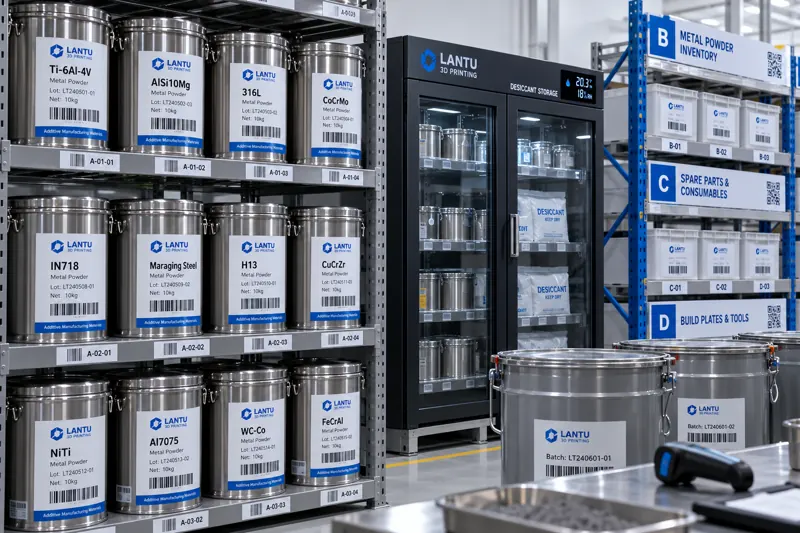
The first principle of material management is that materials in different states, grades, and batches must be physically segregated and clearly, unambiguously identified. In practice, warehouse areas should be divided along four dimensions: quarantine, approved, return, and scrap areas. No material may enter the approved area before inspection, and rejected materials must be moved to the return area within 24 hours and issued a status card. Grade segregation should be implemented at the rack level rather than between adjacent storage locations, because adjacent locations are highly susceptible to mix-ups during frequent picking and put-away operations. Identification should use barcode- or QR-code-linked material cards containing at least the material code, grade, batch number, receipt date, number of reuse cycles, expiration date, and current status. For visually similar white nylon powders and semi-transparent resins, visual identification alone will inevitably lead to errors; scan verification is essential. In its engineering practice, lantu3D embeds scan verification into material-issuing actions. No outbound record is generated unless the material is scanned, preventing human oversight from entering the system.
3. FIFO and Batch Traceability: Giving Every Gram of Powder a Known Origin and Destination
First-in, first-out is a basic warehouse management rule, but in additive manufacturing workshops it should be expanded into a status-priority release sequence. When multiple batches of the same grade coexist, priority should be given to batches with fewer reuse cycles, shorter exposure times, and complete inspection reports, rather than mechanically sorting only by receipt date. This can be achieved by maintaining a status card for each batch, including cumulative sieving cycles, cumulative reuse cycles, the latest oxygen and nitrogen test results, the latest flowability test results, and exposure hours. When materials are issued, the system ranks and recommends batches according to their status scores. After the operator confirms by scanning, the batch information is written into the work order. The value of this step is most apparent during traceability investigations: when a part shows abnormal porosity, the workshop can identify within ten minutes which powder batch was used, that batch's reuse history and inspection records, and which other orders used the same batch. This narrows the investigation from the entire plant to a specific batch. Without such records, traceability depends on searching paper documents and often takes several days.
4. Environment and In-Storage Maintenance: Turning Storage Conditions into Measurable, Alarm-Enabled Parameters
The objective of warehouse environmental control is measurability and alarm capability, rather than reliance on experience-based judgment. Metal powder storage areas should maintain relative humidity below 40 percent and temperatures between 18 and 25 degrees Celsius, with continuous data loggers and alarms triggered when limits are exceeded. Opened powders should be transferred to inert-gas-protected containers or vacuum drying cabinets, and cumulative exposure time should be recorded. Resin storage areas must be protected from light and temperature fluctuations to prevent viscosity drift. Sieving equipment and screens must also be included in material management: damaged screens can directly cause abnormal particle-size distributions, so screens should have maximum usage limits and periodic inspection records. In-storage maintenance also includes regular inventory counts and status reviews. High-value alloy powders should be counted monthly, while resins should be reviewed quarterly. Any discrepancy between count results and actual inventory must have a documented cause and be closed out. Only when environmental parameters and maintenance actions are continuously recorded can process teams determine whether a defect originates from material condition or process parameters.
5. Inventory Accuracy and Closed-Loop Discrepancy Management: From Mismatched Numbers to Identifiable Causes
In many workshops, material records frequently fail to match physical inventory. The root cause is that inbound and outbound movements are not linked to business documents. There are three solutions: first, all inbound and outbound transactions must be document-based. Material issue slips must be linked to work-order numbers, return slips must be linked to reason codes, and any transaction without documentation is treated as an exception. Second, powder loss and sieving loss must be measured separately rather than broadly classified as consumption; otherwise, both reuse-cycle counts and inventory quantities will be distorted. Third, a discrepancy-handling process must be established. When a discrepancy exceeds a predefined threshold, a review must be initiated. Review findings should be classified into four categories: omitted document entries, measurement errors, material mix-ups, and abnormal losses, with different corrective actions assigned to each category. Inventory accuracy is not intended to make records look better; it enables production planning based on reliable inventory data. Only when inventory data are trustworthy do material-availability checks become meaningful and delivery commitments have a sound basis.
6. Implementation Roadmap and Checklist
Material and warehouse management can be implemented in four steps. First, identify all materials and classify them by state sensitivity, defining different management intensities for Class A highly sensitive materials and Class C general consumables. Second, complete warehouse zoning and identification upgrades, equipping Class A materials with barcodes and status cards. Third, embed scan verification into the three key actions of material issue, material return, and inventory counting, beginning with Class A materials and expanding gradually. Fourth, establish a monthly inventory-counting and discrepancy-closure mechanism, and incorporate inventory results into supplier evaluations and process review inputs. The checklist should include at least six items: whether physical warehouse segregation is in place, whether each item has a unique code, whether batch data fields are complete, whether environmental records are continuous, whether inbound and outbound movements are document-based, and whether inventory discrepancies are closed out. Each item should have a clearly assigned owner and review frequency.
Conclusion
The competitiveness of 3D printing depends not only on equipment accuracy and process windows, but also on whether the material path from warehouse receipt to machine loading is under control. When warehouse and material management are established as a traceable, verifiable, closed-loop system, process stability can truly be converted into delivery certainty, while traceability costs, mix-up risks, and inventory distortion decline accordingly. For manufacturing service platforms positioned around lifecycle management, this seemingly inconspicuous link is precisely the infrastructure that supports scalable delivery capability.
Submit a model, drawing, image or written notes. Engineers will review material, process, finishing and delivery based on actual use.