The Mechanism of Environmental Control on 3D Printing Quality
3D printing is a manufacturing process that is highly sensitive to environmental factors. Temperature fluctuations, humidity changes, air quality, and pressure differences can all have measurable effects on print quality. In FDM processes, excessively low ambient temperatures can cause poor interlayer bonding and warping; in SLA processes, temperature fluctuations can change resin viscosity, thereby affecting layer thickness accuracy; in SLM metal printing, oxygen content control is directly related to powder oxidation and the mechanical properties of parts. Establishing a refined environmental control system is a fundamental engineering requirement for 3D printing service companies to ensure consistent quality. Studies show that when temperature fluctuations in an FDM printing environment exceed ±3°C, part dimensional accuracy drops by about 15-20%. In SLA processes, every 1°C change in resin temperature causes a layer thickness change of about 0.5-1 micron. Metal printing has even stricter environmental requirements, and the oxygen content in the build chamber must be controlled below 1000 ppm.
Design and Implementation of Temperature Control Systems
Temperature control is the core of the environmental control system. Depending on the printing process, temperature control strategies differ as well. FDM workshops should maintain an ambient temperature range of 22-26°C, with fluctuations not exceeding ±2°C. For high-precision printing, a constant-temperature printing enclosure can be used to stabilize the temperature of the print area at a specific value and reduce thermal gradients. SLA workshops have even higher requirements for temperature stability; it is recommended to control the temperature at 23±1°C and use a circulating water bath system to stabilize the resin tank temperature. Temperature control for metal 3D printing equipment is more complex. The build chamber needs to be preheated to a specific temperature to reduce thermal stress and deformation. The HVAC system should be designed in coordination with the equipment cooling system to avoid energy waste caused by hot-and-cold conflicts.
Humidity Management and Powder Material Protection
Humidity is the number one enemy of 3D printing, especially powder bed printing. Nylon powder is hygroscopic; once it absorbs moisture, it can produce bubbles, pores, and degraded mechanical properties during printing. Metal powder is less hygroscopic, but moisture can increase oxidation and destabilize the melt pool. Generally, the relative humidity of the powder storage environment should be controlled below 30-40% RH. Technical solutions for humidity control include installing industrial dehumidifiers and using humidity sensors for automatic adjustment; establishing a drying room in the powder storage area; and using drying cabinets to store opened powder materials. For materials with severe moisture sensitivity, it is recommended to dry the powder before printing to ensure the moisture content is below 0.2%.
Air Quality Management and Exhaust Treatment
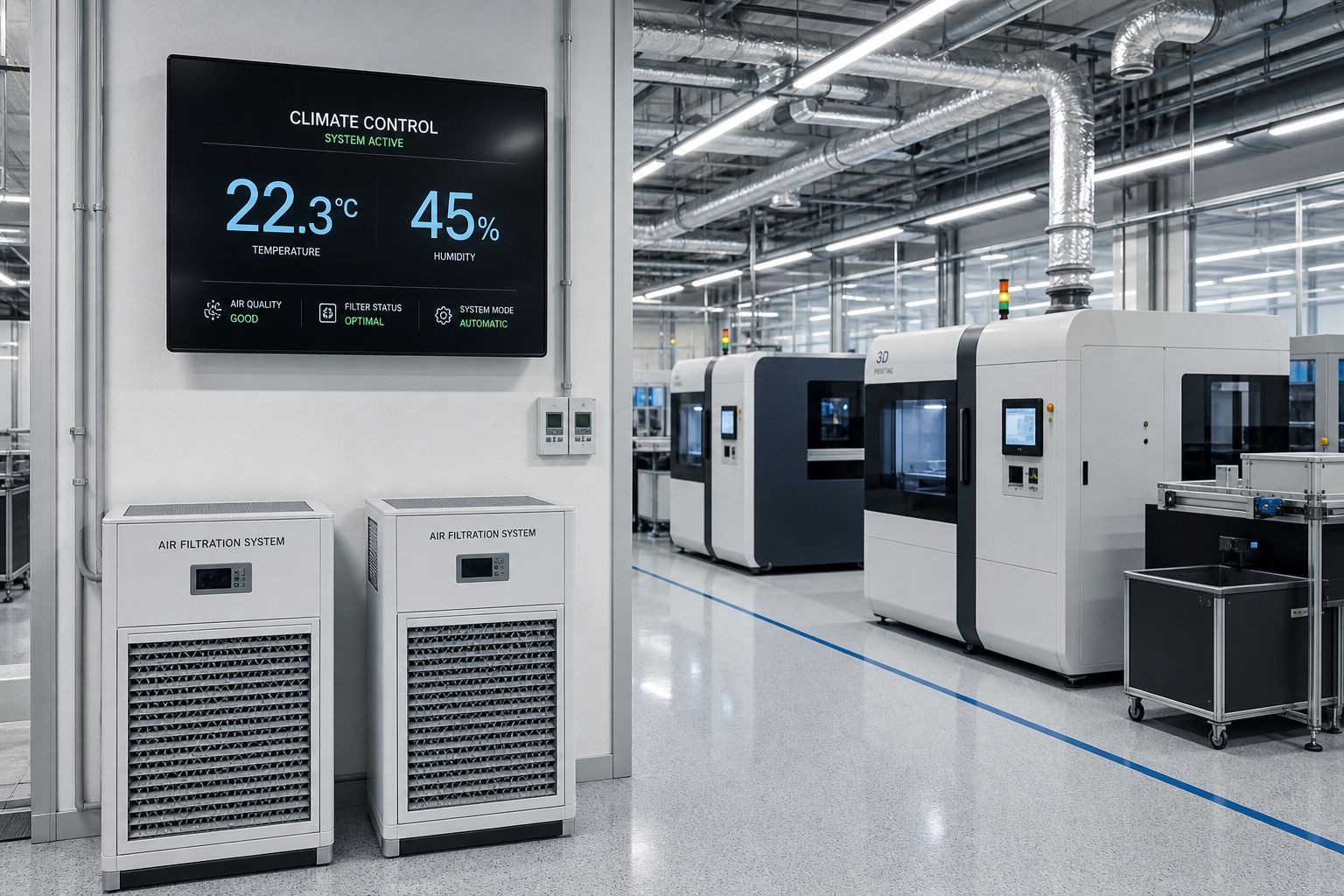
During 3D printing, various air pollutants are generated, including printer volatile compounds, ultrafine particulate matter, and, in metal printing, metal fumes and inert gases. Long-term exposure to these pollutants can harm the health of operators and may also affect print quality. Key design points for an air quality management system include installing local exhaust hoods above each machine to capture pollutants at the source; installing HEPA filters and activated carbon filters; installing dedicated metal fume filters for metal printing; maintaining positive pressure in the workshop to prevent external pollutants from entering; and regularly testing workshop air quality to ensure compliance with occupational health standards.
Environmental Monitoring and Data Acquisition Systems
The essence of environmental control lies in the fact that what can be measured can be managed. Establishing a comprehensive environmental monitoring system can collect key parameters such as temperature, humidity, pressure difference, particulate matter concentration, and oxygen content in real time, and use data visualization to help managers detect anomalies promptly. Modern environmental monitoring systems are usually based on an IoT architecture, with sensor data transmitted via wireless or wired networks to a central database, supporting real-time alarms and historical trend analysis. Implementation steps for an environmental monitoring system include determining monitoring parameters and accuracy requirements based on process needs, deploying sensors at key locations, establishing data acquisition and storage systems, configuring alarm rules, and generating environmental compliance reports on a regular basis. For companies that have obtained quality certification, environmental monitoring data is important evidence for quality system audits.
Workshop Layout and Environmental Zoning Design
A scientific workshop layout can maximize the efficiency of the environmental control system. A zoned design is recommended: divide the workshop into a clean area, a core production area, and a support area. Different areas should have independent environmental control parameters and pressure-difference control. Workshop layout should also consider the separation of personnel flow and material flow. Operators entering the clean area should pass through an air shower room to reduce the introduction of external contaminants. Equipment layout should leave sufficient maintenance space while also taking equipment heat dissipation requirements into account to avoid heat island effects. A good workshop l
Submit a model, drawing, image or written notes. Engineers will review material, process, finishing and delivery based on actual use.