
Introduction: The Overlooked Workshop Environment Is Quietly Changing Printing Results
In metal 3D printing workshops, engineers often attribute quality fluctuations to process parameters: laser power, scanning speed, and layer thickness. However, extensive on-site data shows that even with the same equipment and the same parameter set, the density, surface quality, and dimensional stability of printed parts can differ significantly between the rainy season and the dry season, or between day shifts and night shifts. The root cause is often not in the process sheet, but in workshop environmental control—temperature and humidity, cleanliness, and metal powder moisture absorption are the true sources of many “occasional defects.” lantu3D incorporates environmental control into full lifecycle management from design to delivery, turning invisible environmental variables into measurable and controllable process parameters.
1. Temperature and Humidity: Underrated Factors in Build Stability
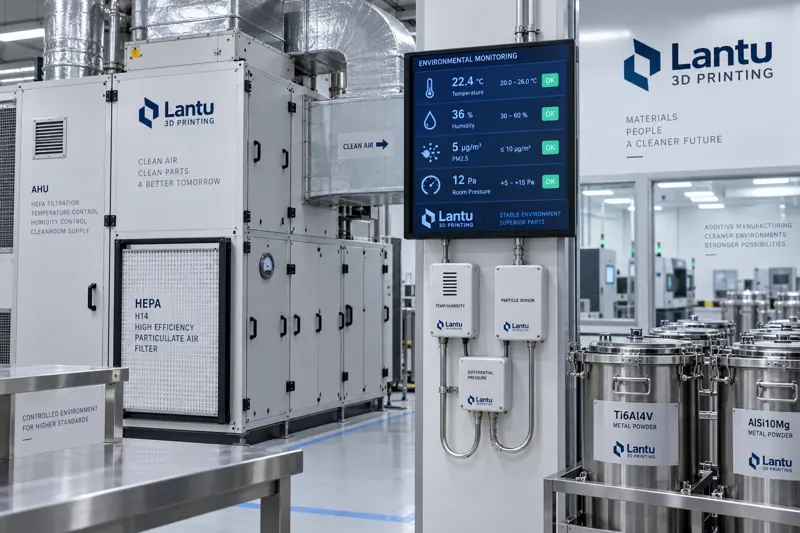
Although SLM/SLS equipment has built-in chamber preheating and inert gas protection, the basic workshop environment can still have a transmitted impact. The room temperature is recommended to remain stable at 22±2°C, with relative humidity controlled at 45%±5%. The humidity in metal powder storage areas should be below 35%. When relative humidity exceeds 50%, the surfaces of titanium alloy, aluminum alloy, and nickel-based alloy powders adsorb water molecules. During printing, the moisture instantly vaporizes under the high temperature of the melt pool, causing pores, spatter, and balling. Day-night fluctuations in ambient temperature can also change the thermal state of the equipment’s reference platform, leading to cumulative warping. lantu3D deploys continuous temperature and humidity recording and out-of-limit alarms in its workshop, integrating environmental data into the production records of each batch.
2. Cleanliness and Particle Contamination: Invisible Sources of Inclusions
Among defects in metal additive manufacturing, non-metallic inclusions are often misidentified as material issues. In reality, airborne dust, abrasive particles generated by grinding and polishing near equipment, and fibers from personnel clothing may all fall into the powder bed, causing inclusions, lack of fusion, and surface pits. It is recommended that powder bed operation areas reach at least ISO Class 8 cleanliness, formerly Class 100,000. Key powder loading and sieving stations should be equipped with local laminar flow or independent negative-pressure operation cabins. lantu3D establishes particle contamination testing for incoming materials and recycled powder, incorporating cleanliness into the closed-loop incoming quality control system.
3. Metal Powder Moisture Absorption: Moisture Prevention Across the Full Chain from Storage to Reuse
Moisture absorption is one of the most hidden quality risks in metal 3D printing. Even unopened sealed powder containers can slowly absorb moisture during long-term storage in humid environments. More commonly, recycled powder is exposed to air during sieving, transfer, and temporary storage, causing its moisture content to rise. As an industry reference, the moisture content of titanium alloy powder should be below 0.05% (500 ppm); above this threshold, porosity increases significantly. Control measures include low-humidity storage in drying cabinets at a constant temperature of 30–40°C, transfer in inert gas (argon) glove boxes, reuse within 4 hours after opening or resealing, and moisture content testing for every incoming batch. lantu3D establishes humidity traceability records for every batch of powder, and powders exceeding the limit are prohibited from entering production.
4. Engineering Implementation of Environmental Control: Monitoring, Interlocking, and Traceability
To transform the environment from something “managed by feeling” into something controllable, three elements are required. First is continuous monitoring: temperature and humidity, cleanliness, oxygen content, and powder moisture content should be collected at minute-level frequency. Second is interlock protection: when environmental conditions exceed limits, the system automatically pauses high-risk processes and sends alerts to prevent production under abnormal conditions. Third is data archiving: environmental curves are bound to equipment process parameters and quality inspection results to form reproducible process records. lantu3D embeds environmental control into its production scheduling and quality traceability systems, ensuring that the stability of batch delivery no longer depends on the experience of individual technicians.
5. Implementation Points and Common Misconceptions
Three common misconceptions often occur during on-site implementation. First, inert protection is applied only inside the equipment while the basic humidity of the workshop is ignored, meaning the powder has already absorbed moisture before entering the machine. Second, cleanliness is treated as “cleaning the workshop,” without quantitative particle counting and regular verification. Third, environmental records are separated from production records, making it impossible to trace quality abnormalities. It is recommended to establish a closed loop in five steps: moisture-proof storage, inert transfer, clean operations, monitoring and interlocking, and record traceability, with gradual quantified improvements based on milestones. For small- and medium-batch customers, lantu3D can provide a lightweight environmental control checklist to manage key risk points without significantly increasing costs.
Conclusion
Workshop environmental control is not an auxiliary item in 3D printing, but the underlying infrastructure for stable build quality. Only by incorporating temperature and humidity, cleanliness, and powder moisture absorption into measurable, controllable, and traceable process management can enterprises truly move from “occasionally qualified” to “stable delivery.” From a full lifecycle perspective, lantu3D integrates environmental control with design optimization, process parameters, and quality traceability, ensuring that every batch of parts is built on a reproducible environmental baseline.
Submit a model, drawing, image or written notes. Engineers will review material, process, finishing and delivery based on actual use.