
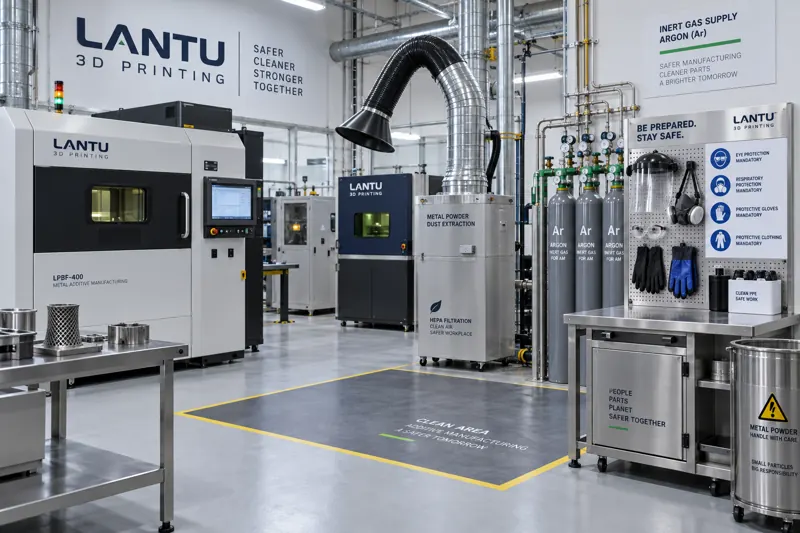
Introduction: Underestimated Workshop Risks
Metal additive manufacturing (SLM, LPBF, Binder Jetting) is being rapidly adopted in aerospace, medical, and tooling industries. However, many teams focus on density and dimensional accuracy while overlooking occupational health and safety (EHS) in the workshop. Metal powders typically have particle sizes of 15 to 45 microns and can remain suspended for long periods; argon inert shielding may displace oxygen in enclosed chambers; fiber laser power can reach several hundred watts. The combination of these risks makes 3D printing workshops environments that require systematic safety management.
1. Identification of Four Typical Hazards
First, metal powder inhalation. Titanium, aluminum, and nickel-based alloy powders can enter the respiratory tract and deposit in the alveoli. Long-term exposure may lead to metal fume fever or pulmonary fibrosis, and some nickel compounds are suspected carcinogens. Second, inert gas asphyxiation. Argon and nitrogen are used in build chambers and glove boxes, and leaks can reduce local oxygen levels below the 19.5% warning threshold. Third, laser radiation and visible light. Failure of door interlocks or accidental opening during maintenance may cause burns to the eyes and skin. Fourth, dust explosion. Aluminum and titanium powders can explode when they reach certain concentrations in air and encounter an ignition source, with improper cleaning being a major trigger.
2. Engineering Controls Take Priority Over Personal Protection
According to the occupational safety principle of the “hierarchy of controls,” engineering modifications should come first. Powder areas should be equipped with overall negative pressure and local exhaust ventilation, with a recommended hood face velocity of no less than 0.5 m/s. Build chambers, powder sieving, and powder removal stations should preferably be located in independent negative-pressure rooms. Inert gas pipelines should be equipped with oxygen concentration monitoring and audible and visual alarms; when oxygen content falls below 18%, exhaust ventilation and access control should be automatically activated. Laser chambers must have hardware interlocks, and maintenance mode should require two-person authorization as well as lockout/tagout (LOTO). Electrical equipment in explosion-protected areas should meet dust explosion-proof ratings, and tools that can easily generate sparks must be prohibited.
3. Personal Protection and Operating Procedures
Beyond engineering controls, PPE must still be standardized: when handling powder, operators should wear N95 or P100 particulate respirators (supplied-air respirators for high concentrations), nitrile gloves, anti-static clothing, and safety goggles. Eating, drinking, and smoking are strictly prohibited in powder areas. A “Powder Spill Emergency Response Card” should be established: small spills should be collected using anti-static scoops and wet methods, while dry sweeping or compressed-air blowing is prohibited; for large spills, evacuate immediately, ventilate the area, and report the incident. New employees and personnel transferring to new positions must complete 8 hours of specialized training and pass an assessment.
4. A Management System from Monitoring to Closed Loop
Safety is not a one-time inspection, but a data-driven closed loop. A regular testing ledger for workshop dust concentration and oxygen levels should be established, with metal fume testing recommended once per quarter. Equipment inspections should be integrated into daily pre-shift checks. MES should be used to record powder opening, recycling, and disposal batches to achieve source traceability. Emergency drills for inert gas asphyxiation and dust fires should be organized every six months, with corrective actions reviewed and incorporated into the knowledge base. Ultimately, EHS indicators should be included in delivery reviews so that safety becomes part of customer trust.
Conclusion
The core of occupational health and safety management in 3D printing workshops is to implement “hierarchy of controls, engineering first, personal protection as the final safeguard, and data-driven closed-loop management.” When powder protection, inert gas monitoring, laser interlocks, and dust explosion prevention all become standard practices, the workshop can deliver every part efficiently and sustainably.
Submit a model, drawing, image or written notes. Engineers will review material, process, finishing and delivery based on actual use.