Introduction: A Usable Technology Is Not Necessarily a Transferable Asset
After years of accumulating expertise in process windows, material formulations, dedicated tooling, and parameter packages, 3D printing companies often face an awkward problem: the R&D team considers the technology mature, while the commercial team cannot turn it into a license agreement that can be priced, delivered, accepted, and audited. Technology transfer usually fails not because a model cannot be printed, but because the boundaries of the transaction are unclear: is the license for a patent, a software package, a process card, or a complete capability package that includes on-site training and continuous improvement? As a management and implementation platform spanning the full lifecycle from design blueprints to physical delivery, Blueprint3D repeatedly sees the same pattern in client projects: only when technology is broken down into verifiable deliverables can it become a tradable asset rather than internal experience.
I. Define the Licensed Assets First: Break the Technology Package into Six Deliverable Categories
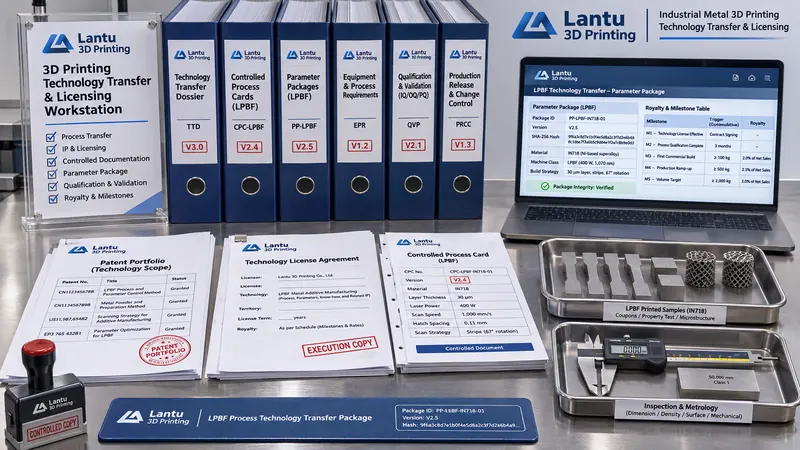
A license agreement must not simply refer to a certain 3D printing technology. It is advisable to establish a six-category asset list: (1) patents and patent applications, specifying patent numbers, claims, territories, and remaining term; (2) trade secrets, including process windows for laser power, scan speed, hatch spacing, layer thickness, preheating temperature, and stress-relief annealing curves; (3) controlled documents, such as process cards, work instructions, inspection procedures, parameter-package versions, and SHA-256 hashes; (4) software and data, including slicing templates, compensation tables, simulation models, and test-coupon databases; (5) dedicated tooling and gauges, specifying positioning accuracy, life-cycle counts, and calibration certificates; and (6) training and technical support, clearly defining person-days, locations, remote-response time limits, and assessment criteria. Each asset category should be linked to a unique identifier, version number, responsible owner, confidentiality classification, and delivery medium. If only PDFs are delivered without simultaneously freezing the parameter package, the recipient often receives materials that can be read but cannot be reproduced.
II. License Scope: Define Rights Narrowly Through Five Dimensions
The greatest risk in technology licensing is language such as “worldwide exclusive” and “perpetual use.” An engineering-oriented approach should define at least five dimensions: territory (countries/regions and production-site lists), term (effective date, renewal conditions, and post-termination inventory sell-off period), field of use (permitted industries such as aerospace, medical, tooling, or education and research), mode of implementation (internal manufacturing only, permitted subcontracting, and sublicensing rights), and exclusivity (sole, exclusive, or non-exclusive license). For example, a Ti6Al4V thin-wall component process package may be limited to two sites in China, for a five-year term, solely for non-implantable medical-device prototypes, with no sublicensing permitted. Equipment serial numbers, parameter-package hashes, and build numbers should be included in the license schedule to facilitate future audits. Improvements must be addressed separately: who owns localized optimization developed by the recipient based on the parameter package, whether platform-wide improvements can be fed back, and whether a new version must be frozen when feedback is triggered.
III. Pricing Structure: Upfront Fees, Milestones, and Royalties Must Each Be Tied to Evidence
Pricing commonly consists of three components: an upfront fee for documentation release and initial training; milestone fees for FAT/SAT, first-article approval, and reaching small-batch yield thresholds; and royalties based on post-production sales revenue or qualified-part volumes. Each payment should have reproducible trigger evidence: the upfront fee should be based on signed receipt of the controlled-document list and hash verification; the first-article fee should be based on a CMM report, material certificate, furnace witness coupons with density above 99.5% of the theoretical Ti6Al4V density, and samples signed off by both parties; and royalties should be based on quarterly sales reports, qualified-part serial-number lists, and return-offset schedules. Royalty rates may be tiered, for example, 3% of net sales for 0 to 500 qualified parts per year, 2.2% for 501 to 2,000 parts, and 1.5% above 2,000 parts, together with an annual minimum guarantee and audit rights. All monetary formulas should be included in contract appendices to avoid combining license fees, NRE charges, equipment payments, and maintenance fees under a single invoice basis.
IV. Technical Acceptance: Replace Subjective Confirmation with Reproducibility Testing
The acceptance criteria for technology transfer should answer one question: can the recipient consistently reproduce the results on the agreed equipment using the delivered package? A three-stage process is recommended. Documentation acceptance verifies identifiers, versions, hashes, confidentiality classifications, and training records. Process acceptance requires standard test specimens to be printed on specified equipment, with layer thickness of 30 to 60 μm, oxygen content of ≤1000 ppm, dew point of ≤−40 °C, and recorded tensile-test and density results. Capability acceptance requires three consecutive batches, each containing no fewer than the specified number of parts, with critical dimensions at Cpk ≥1.33 and surface roughness and density within the mutually frozen window. Acceptance reports must specify the equipment serial number, powder batch number, parameter-package version, environmental records, and deviations. If any stage fails, it should enter a defect list and corrective-action window rather than being verbally approved by commercial personnel. Corrective actions should address only the frozen acceptance criteria; thresholds must not be temporarily relaxed simply to reach a payment milestone.
V. Version Control, Confidentiality, and Infringement Boundaries
The licensed package will continue to evolve after delivery. Version-control rules should be established: master copies should be maintained by designated administrators from both parties; each change should be submitted through a change request that records the reason, impact analysis, retirement date of the old version, old-to-new parameter mapping, and scope of revalidation; and any change involving safety, material grades, or critical CTQs must undergo first-article revalidation. For confidentiality, access permissions, download watermarking, external-distribution approval, activity logs, and access revocation upon employee departure should be set according to asset classification. Trade secrets must not automatically become public when the agreement terminates. Rights and responsibilities must also be clearly defined: each party retains its background intellectual property, while foreground results are allocated according to contributions and contractual terms. Where the platform provides an FTO search conclusion, it should cover only the specified territory and search date and should not guarantee that all future patents are invalid. In the event of a third-party infringement claim, the agreement should define notice periods, evidence provision, the party leading the defense, the scope of implementation suspension, and cost sharing, preventing the recipient from shifting all market risk back to the technology provider.
VI. A 30-Day Implementation Checklist and a 30-Minute Traceback Drill
In week one, complete a technology-asset inventory and produce the six-category asset list and confidentiality classifications. In week two, freeze the five dimensions of license scope, pricing formulas, and payment evidence. In week three, complete standard specimens, three-batch capability-acceptance templates, and deviation-handling procedures. In week four, prepare contract appendices, configure access permissions, establish version registers, and conduct audit sampling. After launch, reconcile five metrics every month: documentation hash consistency rate, parameter-package version consistency rate, royalty-report-to-qualified-part-serial-number matching rate, change-request closure rate, and number of unauthorized-access incidents. A 30-minute traceback drill should be conducted quarterly: randomly select a delivered batch and use its contract number to trace the license scope, parameter-package hash, equipment serial number, acceptance report, payment evidence, and improvement-feedback record. Key-field completeness should be at least 95%. If the transaction cannot be traced back, the technology has merely been sent, not transferred in a governable manner.
Conclusion
Licensing 3D printing technology is not simply packaging and sending documentation to a customer. It requires simultaneous delivery of rights boundaries, pricing formulas, reproducibility criteria, version status, and evidence chains. Only companies that can map a process to asset identifiers, the five dimensions of license scope, a qualified-part royalty basis, three-batch capability acceptance, and change-feedback records truly possess the capability to turn R&D outcomes into sustainable transactions. Blueprint3D is not positioned merely to print parts, but to make every step from design blueprints and process knowledge to physical delivery verifiable, reusable, and settleable.
Submit a model, drawing, image or written notes. Engineers will review material, process, finishing and delivery based on actual use.