Introduction: The Supply Chain Determines Delivery Stability
3D printing is often seen as a technology that shortens the supply chain, but service platforms still depend on powder, resin, filament, post-processing, machining, inspection, packaging, and logistics. If any one link gets out of control, the final lead time will be affected. The goal of supply chain management is to make materials, outsourcing capacity, and order planning work together, rather than trying to recover after shortages or delays have already occurred.
1. Material Inventory Should Be Risk-Tiered
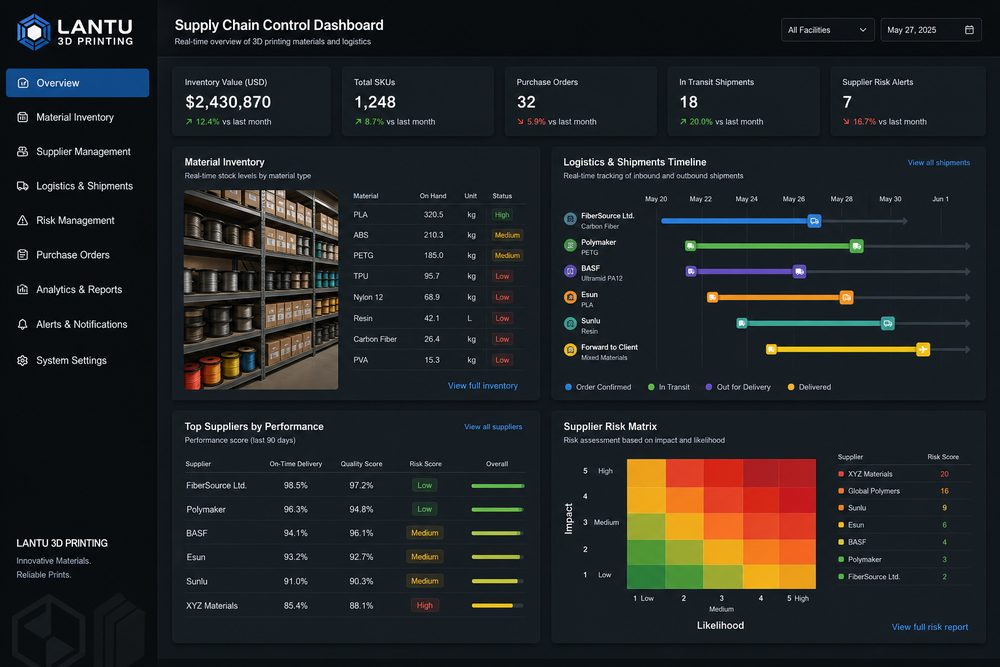
Common materials such as PA12, standard resin, PLA, and 316L can be managed with safety stock, while high-value or low-frequency materials are better purchased on a project basis. Inventory management should record batch number, shelf life, moisture content, or opening time. For metal powders and photopolymer resins, the storage environment directly affects forming quality, so you cannot look only at the on-hand quantity.
2. Outsourced Resources Need Capability Profiling
Heat treatment, machining, painting, electroplating, coordinate measuring machine inspection, and CT inspection are often handled by external partners. When selecting outsourcing providers, price alone should not be the deciding factor. Record their equipment capability, delivery stability, quality performance, communication efficiency, and exception-handling capability. For critical projects, prepare backup suppliers to avoid a single point of failure.
3. Lead-Time Management Must Identify the Critical Path
The critical path for an order may not be printing time, but material arrival, heat-treatment queueing, inspection appointments, or customer approval. At project launch, the nodes should be broken down, non-compressible steps identified, and buffers set for high-risk nodes. Expedited orders must be evaluated for their impact on other orders to avoid disrupting the overall schedule.
4. Supply Chain Data Supports Continuous Optimization
Tracking supplier on-time delivery rates, material consumption, rework causes, logistics exceptions, and customer changes can help companies identify the real delivery bottlenecks. A data-driven supply chain can also support more accurate quoting and inventory strategies, reducing cost fluctuations caused by last-minute purchasing.
Conclusion
3D printing supply chain management is not an accessory to traditional manufacturing; it is a core capability for stable delivery on a service platform. By tiering material risk, profiling outsourced capabilities, managing the critical path, and reviewing performance with data, companies can better control lead-time, cost, and quality risks.
Submit a model, drawing, image or written notes. Engineers will review material, process, finishing and delivery based on actual use.