
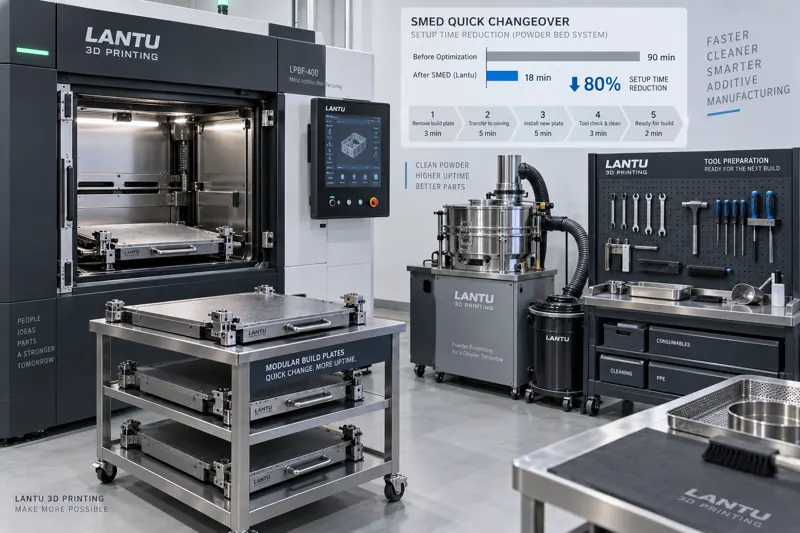
Introduction: In High-Mix, Low-Volume Scenarios, the Real Bottleneck Is Often Not Printing Speed
As 3D printing moves from prototype validation to batch delivery, many teams attribute insufficient capacity to equipment that is "not fast enough." But in real high-mix, low-volume order structures, an industrial SLS or SLM machine often spends less than 60% of each day on actual part formation. The remaining time is consumed by "non-printing activities" such as powder change, chamber cleaning, parameter adjustment, first-article confirmation, fixture changeover, and program loading. When order volume drops from 500 pieces to 30 pieces and the number of product types increases from 3 to 20, changeover frequency rises severalfold. If each changeover still takes 40 to 90 minutes, effective equipment output can fall sharply. Rapid changeover, or SMED (Single Minute Exchange of Die), is a systematic method designed to address this contradiction: it does not aim to make printing faster, but to shorten as much as possible the time from the last qualified part to the next qualified part.
1. Distinguish Internal and External Operations First to Identify Compression Opportunities
The first core step of SMED is to divide the entire changeover process into two categories based on whether the machine must be stopped. Internal operations are actions that must be performed while the equipment is stopped: powder cleaning, powder change, sieving, chamber preheating, recoater calibration, laser power and galvanometer zero-point verification, build plate leveling, and first-article printing. External operations can be completed in parallel while the machine is running: drying new powder and testing moisture content, sieving and blending, calling up and reviewing process parameter packages, pre-assembling fixtures, preparing inspection gauges, and organizing and archiving inspection reports from the previous batch.
In actual improvement work, the greatest benefits usually come from converting internal operations into external ones. Taking metal LPBF as an example, powder drying at 120–150°C for 2–4 hours, as well as testing oxygen content, sphericity, and particle size distribution (D10/D50/D90), can all be prepared in advance. If these tasks only start after the machine stops, this item alone can consume more than 30 minutes. Similarly, if parameter packages rely on engineers retrieving historical screenshots on site, layer thickness, hatch spacing, and exposure strategy must be reconfirmed every time. If they are solidified into version-controlled parameter cards and preloaded on the equipment side, changeover only requires one verification and confirmation.
2. Use Stopwatch-Based Time Studies to Break Down Actions Instead of Estimating by Experience
Changeover time reduction must be based on measured data. The recommended approach is to continuously record more than 10 complete changeover processes, using a stopwatch or video to time each action and create an action list: start time, end time, operator, whether the equipment is stopped, and whether the action can be performed in parallel. Actual measurements often reveal three types of hidden waste: waiting, such as waiting for the oven, forklift, or quality inspection signature; rework, such as reprinting due to incorrect parameters or first-article scrap caused by an unleveled build plate; and searching, such as looking for screens, tools, or previous batch records.
Measured data from one service bureau showed that, in a 68-minute changeover, the truly technical actions—powder cleaning, leveling, and first-article confirmation—accounted for only 27 minutes, while the remaining 41 minutes were distributed across waiting, rework, and searching. This shows that the focus of changeover improvement is not to make hands move faster, but to improve process design and readiness.
3. Advance Improvements Along Three Parallel Paths
The first path is standardization. For each material-equipment-process combination, establish a fixed changeover work instruction that includes the powder cleaning process, screen mesh size, chamber preheating curve, recoater gap, first-article sample specifications, and acceptance criteria, supported by checklists. Standardization turns "relying on experience" into "following the checklist" and helps keep changeover quality consistent across different shifts.
The second path is fixture and structural improvement. Quick clamping mechanisms replacing bolt fastening, unified build plate locating pin spacing, pre-leveled spare build plates, and recoater adjustment mechanisms with scales can all directly reduce internal operation time. Closed-loop powder conveying and integrated sieving equipment can reduce both powder exposure and changeover time during powder changes, while also providing occupational health benefits for metal powders.
The third path is version-controlled management of parameters and programs. Every validated process combination should be solidified as a parameter package with a version number, recording material batch number, powder reuse cycles, layer thickness, laser power, scanning strategy, support parameters, and measured density. During changeover, operators call up the parameter package instead of configuring everything again. The focus of first-article confirmation shifts from "parameter tuning" to "verification," changing both the time structure and the risk structure.
4. First-Article Confirmation Is the End Point of Changeover and the Step Most Easily Over-Compressed
The sign that changeover has ended is not that the equipment has started printing, but that the first qualified part has been produced. Therefore, first-article confirmation must be retained, but it should be designed efficiently: use standard test coupons containing typical thin walls, overhangs, and hole features; inspect dimensions, surface quality, and density according to established criteria; release production once qualified and record the results. Never skip the first article simply to reduce changeover time. An undetected worn recoater or laser power decay can later magnify into batch rework across hundreds of parts, costing far more than those extra ten-plus minutes.
It is recommended to include first-article data in trend management. If dimensional deviations in first articles from the same machine show a one-directional drift across several consecutive changeovers, this often indicates contamination of the optical system, wear in the powder spreading mechanism, or degradation of powder performance. Maintenance should be triggered when drift exceeds limits, rather than continuing production.
5. Close the Loop with Metrics to Make Improvements Sustainable
Three metrics are recommended: average changeover time, measured from machine stop to qualified first article; changeover first-pass rate, meaning the proportion of changeovers that are qualified the first time without rework; and effective equipment operating rate, meaning forming time as a proportion of planned operating time. Only by combining these three can you determine whether improvement is real. Reducing changeover time while lowering first-pass rate is a typical false improvement.
For target setting, the first-stage goal can be to reduce single changeover time by 30%, then move toward "single-digit minutes," which reflects the original meaning of SMED. For high-mix, low-volume order structures, every 10-minute reduction in changeover time equals nearly 5 additional hours of effective capacity per week on a line with an average of four changeovers per day, without any additional equipment investment.
Conclusion
Rapid changeover is not a single technique, but a methodological system that includes motion time studies, separation of internal and external operations, standardization, fixture improvement, parameter version control, and a first-article closed loop. For 3D printing services centered on high-mix, low-volume orders, its investment is far lower than adding a new machine, yet it can often release equal or even greater capacity. What truly needs to change is the default assumption that changeover is "necessary preparation time." In a changeover process that can be measured in minutes, the capacity ceiling is often hidden within those dozens of minutes.
Submit a model, drawing, image or written notes. Engineers will review material, process, finishing and delivery based on actual use.