Introduction: Sustainable Manufacturing Is the Future Responsibility of 3D Printing Services
The global manufacturing industry is undergoing a profound green transformation, and environmental compliance has shifted from a "nice-to-have" to a "must-have." The EU Carbon Border Adjustment Mechanism (CBAM), China’s dual carbon goals, and the United States’ clean manufacturing initiatives are all pushing manufacturers to take on greater environmental responsibility. 3D printing technology itself has the environmental advantage of additive manufacturing—adding material only where it is needed and reducing raw material waste. However, 3D printing services still face many environmental challenges in actual operations: chemical waste from resin materials, dust emissions from powder materials, high energy consumption during equipment operation, and non-recyclable support materials. Building a systematic environmental compliance and sustainable manufacturing system is not only a regulatory requirement, but also a reflection of corporate social responsibility and brand value.
Material Recycling System: Reducing Waste and Lowering Costs
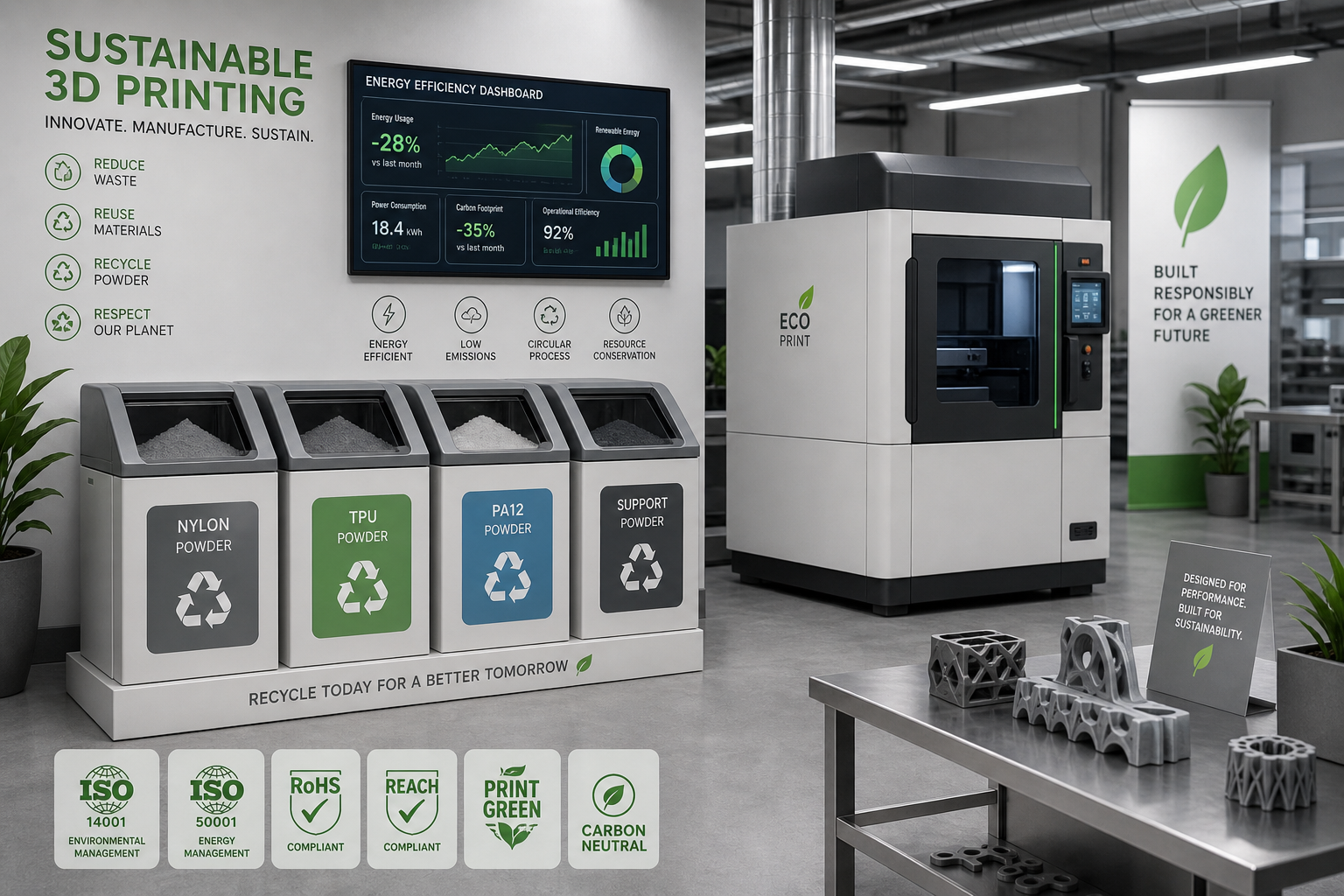
Material recycling is the most direct environmental practice for 3D printing services. For SLS nylon powder, unsintered powder can be recovered and reused, with a typical recovery rate of 30%-50%. Establishing a powder recycling system requires: first, using separation devices during printing to separate unsintered powder from parts; second, screening and drying the recovered powder to remove impurities and clumps; third, mixing recovered powder with virgin powder in a controlled ratio, with recovered powder usually kept below 30% to ensure performance. For SLA resin, although liquid resin is difficult to recycle directly, cured resin can be chemically broken down into raw monomers, or used as filler in other applications. Establishing a material recycling system not only reduces environmental pressure, but also significantly lowers material costs, creating a win-win situation for both economic and environmental benefits.
Energy Management: Optimizing Equipment Operating Efficiency
Energy management for 3D printing equipment is an important part of sustainable manufacturing. Industrial-grade 3D printers typically have high power consumption (SLA equipment: 2-5 kW; SLM equipment: 10-30 kW) and often require long periods of continuous operation. The core strategies for energy management include: first, when selecting equipment, prioritize models with high energy efficiency and focus on output efficiency per unit of energy consumed; second, optimize production scheduling to reduce idle time and achieve continuous production whenever possible; third, take advantage of peak and off-peak electricity pricing by scheduling energy-intensive processes during low-price hours; fourth, improve workshop environmental control by optimizing insulation and ventilation to reduce air-conditioning energy use. Through refined energy management, companies can not only reduce carbon emissions but also directly lower operating costs and improve competitiveness.
Waste Classification and Compliant Disposal
Waste generated during 3D printing must be sorted and disposed of in compliance with environmental regulations. Resin-based waste (including cleaning fluids, waste resin, and protective gear contaminated with resin) is hazardous waste and must be handed over to qualified entities for disposal, with complete transfer manifest records maintained. Powder waste (metal powders, nylon powders) must be collected with dust-control measures to prevent dust pollution, and recyclable portions should be recovered first. Support materials, packaging materials, and other general waste should be sorted and recycled to reduce landfill volume. Establishing a waste management ledger to record the generation volume, disposal method, and disposal entity for each waste type is not only a requirement for environmental compliance, but also a reflection of a company’s environmental management capability. Regular environmental audits can help identify management gaps and continuously improve environmental performance.
Carbon Footprint Accounting: A Scientific Method for Quantifying Environmental Impact
Carbon footprint accounting is a core tool for measuring the environmental impact of manufacturing activities. The carbon footprint of 3D printing services includes direct emissions (indirect emissions associated with electricity consumption by equipment, transportation emissions, etc.) and indirect emissions (full life-cycle emissions from material production, equipment manufacturing, waste disposal, and more). Accounting methods should follow international standards such as ISO 14067 or PAS 2050 to ensure data comparability and credibility. The results of carbon accounting can be used to: first, identify key emission-reduction areas and prioritize improvements in high-emission links; second, disclose product carbon footprints to customers to meet their supply-chain carbon management requirements; third, participate in carbon trading markets and convert emission-reduction achievements into economic returns. Carbon footprint accounting is not a one-time task; it should be established as an annual accounting mechanism to track emission-reduction progress and continuously improve environmental performance.
Green Certification System: Enhancing Brand Value and Market Competitiveness
The best proof of environmental compliance is obtaining authoritative green certifications. Common certifications include: ISO 14001 environmental management system certification, LEED green factory
Submit a model, drawing, image or written notes. Engineers will review material, process, finishing and delivery based on actual use.