Introduction: Service Quality Starts with Process Quality
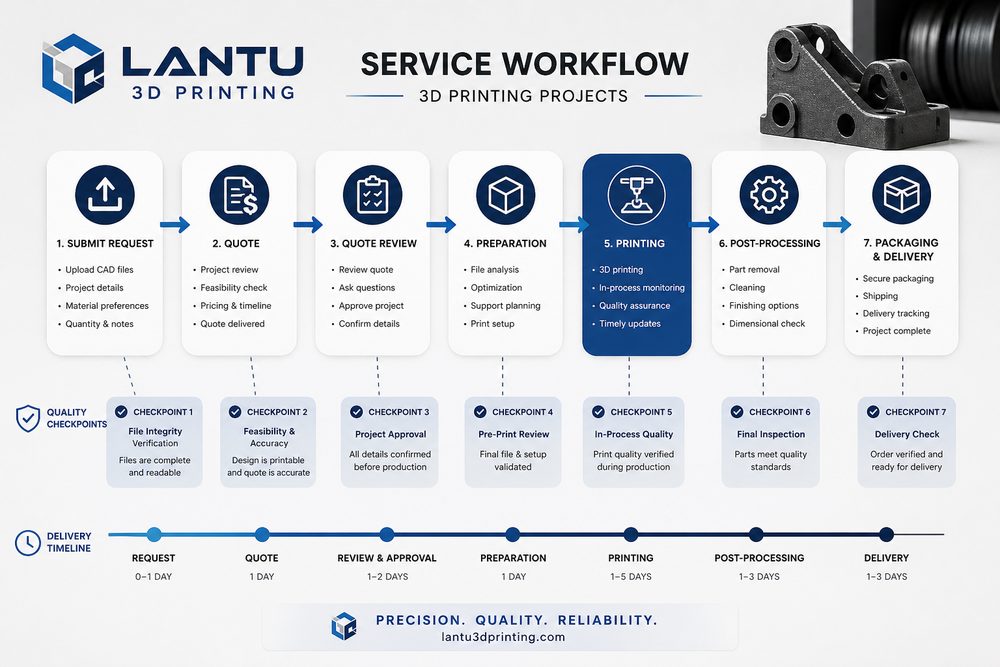
When a customer says, “Please print this for me,” the request may involve material performance, assembly relationships, aesthetic requirements, lead time, budget, and confidentiality. If the service provider quotes based only on the file, expectation gaps are likely to appear at delivery. A mature 3D printing service process should cover requirement clarification, design review, process selection, quote confirmation, production tracking, quality inspection and delivery, and post-project review.
1. Requirement Clarification Should Focus on the Use Case
The first step in service is not opening slicing software, but confirming what the part is for. Is it a visual prototype, a functional test part, an assembly fixture, or a final-use component? Will it bear load, heat, chemical exposure, or repeated opening and closing? Will the surface be painted, dyed, or kept in its original color? These answers determine the material, process, and post-processing route, and they also determine whether the quote is accurate.
2. Design Review Reduces Rework Risk
The model file may have issues such as insufficient wall thickness, undercut structures, long overhangs, holes that are too small, or inadequate assembly clearance. A design review should provide clear recommendations: where to add thickness, which surfaces require support, which holes should be post-machined, and which appearance surfaces should be reoriented. Identifying problems early is more professional than explaining a print failure afterward.
3. Quotes Should Reflect Risk and Service Boundaries
A quote is not simply the sum of material cost and machine time. It should include print time, failure risk, post-processing, inspection, packaging, rush costs, and communication costs. For projects with high uncertainty, a sample-validation-plus-batch-quote approach can be used: first verify key parameters with a prototype, then move into full production.
4. Delivery Review Builds Organizational Knowledge
After each project ends, customer feedback, process parameters, defect causes, improvement suggestions, and reusable templates should be recorded. A review is not a formality; it makes the next similar project faster, more accurate, and more stable. Blueblue 3D views the service process as a management chain from blueprint to physical part, helping customers reduce trial-and-error costs.
Conclusion
The competitiveness of 3D printing services comes from a closed-loop process, not from standalone printing capability. Through requirement clarification, design review, risk-based quoting, production tracking, and delivery review, service platforms can reduce rework, improve satisfaction, and turn project experience into repeatable delivery capability.
Submit a model, drawing, image or written notes. Engineers will review material, process, finishing and delivery based on actual use.