Introduction: 3D printing turns ideas into physical objects faster, and brings data risk closer to production
In 3D printing projects, the most valuable assets are often not the final prototype, but the model files, structural solutions, process parameters, and application scenarios. A product shell that has not yet been launched, a fixture structure, or a prototype for a medical assistive device may all contain a customer’s trade secrets. 3D printing shortens the path from design to physical part, and it also turns intellectual property protection from a legal issue into a day-to-day production process issue.
If a service provider does not have clear file management and access control, models may be copied multiple times during communication, quoting, slicing, subcontracting, post-processing, and delivery. Each copy increases the risk of leakage. lantu3D Printing emphasizes "necessary visibility, traceable processes, and closed-loop delivery" in project management, with the goal of ensuring that data flows serve manufacturing rather than spreading out of control.
1. File intake: clarify ownership, purpose, and confidentiality boundaries
At the start of a project, the ownership of the model file and the scope of permitted use should be clearly defined. When a customer uploads a file, that does not mean the service provider may use it for display, training, secondary development, or public case studies. The quotation form, contract, or platform terms should state that the file is used only for quoting, process evaluation, production, and delivery, and may not be disclosed or transferred to any third party without authorization.
The file intake process should also record the version, format, submission time, and revision notes. Common formats include STL, STEP, IGES, OBJ, and 3MF. For STEP and other files that contain editable features, protection requirements are usually higher than for simple mesh files. For important projects, a dedicated upload channel is recommended to avoid long-term transfer and storage through personal chat tools.
2. Access control: let the right people see only what they need
The core of intellectual property protection is not to keep everyone from seeing the file, but to ensure that each role accesses only the information needed to complete the task. Sales teams need to understand requirements and pricing scope, engineers need to review structure and process risks, production staff need slicing files and operating instructions, and subcontractors may only need redacted machining drawings or partial models.
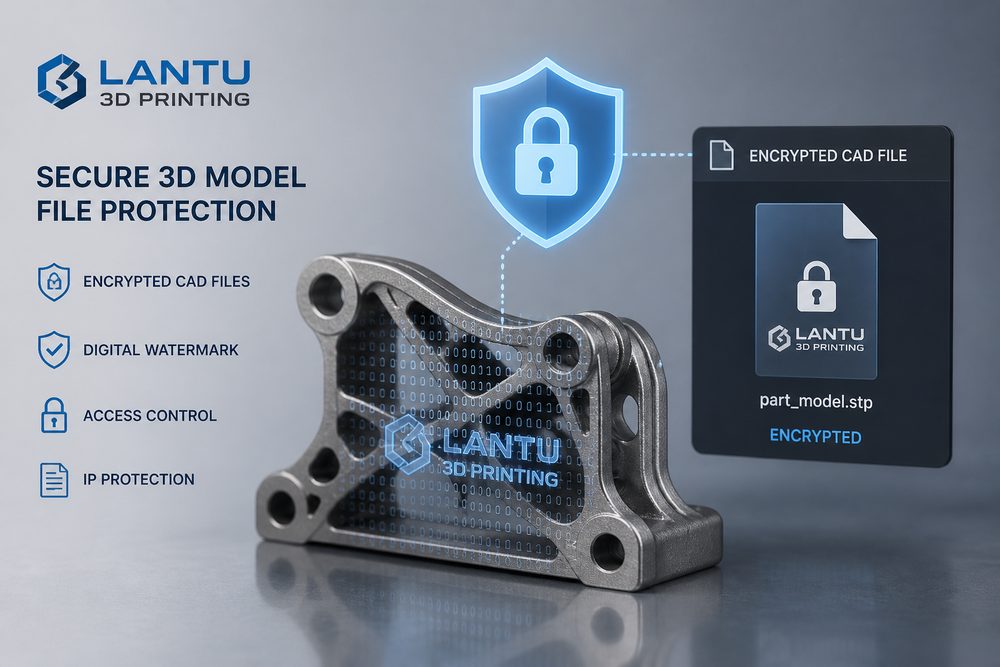
Practical measures include: creating project-based folder permissions; adding watermarks or download restrictions for sensitive projects; hiding unnecessary features when exporting production files; signing confidentiality agreements and limiting use before subcontracting; and archiving or deleting temporary files after the project ends as agreed. For platform-based services, operation logs, download records, and version history are equally important.
3. Version control: avoid commercial and quality losses caused by the wrong file
Intellectual property protection is not only about preventing leaks, but also about preventing the wrong version from being manufactured. In many projects, design iterations can lead to confusing names such as "final version," "final revised version," or "confirmed version 2." Once the wrong file enters production, it not only wastes materials and delays delivery, but may also expose an unapproved plan.
The standard approach is to establish version numbers and status labels, such as V1.0 for evaluation, V1.1 for revision, and V2.0 for production approval. Before production, the customer or project owner should confirm version freeze; after that, any change requires a new review of pricing, lead time, and quality risks. lantu3D Printing recommends binding the model version, slicing file, and production record together so that the delivered part can be traced back to a specific design version.
4. Case studies and supply chain collaboration: authorization is required before public disclosure
3D printing service providers often want to showcase successful cases, but customer projects cannot be made public by default. Even if brand identifiers are removed, special structures, application scenarios, or appearance contours may still reveal the customer’s R&D direction. Cases used for websites, social media, exhibitions, and training should be explicitly authorized, with the permitted scope agreed in advance: whether images, materials, industry, data, customer names, and performance indicators may be shown.
Supply chain collaboration also needs boundaries. Heat treatment, painting, CNC finishing, or inspection may require third-party participation. The service provider should evaluate the subcontractor’s data security capabilities and provide only the minimum necessary files whenever possible. For sensitive parts, methods such as part splitting, local masking, or on-site processing can be used to reduce risk.
Conclusion: embed intellectual property protection into the delivery workflow
3D printing intellectual property protection is not just a confidentiality promise; it is a systematic design of file intake, access control, version management, subcontracting boundaries, and case authorization. When enterprise clients choose a service partner, they should pay attention to whether the platform has traceable file management and process-based confidentiality mechanisms. lantu3D Printing combines data security with manufacturing delivery through lifecycle management, allowing customers’ ideas to be realized quickly while remaining under control.
Submit a model, drawing, image or written notes. Engineers will review material, process, finishing and delivery based on actual use.