Strategic Significance of Equipment Lifecycle Management
For 3D printing service enterprises, equipment is the most critical production asset. An industrial-grade metal 3D printing machine can cost millions of yuan to purchase, and the overall efficiency of the equipment directly determines a company’s profitability and market competitiveness. Equipment lifecycle management is a systematic asset management approach that covers the entire process from planning and procurement to final decommissioning, maximizing return on investment through scientific management methods. Research shows that in the total lifecycle cost of equipment, procurement cost accounts for only 30-40%, while operating and maintenance costs account for 50-60%, and decommissioning costs account for 5-10%. This means that focusing only on the purchase price while ignoring subsequent operating costs is a short-sighted equipment management strategy. Lifecycle management minimizes total cost by optimizing decisions at every stage.
Equipment Selection and Procurement Evaluation
Equipment selection is the starting point of equipment management and also the decision with the farthest-reaching impact. In the 3D printing industry, there are many types of equipment, and each process has its applicable scenarios and limitations. Selection evaluation should be based on the following dimensions: technical capability, production capacity, operating cost, and supplier support capability. Quantitative evaluation tools can help make objective decisions. It is recommended to use a weighted scoring method, assigning weights to each evaluation dimension according to the enterprise strategy, and then scoring the candidate equipment. In procurement negotiations, in addition to equipment price, companies should also strive to include a comprehensive service package that covers installation and commissioning, operator training, the first-year warranty, and process development support.
Installation, Commissioning, and Acceptance Standards
Equipment installation and commissioning are key steps in determining whether equipment can quickly become productive. Before installation, site conditions should be confirmed: power capacity, gas supply, environmental conditions, and foundation load-bearing requirements. For metal 3D printing equipment, inert gas supply and exhaust gas treatment systems must also be considered. Acceptance testing should be conducted according to the acceptance standards provided by the supplier, but the enterprise should also develop its own supplementary acceptance items. Key acceptance indicators include forming dimensional accuracy, surface quality, equipment repeatability, and safety function testing. All acceptance data should be recorded in detail and used as the foundational data for the equipment file. For items that do not pass acceptance, the supplier should be required to make corrections within a specified period until full compliance is achieved.
Designing an Equipment Maintenance System
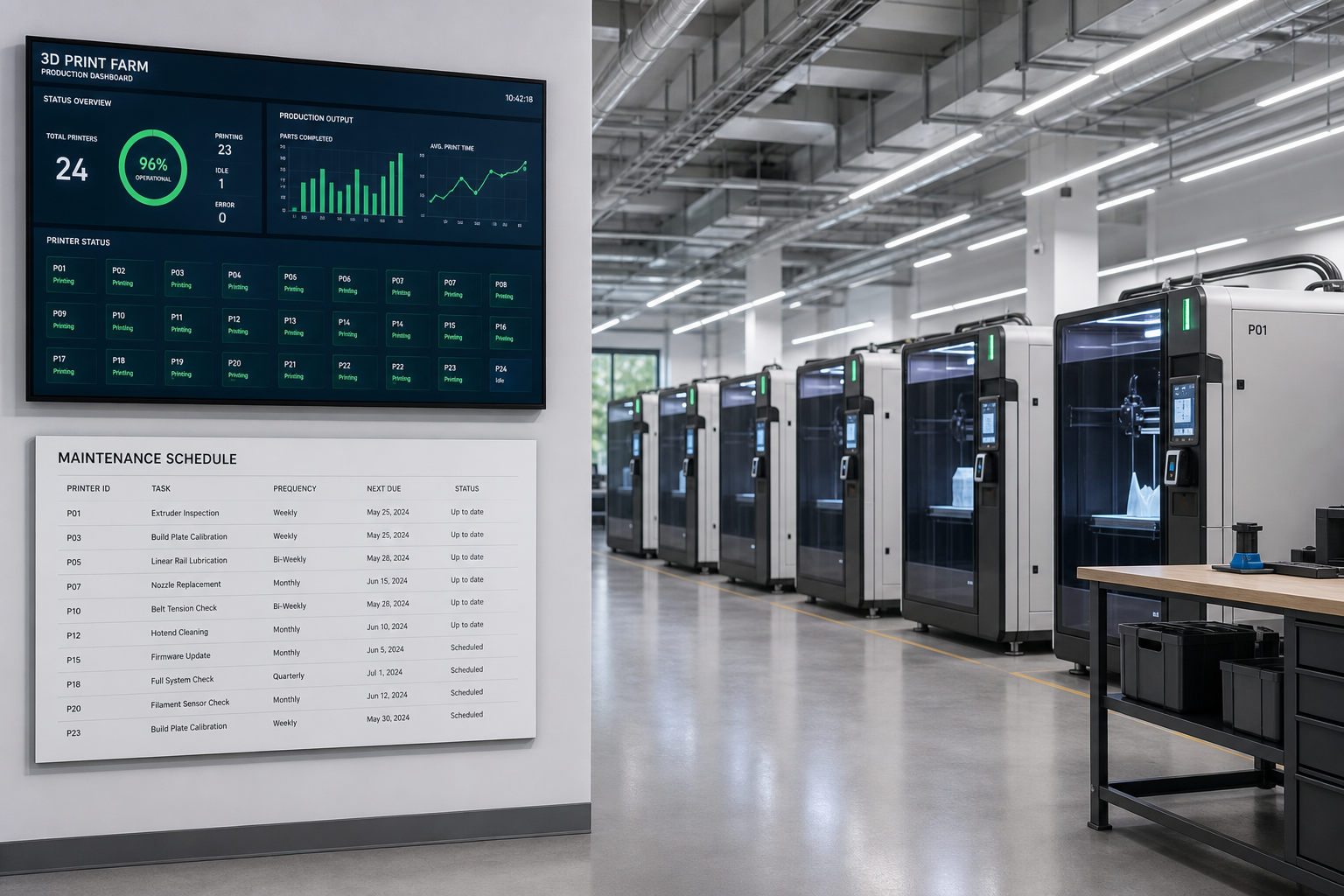
A scientific maintenance system is the core of preventing equipment failures and extending equipment life. Maintenance activities can be divided into four categories: preventive maintenance, predictive maintenance, corrective maintenance, and improvement maintenance. Preventive maintenance is regular maintenance based on time intervals or usage counts; predictive maintenance, on the other hand, is based on equipment condition monitoring data and intervenes before failures occur. Key steps in building an equipment maintenance system include developing maintenance plans that clearly define the frequency, content, and responsible person for each maintenance activity; establishing spare parts inventory management; implementing maintenance record management; and training equipment operators in basic maintenance skills. With a digital maintenance management system, automatic reminders, record tracking, and cost analysis of maintenance activities can be realized.
Equipment Performance Monitoring and OEE Improvement
Overall equipment effectiveness is the most important metric for measuring equipment productivity, and it consists of three dimensions: availability, performance efficiency, and quality rate. In the 3D printing industry, typical OEE targets are availability ≥90%, performance efficiency ≥85%, quality rate ≥95%, and overall OEE ≥73%. Specific measures to improve OEE include reducing equipment downtime through quick changeover techniques, increasing printing speed through process parameter optimization, reducing unexpected downtime through equipment condition monitoring, and reducing unplanned downtime through preventive maintenance. Regular analysis of the root causes of OEE losses can identify improvement opportunities and quantify the results of improvements.
Equipment Upgrades and Technology Retrofit Decisions
With the rapid development of 3D printing technology, equipment upgrades have become an important means of maintaining competitiveness. Upgrade decisions should be based on cost-benefit analysis: upgrade cost versus the capability improvements and cost savings brought by the upgrade. Common types of upgrades include hardware upgrades, software upgrades, and process expansion. When making decisions, the impact of the upgrade on the remaining useful life of the equipment should be assessed. For equipment that has already been in use for more than 70% of its designed service life, upgrading is usually less economical. Enterprises should establish a technical evaluation mechanism for equipment, regularly assess the technical level of equipment in use, and formulate upgrade or replacement plans. Through a complete equipment lifecycle archive, enterprises can continuously optimize equipment management strategies and maximize asset value.
Submit a model, drawing, image or written notes. Engineers will review material, process, finishing and delivery based on actual use.