Data Security Challenges in the Era of Digital Manufacturing
In the wave of digital transformation, 3D printing service providers handle large volumes of sensitive customer design data every day, including product prototypes, mold structures, and functional parts—core intellectual property. Once these data are leaked, customers may lose their market competitive advantage and even suffer huge economic losses. Therefore, establishing a comprehensive data security and confidentiality agreement system has become one of the core competitive advantages of 3D printing service providers.
Unlike traditional manufacturing, 3D printing services involve more data flow links and more complex risk points. From the moment a customer uploads a 3D model file, through data processing, process planning, production, post-processing, and finally finished product delivery, every step may involve the risk of data leakage. Especially with the rise of new service models such as cloud collaboration, remote ordering, and distributed manufacturing, the boundaries of data security have become increasingly blurred and the difficulty of protection has increased significantly.
Encryption and Identity Authentication at the File Transfer Layer
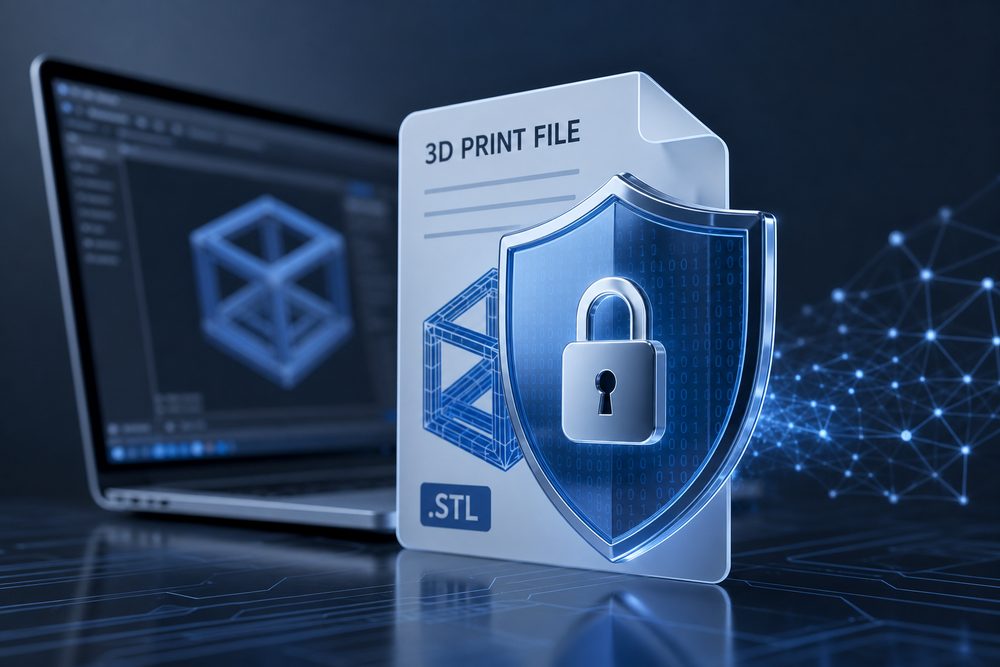
The first critical link in data security is file transfer. A professional 3D printing service platform should adopt bank-grade encrypted transmission protocols (such as TLS 1.3) to ensure that customers' uploaded STL, OBJ, STEP, and other 3D model files cannot be intercepted or tampered with during network transmission. At the same time, the platform should implement strict identity authentication mechanisms, including two-factor authentication (2FA), IP whitelisting, and access token expiration control, to prevent unauthorized access.
For highly sensitive projects, an end-to-end encryption (E2EE) solution is recommended so that only the customer and the service provider's project manager can decrypt and view the file contents, and even the platform's system administrators cannot access the original data. In addition, the file transfer system should have complete audit logging functions, recording the time, IP address, and operator for every file upload, download, and preview operation, providing a traceable chain of evidence for subsequent security audits.
Security Architecture Design for Data Storage
3D printing service companies should establish a tiered storage architecture and classify different security domains according to data sensitivity. Public design cases and standard part models can be stored in lower-security areas, while customers' proprietary designs and unpublished product prototypes must be stored in high-security encrypted storage systems. Encrypted storage should use AES-256 or higher encryption standards, with key management physically separated from data storage to prevent bulk data leakage if a single system is compromised.
Data storage also needs to consider offsite backup and disaster recovery. Critical data should be backed up in real time across at least two geographically separate data centers to ensure that business operations can be quickly restored in the event of natural disasters, hardware failures, or cyberattacks. Backup data must also be encrypted and regularly tested through recovery drills to verify the integrity and availability of the backup data.
Data Isolation and Access Control During Production
The on-site environment of 3D printing production also poses data leakage risks. Workstations in the production workshop, slicing software, and equipment control systems can all become attack surfaces. Companies should implement network isolation strategies, physically or logically separating the production network from the office network and the Internet to prevent external attackers from penetrating the production system through the office network.
Operators should follow the principle of least privilege and only access the data and functional modules within the scope of their job responsibilities. For example, workers in the post-processing stage do not need to view complete design drawings; they only need to know the part placement orientation and support removal requirements. Through refined permission management, even if an operator account is compromised, the information available to the attacker will be extremely limited. In addition, the production site should deploy monitoring measures such as screen watermarks and operation video recording to prevent leakage of design information through photography or screen recording.
Closed-Loop Management for Finished Product Delivery and Data Destruction
Data security involves not only the protection of digital assets, but also the confidential delivery of physical finished products. For highly sensitive prototypes, measures such as tamper-evident packaging, dedicated logistics channels, and identity verification upon receipt should be adopted to ensure that the finished product is not accessed or copied by third parties during delivery. When necessary, a non-disclosure agreement (NDA) can be signed with the customer to clarify the rights and obligations of both parties regarding intellectual property protection, providing a contractual basis for possible legal disputes.
After a project is completed, timely data destruction is equally important. Many data leakage incidents do not occur during
Submit a model, drawing, image or written notes. Engineers will review material, process, finishing and delivery based on actual use.