Introduction: Quality Does Not Start at Final Inspection
The quality of a 3D-printed part is determined by design, material, equipment, process parameters, environment, post-processing, and inspection. If you only perform a visual check before shipment, you cannot explain the source of dimensional deviations, insufficient strength, or batch-to-batch variation. The goal of a quality management system is to ensure that every part has traceable evidence, rather than relying solely on operator experience.
1. Design Inputs Must Be Standardized
Quality control starts with customer requirements and the model file. Drawing version, key dimensions, tolerance requirements, material grade, appearance grade, assembly relationships, and acceptance criteria must be clearly defined. If no drawing is available, key requirements should still be documented through a confirmation form. For high-risk parts, a DFM or DFAM review should be completed before production to prevent design defects from entering the manufacturing stage.
2. Process Parameters Must Be Recordable and Reusable
Equipment model, material batch, layer height, nozzle temperature, laser power, scan speed, build orientation, support strategy, and post-processing conditions should all be recorded. Parameter logging is not about creating paperwork for its own sake; it is about quickly identifying root causes when problems occur and turning successful projects into standardized process packages.
3. Inspection Strategies Should Be Tiered by Risk
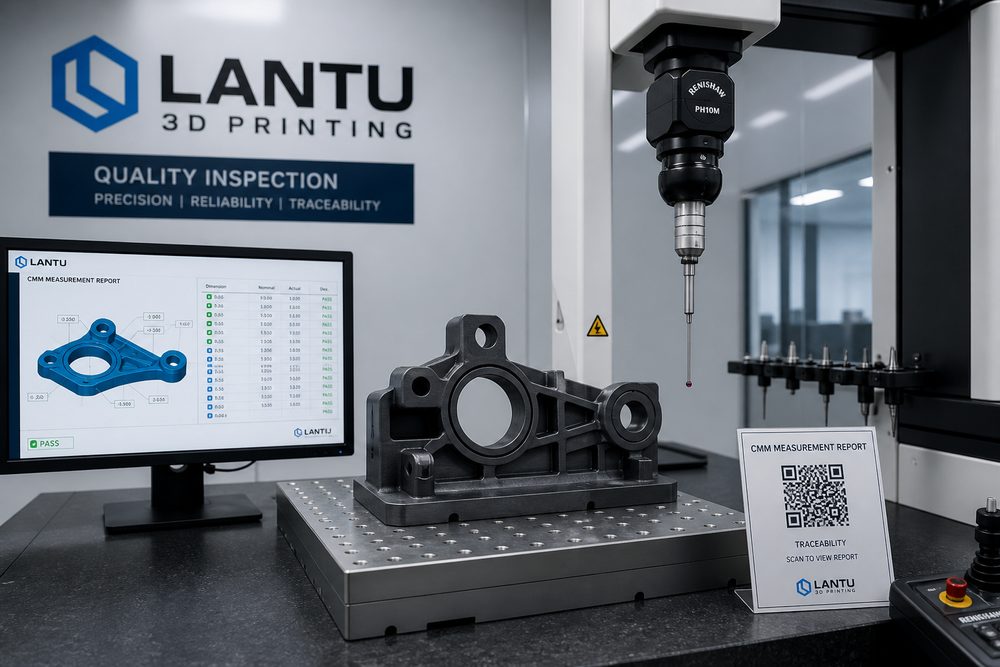
Not every part requires CT scanning or coordinate measuring machine inspection. Parts can be classified by application into cosmetic parts, assembly parts, functional parts, and safety-critical parts. Cosmetic parts focus on surface finish and color consistency; assembly parts focus on hole locations, snap fits, and clearances; functional parts require material performance or load testing; safety-critical parts may require nondestructive testing and a complete report.
4. Traceability Systems Increase Customer Confidence
Each order should be linked to the model version, production batch, inspection records, and nonconformance handling. Through QR codes, project numbers, or digital archives, customers can understand the part’s origin and handling process. For long-term customers, traceability data can also support design improvements and cost optimization.
Conclusion
The core of a 3D printing quality management system is transforming tacit experience into explicit evidence. Companies should build capabilities in four areas—design inputs, process records, tiered inspection, and traceability archives—so that quality issues can be prevented, located, and reviewed, thereby improving delivery reliability.
Submit a model, drawing, image or written notes. Engineers will review material, process, finishing and delivery based on actual use.