Importance of Project Archive Management
During the 3D printing service process, each project generates a large amount of valuable data and documentation. This information is not only the basis for project execution, but also an important resource for a company’s technical accumulation. Establishing a comprehensive project archive management system is of great significance for improving service quality, protecting intellectual property, and promoting technological innovation.
Archive Classification System
lantu3D has established a scientific project archive classification system, dividing archives into four major categories: design files, process files, quality files, and business files.
Design Files
Design files are the core of project archives, including original design drawings, optimized print files, support structure files, and more. Revision records for each version are fully preserved for easy traceability and reuse. Design files use standardized naming rules, including key information such as project number, version number, and date.
Process Files
Process files record key parameters in the project production process, including printing parameters, post-processing plans, material batches, and more. This information is of important reference value for reproducing production and optimizing processes. The system automatically records equipment operating parameters to reduce errors from manual entry.
Quality Files
Quality files include inspection reports, dimensional measurement data, appearance photos, issue records, and more. These files are not only the basis for delivery, but also important material for quality improvement. For nonconforming products, the causes of the issues and the handling measures are recorded in detail to form a quality knowledge base.
Business Files
Business files include contracts, quotations, delivery notes, invoices, and more. These documents are stored in accordance with financial standards, supporting rapid search and audit requirements. The system is connected with financial software to enable automatic data synchronization.
Archive Storage System
lantu3D adopts a dual-storage strategy of cloud storage plus local backup to ensure that archives are safe and reliable.
| Storage Method | Purpose | Features |
|---|---|---|
| Cloud Storage | Daily access, collaborative work | Access anytime, anywhere; automatic backup |
| Local Storage | Fast access, large data volumes | Fast access speed, large capacity |
| Offsite Backup | Disaster recovery | Data security, prevents single points of failure |
Archive Security Mechanism
Project archives involve customer intellectual property, so security is critical. lantu3D has established a multi-layered security mechanism. Access permissions are managed by levels, and different roles can only access archives at the corresponding level. Sensitive operations are logged for auditing, making traceability easier. Data transmission uses encrypted protocols to prevent information leakage. Regular security audits and penetration tests are conducted to identify and fix security vulnerabilities in a timely manner.
Archive Utilization and Sharing
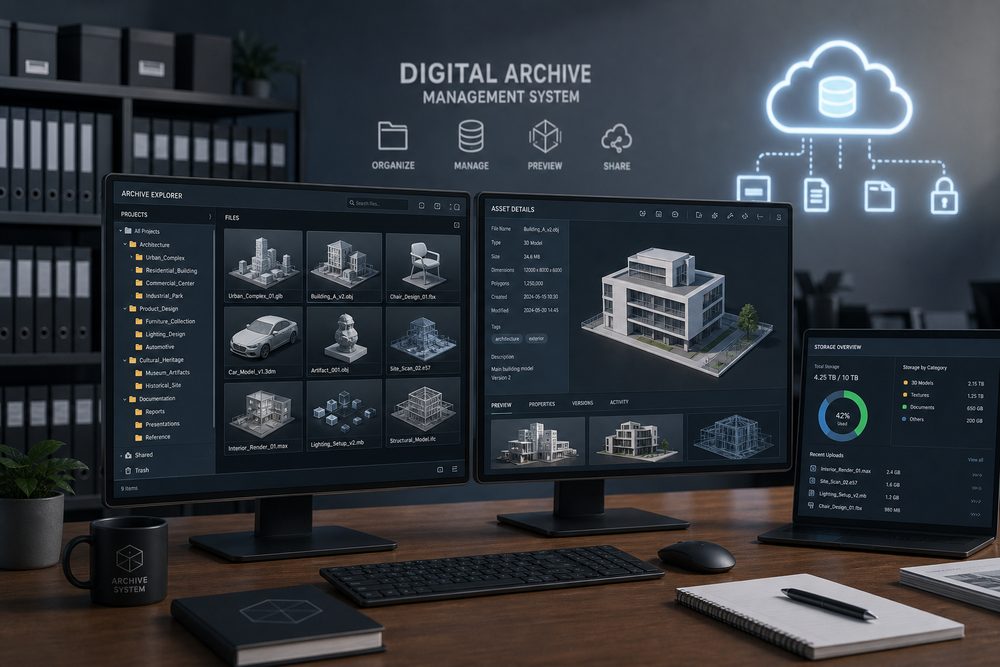
The value of archives lies in their use. lantu3D has developed an intelligent retrieval system that supports multiple search methods such as keywords, project number, and time range. For similar projects, the system recommends reference archives to help engineers quickly find historical experience. The knowledge management system extracts valuable knowledge points from archives to form an enterprise knowledge base.
Archive Filing Cycle
After a project is completed, the archives are organized and filed. The filing process includes checks for file completeness, metadata entry, and allocation of storage locations. Once filed, the archives enter long-term preservation, with retention periods determined according to archive type and regulatory requirements. Expired archives are handled according to the destruction process.
Digital Archive Development
lantu3D continues to promote digital archive development by using OCR technology to recognize scanned documents, AI technology to extract key information, and blockchain technology to ensure archive authenticity. Digital archives are not only easier to manage and use, but can also be integrated with other enterprise systems to create greater value.
Conclusion
Project archive management is a foundational task in 3D printing services and is of great significance for improving service quality, accumulating technical experience, and protecting intellectual property. Through a scientific classification system, a comprehensive storage system, and a strict security mechanism, lantu3D has established a high-quality archive management system.
Submit a model, drawing, image or written notes. Engineers will review material, process, finishing and delivery based on actual use.