Introduction: Many rework issues are not production quality problems, but delivery damage caused by inadequate packaging support, shipping vibration, or environmental changes
Printing complete does not mean delivery complete: A Guide to Packaging and Shipping 3D Printed Parts is not a single technical issue, but a systems engineering task that spans customer requirements, model data, process selection, production scheduling and delivery, and after-sales review. For a full lifecycle management platform like lantu3D, which takes projects from blueprint/design to physical delivery, the key is not whether something can be printed, but whether uncertain requirements can be turned into a planned, traceable, and deliverable manufacturing process. A common misconception in the industry is to focus only on machine parameters while ignoring order batches, validation checkpoints, quality records, and cross-department information flow, ultimately causing rework, delays, or uncontrolled costs. This article focuses on 3D printing packaging and shipping management and, in the context of small-batch manufacturing, provides an actionable framework.
1. Choose Packaging by Risk, Not by Size
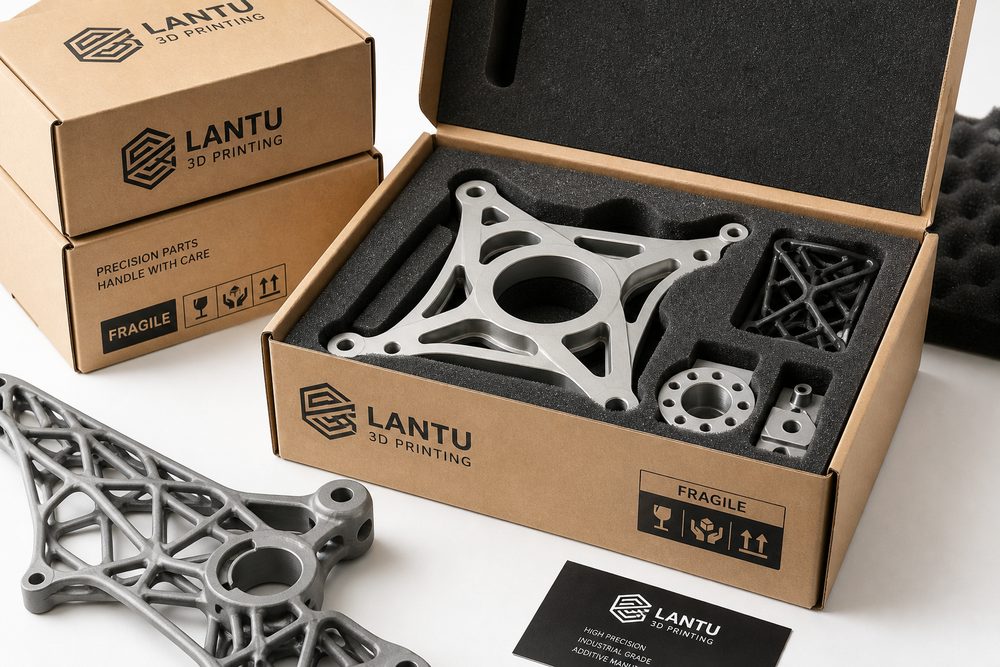
A small part is not necessarily low risk, and a large part is not necessarily hard to ship. Thin-walled resin parts, painted cosmetic parts, long nylon parts, models with sharp edges, and multi-part assemblies all require separate assessment. It is recommended to establish a four-level packaging standard based on brittleness, surface sensitivity, deformation risk, and replaceability. High-risk parts should use custom foam, localized supports, and crush-resistant outer boxes; do not rely on bubble wrap alone.
2. Material Properties Determine the Key Protection Points
SLA resin parts have fine surfaces but high brittleness, so point-impact collisions must be avoided during transport; SLS nylon parts are tough, but dyed parts need protection against friction and color transfer; metal printed parts are heavy and should be kept from bumping into each other and causing edge damage; painted parts must be protected from direct contact between tape and the coating. Using the same packaging method for different materials is often the root cause of delivery exceptions.
3. Assemblies Must Be Protected Against Self-Disassembly in Transit
For samples that include magnets, snap-fits, threaded features, or moving structures, confirm before packaging whether they should be preassembled, partially disassembled, or fixed as separate parts. For display models, the unpacking instructions can note the assembly sequence; for functional parts, protective spacers should be retained on critical moving areas. If the customer needs to assemble the parts themselves after receipt, it is recommended to include a parts list and photos to reduce complaints caused by incorrect assembly.
4. Shipping Records Are Also Part of Quality Traceability
Before delivery, photograph the inside and outside of the packaging, and record the tracking number, number of boxes, special instructions, and the customer's signature requirements. For high-value or fragile parts, it is advisable to declare a higher value and use a rigid outer box. If damage occurs, complete packaging records help determine whether the problem was caused by production, packaging, or transport, and they also support rapid replacement and responsibility assignment.
Conclusion: Turn Experience into Repeatable Delivery Capability
Printing complete does not mean delivery complete: The core of a Guide to Packaging and Shipping 3D Printed Parts is to turn fragmented experience into standardized actions: requirements have an intake point, decisions have a basis, processes have records, exceptions have closed-loop handling, and results can be reviewed. Companies are advised to start with one high-frequency product category or one typical customer project, establish the minimum viable process first, and then gradually expand to a materials library, process library, pricing rules, and quality traceability system. This is exactly the kind of continuous capability building from blueprint to physical delivery that lantu3D focuses on, enabling 3D printing to be more than just a prototyping tool and becoming a reliable node for rapid validation, small-batch production, and on-demand manufacturing.
Submit a model, drawing, image or written notes. Engineers will review material, process, finishing and delivery based on actual use.