Why Intelligent Order Allocation Is Necessary
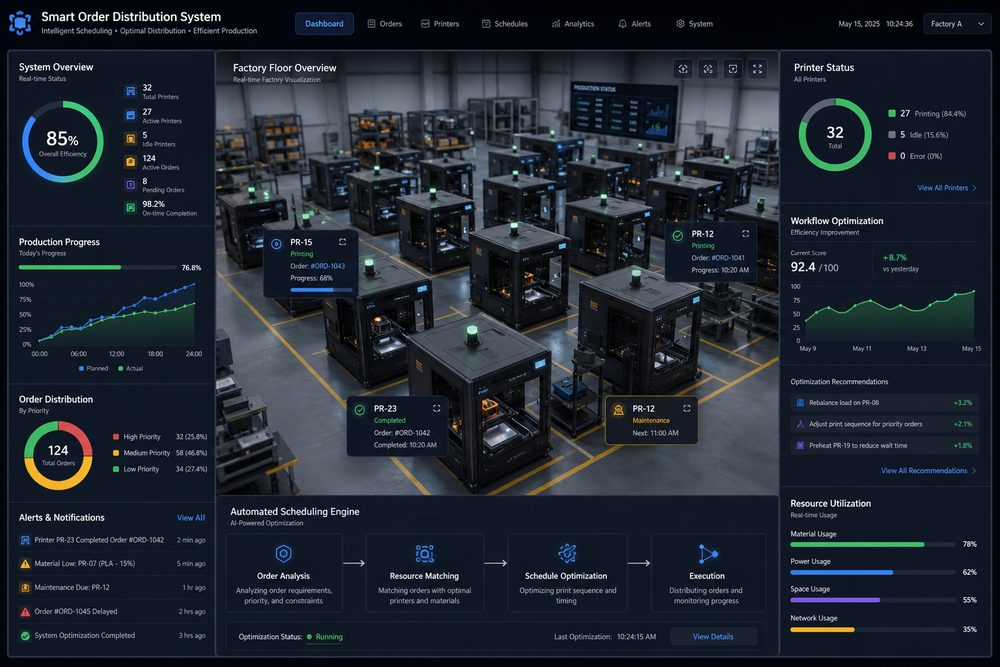
As the scale of 3D printing services grows, traditional manual order allocation can no longer meet demand. Manual allocation is not only inefficient, but also prone to issues such as uneven distribution and resource waste. An intelligent order allocation system uses algorithmic optimization to achieve the best match between orders and production resources.
Core Elements of Intelligent Allocation
An intelligent order allocation system must comprehensively consider multiple factors, including order attributes, equipment capabilities, material inventory, and personnel skills.
Order Attribute Analysis
Each order has a series of attributes, such as material type, process requirements, precision level, delivery time, and quantity. The system performs multidimensional analysis of orders, extracts key features, and uses them as inputs for allocation decisions.
Equipment Capability Matching
Different 3D printing devices have different capability characteristics. Some are good at high-precision printing, some are suitable for mass production, and some support special materials. The system maintains a detailed database of equipment capabilities and can accurately match order requirements with device capabilities.
Material Inventory Check
Materials are a necessary condition for production. The system checks material inventory in real time, and for materials that are in short supply, it issues advance warnings and triggers the procurement process. It also takes into account factors such as shelf life and batch consistency.
Personnel Skills Matching
Certain orders require operators with specific skills. The system records each employee’s skill qualifications and experience level, enabling reasonable staffing arrangements to ensure production quality.
Allocation Algorithm Optimization
lantu3D’s intelligent order allocation system adopts a multi-objective optimization algorithm to solve for the optimal allocation plan under multiple constraints.
| Optimization Objective | Weight | Description |
|---|---|---|
| On-time Delivery Rate | High | Ensure orders are delivered on time |
| Equipment Utilization | Medium | Improve equipment usage efficiency |
| Production Cost | Medium | Reduce material and energy consumption |
| Quality Consistency | High | Ensure stable product quality |
Real-Time Scheduling Adjustments
During production, abnormal situations such as equipment failures and urgent order insertions are unavoidable. The intelligent allocation system supports real-time scheduling adjustments and can recalculate the allocation plan in the shortest possible time, minimizing the impact on production. The system also learns from historical scheduling experience to continuously optimize adjustment strategies.
Intelligent Prediction and Early Warning
The system can not only handle current orders, but also predict future production. By analyzing order trends and equipment status, the system issues early warnings about potential capacity bottlenecks, material shortages, and other issues, providing a basis for decision-making.
Human-Machine Collaborative Decision-Making
Although intelligent algorithms can automatically complete most allocation decisions, human intervention is still required in complex situations. The system provides a user-friendly decision support interface that displays recommended plans and alternative options for final confirmation by scheduling personnel. The human-machine collaborative model ensures efficiency while retaining flexibility.
Effect Evaluation and Continuous Optimization
After each allocation is completed, the system tracks execution results and collects data on key indicators. Through comparative analysis, it continuously optimizes the allocation algorithm parameters and improves allocation quality. At the same time, the evaluation results are fed back to the production management team as a basis for improving production processes.
System Integration
The intelligent order allocation system does not exist in isolation; it needs to be closely integrated with other enterprise systems. It connects with the ERP system to obtain order and material information. It connects with the MES system to obtain production status. It connects with the equipment management system to obtain equipment status. Through system integration, it enables real-time data flow and closed-loop execution of decisions.
Conclusion
Intelligent order allocation is an important part of the digital transformation of 3D printing enterprises. By building an intelligent allocation system, lantu3D has achieved the best match between orders and production resources, significantly improving production efficiency and service quality.
Submit a model, drawing, image or written notes. Engineers will review material, process, finishing and delivery based on actual use.