
Introduction: Being Able to Print Is Not the Same as Being Able to Produce at Scale
In 3D printing service operations, a common and frustrating scenario is this: first-article validation goes smoothly, the customer approves the sample, and order volume subsequently rises from 20 to 300 parts per month. Then problems begin to occur continuously on the shop floor—using the same parameter file on another machine produces inconsistent results; changing powder batches reduces density; previously stable takt time is disrupted by rework and reinspection; and delivery lead time stretches from 7 days to 15 days. The issue is not machine capability, but the absence of a measurable ramp-up mechanism when moving from prototyping to batch production.
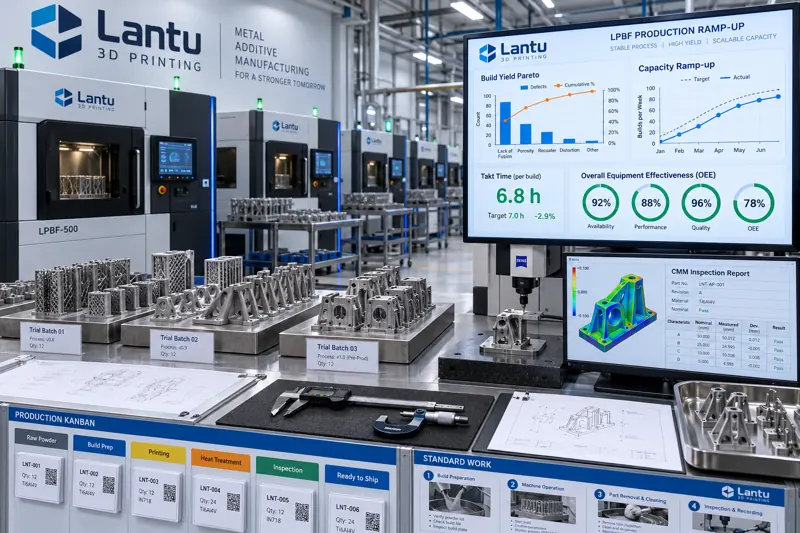
lantu3D's experience across full-lifecycle delivery has repeatedly shown that the core of small-batch production management is not running machines at maximum capacity. It is raising three curves simultaneously: the process window, yield, and takt time. This article presents an engineering approach to moving from pilot production to capacity ramp-up, covering ramp-up stages, parameter standardization, yield attribution, takt-time measurement, and release gates.
1. Why First-Article Success Does Not Equal Batch Stability
A first article is produced under highly controlled conditions: an experienced engineer personally adjusts the machine, a single batch of new powder is used, ambient temperature and humidity are verified, the build plate is precisely leveled, and inspection covers all dimensions and requirements. These conditions are not sustainable during batch production.
The differences mainly arise from four categories of variables. The first is machine-to-machine variation: actual laser power output may differ by 3%–8% between machines, while galvanometer calibration, protective-window transmittance, and optical-path cleanliness also vary. The second is material batch variation: changes in the proportion of reclaimed powder can shift particle-size distribution; a D50 shift from 38 μm to 45 μm can significantly alter powder-bed density and melt-pool wetting behavior. The third is environmental variation: powder moisture content above 0.05% releases water vapor in the melt pool, causing porosity and spatter; room-temperature fluctuations exceeding ±3°C alter the thermal gradient of the build plate. The fourth is operational variation: human deviations in depowdering, part removal, and orientation are amplified in small-batch production.
Therefore, the objective of ramp-up is not to replicate the luck of a single successful first article. It is to bring each of these four variable categories under control and establish clearly assessable limits.
2. The Four Stages of Capacity Ramp-Up
It is recommended to divide the transition from small batches to stable volume production into four stages, each with defined entry conditions, duration, and exit gates.
Stage 1: Process Standardization (1–2 weeks). The objective is to convert first-article settings into a reproducible parameter package. Activities include cross-machine validation (at least 2 machines, 3 placement positions, and 2 powder batches, for a total of at least 12 combinations), establishing an energy-density window (for example, a usable volumetric energy density range of 55–75 J/mm³ rather than a single value), determining shrinkage compensation factors for critical dimensions, and issuing a standard parameter package. Exit gate: density ≥99.5% and CPK ≥1.33 for critical dimensions across 3 consecutive batches.
Stage 2: Small-Batch Pilot Production (2–4 weeks). Run batches of 20–50 parts while introducing real-world disturbances such as changeovers, powder changes, and shift changes. Focus on tracking first-pass yield, rework rate, and labor hours per part. Exit gate: first-pass yield ≥90% and takt-time variation within ±20%.
Stage 3: Ramp-Up (4–8 weeks). Increase output to 100–300 parts per month while identifying bottlenecks and balancing the production line to align the takt times of printing, depowdering, heat treatment, machining, and inspection. Exit gate: capacity reaches at least 85% of the target level and unit cost enters the target range.
Stage 4: Steady State. Enter SPC-based process control. Parameter changes must undergo change review, and any deviation must trigger an exception-handling process.
The four stages must not be skipped. Moving directly to volume production without completing Stage 1 is the starting point for most batch-quality incidents.
3. Process Parameter Standardization: From Experience-Based Values to a Parameter Package
The deliverable of parameter standardization is not a single number, but an auditable parameter package containing at least seven elements: build-plate preheat temperature and allowable variation range; layer thickness and the corresponding laser power/scanning speed/hatch spacing combination; scanning strategy, including stripe width, rotation angle, and contour compensation; support type and generation rules; build orientation and minimum spacing; maximum reclaimed-powder blending ratio; and environmental requirements, including temperature, humidity, powder moisture content, and oxygen level.
Cross-machine consistency is among the most frequently overlooked elements. It is recommended to conduct a monthly cross-machine comparison using standard test coupons: print the same model using the same parameter package on every machine, measure density, tensile strength, and critical dimensions, and create a machine-to-machine deviation matrix. Machines with deviations exceeding 5% should be taken offline for optical-path calibration or placed on a restricted-use list. This task is inexpensive—approximately two machine-hours per machine—but can prevent the scrapping of an entire batch.
In addition, define triggering conditions and approval routes for parameter changes. Every adjustment must have an ID, reason, validation data, effective date, and corresponding parameter-package revision. A parameter file without version control is equivalent to having no process at all.
4. Yield Attribution: Turning Nonconforming Parts into Actionable Data
The most effective tool during ramp-up is Pareto analysis of defect causes. Establish a defect classification dictionary covering porosity, lack of fusion, balling, cracking, warpage and distortion, dimensional out-of-tolerance conditions, excessive surface roughness, support residue, incomplete depowdering, and post-processing damage. Record the number and proportion of parts affected by each defect type for every batch.
Root-cause attribution must be traced to the process-variable level. For example, elevated porosity requires distinguishing among excessive powder moisture, insufficient energy density, and excessive hatch spacing. Excessive warpage requires distinguishing among inadequate support design, improper build orientation, and incorrect stress-relief annealing timing. The accuracy of attribution determines whether corrective action will work—adjusting laser power because porosity is incorrectly assumed to be an energy-density issue often makes the problem worse.
Set a yield ramp-up target curve: ≥90% in Stage 2, ≥95% in Stage 3, and ≥98% in steady state. When yield falls more than 5 percentage points below the stage target for two consecutive batches, volume expansion should be paused and root-cause analysis initiated, rather than continuing to increase output in the hope that probability will improve.
5. Takt Time and Capacity: From Machine Utilization to Line Balancing
Many teams assess capacity based on machine utilization, which creates a systematic overestimate. Actual delivery capability is determined by the takt time of the bottleneck process. For metal printing, a part must pass through seven steps before release: printing, depowdering, heat treatment, wire EDM part removal, support removal, machining, and inspection. If the takt time of any step exceeds that of the preceding step, work-in-process inventory will accumulate.
Measure standard labor time for each process by continuously observing at least 20 parts and using the median value. Then create a process takt-time bar chart to identify bottlenecks. Improve them through three approaches: splitting, by transferring some bottleneck activities to upstream or downstream processes; parallelization, by adding equipment or workstations at the bottleneck; and reduction, by optimizing the work itself—for example, replacing manual depowdering with dedicated fixtures and vibratory screening.
Changeover time must also be included. In high-mix, small-batch environments, changeovers often consume 20%–40% of available machine time. They should be standardized through a changeover checklist covering powder replacement, chamber cleaning, sieving, parameter loading, first-part trial printing, and first-part confirmation. Each step should have standard time requirements and checkpoints. Converting changeovers from veteran-operator experience into standardized work instructions is one of the most cost-effective improvements during ramp-up.
6. Ramp-Up Release Gates and Decision Mechanisms
Establish clear release-review checkpoints. Before each increase in production volume, conduct a brief review of six items: whether the parameter package is current and has completed cross-machine validation; whether the most recent 3 batches meet yield targets with an upward trend; whether the bottleneck process has more than 10% takt-time headroom; whether powder and critical consumables inventory can support the next volume tier; whether inspection capacity, including inspection cycle time, matches the batch volume; and whether exception handling and traceability records are closed-loop.
Volume may be increased only when all six items pass. If any item fails, maintain the current volume tier and assign an owner and closure date. The value of this mechanism is that it turns volume expansion from an intuitive decision into an evidence-based one, while also making progress understandable to customers.
7. Common Misconceptions
Misconception 1: Using first-article data to promise batch delivery lead times. A first article represents the optimum condition for one part. Batch production must account for queuing, rework, and inspection queues. Simply multiplying first-article labor time by the number of parts will severely underestimate lead time.
Misconception 2: Relying on 100% inspection when yield does not meet target. Full inspection shifts costs into pricing and lead time. The correct approach is to improve process capability and make inspection a verification method rather than a sorting mechanism.
Misconception 3: Skipping cross-machine validation to rush an order. Running multiple machines in parallel is a primary source of small-batch capacity. Skipping validation concentrates risk on the weakest machine.
Misconception 4: Equating cost optimization with reducing print time per part. Reducing supports and increasing packing density can lower costs, but if yield is sacrificed, rework costs often far exceed the savings.
Conclusion
The transition from pilot production to stable batch output is fundamentally about converting one successful result into a repeatable system capability. Five actions are essential: standardize first-article settings into a version-controlled parameter package and complete cross-machine validation; advance through four stages with clear exit gates for each; use a defect dictionary for yield Pareto attribution rather than broad corrective actions; measure capacity by bottleneck-process takt time rather than machine utilization; and use a six-point checklist to make volume expansion a controlled decision event.
lantu3D's delivery practice consistently follows one principle: full-lifecycle management from blueprint to physical part. Capacity ramp-up is not an isolated optimization of the printing process, but the outcome of coordination among design, process engineering, inspection, and supply chain. Once a ramp-up mechanism is established, small-batch production becomes genuinely deliverable.
Submit a model, drawing, image or written notes. Engineers will review material, process, finishing and delivery based on actual use.