Introduction: Why First Article Inspection Is the First Gate for Batch Delivery in 3D Printing
In the past, small-batch 3D printing was often based on the idea of “print it and deliver it,” lacking systematic first-article release. This led to frequent dimensional drift, strength variation, and missing traceability during batch production. First Article Inspection (FAI) borrows the quality-gate mechanism from the aerospace and automotive industries. By conducting closed-loop verification of dimensions, materials, and process parameters on the first article, it blocks uncertainty before batch production begins. It does not require additional equipment investment, yet it is the quality foundation that moves 3D printing from “capable of prototyping” to “capable of mass production.”
1. Scope and Acceptance Criteria of First Article Inspection
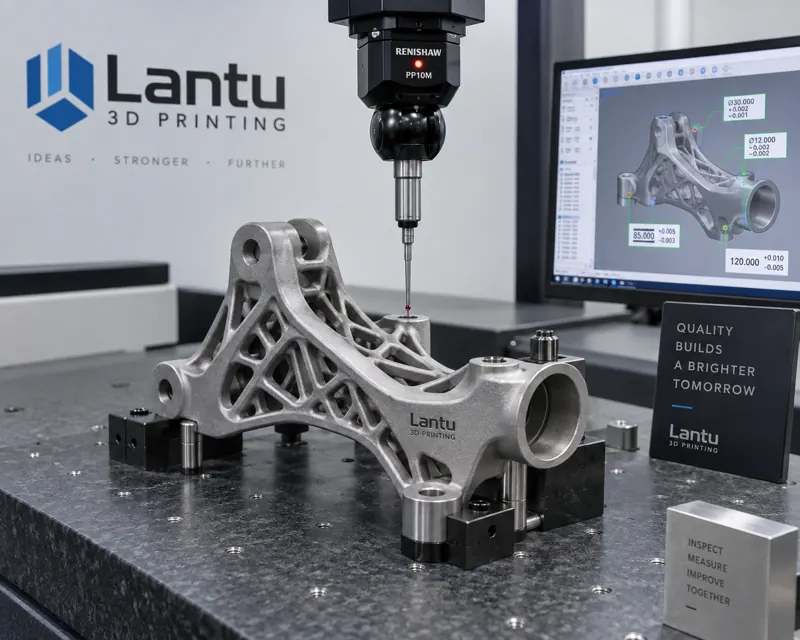
FAI is not just about measuring one dimension. In engineering practice, it should include three types of evidence: a full-dimensional inspection report (using coordinate measuring machines, or CMM, to verify key features, usually requiring tolerances within ±0.1 mm), material conformity (grade, batch, and sampled mechanical properties such as tensile strength, hardness, and density), and locked process parameters (layer thickness, laser power, scanning strategy, and build plate preheating temperature). The recommended acceptance criteria are “zero out-of-tolerance key features and a CPK of no less than 1.33 for general features.” If any key feature is out of tolerance, the part should be judged nonconforming, and a closed responsibility loop containing measurement data and signatures must be established.
2. How Process Capability (CPK/PPK) Supports Batch Release
A single qualified part does not mean the process is stable. The process capability index CPK reflects how centered and dispersed the dimensional distribution is within the tolerance band. For batch scenarios, it is recommended to calculate CPK based on samples from 3–5 consecutive first articles. When CPK is no less than 1.33, process capability can be considered sufficient and the process may proceed to small-batch production. If it falls within the range of 1.0–1.33, tightened inspection is required. If it is below 1.0, the process must be optimized before release. PPK is used to evaluate process potential during the initial process stage when long-term data is insufficient. Together, the two form the basis for release decisions.
3. The Three-Stage Release Ladder from First Article to Batch Production
It is recommended to adopt a three-stage ladder of “first article → small batch → mass production”: first, the first article inspection is passed and the FAI report is signed; then, in small-batch production (for example, 10–50 pieces), process capability validation shows CPK no less than 1.33 and no critical defects; finally, mass production is monitored through AQL sampling (such as AQL 1.0) combined with SPC control charts to track trends in key dimensions. Each stage should have a clearly designated release owner, such as a quality engineer, and documented records, avoiding batch risks caused by “scaling up based on feeling.”
4. Common Failure Modes and Upfront Interception Points
Typical failures include dimensional and surface damage introduced by support removal, strength variation caused by powder batch differences, and deformation caused by post-processing such as heat treatment or sandblasting. FAI should set up dedicated inspections at these points: fillets and residues at support roots, dimensional comparison before and after heat treatment, and mechanical properties of witness coupons processed in the same furnace. Moving interception points forward to each process step, rather than waiting until final inspection, can significantly reduce the probability of batch rework.
5. Data Closed Loop and Traceability Implementation
The value of first article inspection lies in turning “experience” into “evidence.” It is recommended to bind the FAI report, inspection data, process parameters, and batch numbers into the same traceability chain, such as an MES or quality dashboard, to achieve serialized management of individual parts. When a customer complaint or field failure occurs, the first-article baseline can be quickly traced back to identify whether the issue originated from incoming materials, the process, or post-processing, thereby shortening the closed-loop resolution time.
Conclusion
First article inspection and process capability validation are the quality foundation that moves 3D printing from “capable of prototyping” to “capable of mass production.” They do not require additional equipment, yet they expose batch risks early and prevent losses in advance, making them an indispensable first gate for scaled delivery. Companies should include FAI and CPK release standards in delivery agreements before quotation, making quality traceable and calculable.
Submit a model, drawing, image or written notes. Engineers will review material, process, finishing and delivery based on actual use.