
Introduction: The Real Question Is Not “Buy or Not,” but “Which Contract Structure Secures Capacity?”
In discussions about building metal additive manufacturing capacity, attention has long remained focused on machine selection: build chamber size, single- or multi-laser configuration, whether the powder recirculation system is closed loop, how to calculate TCO, and the expected payback period. These issues are certainly important. However, when the procurement budget for an industrial metal LPBF machine reaches the seven-figure range, the real question is often not “Do we need this capability?” but “Must this capital expenditure appear on this period’s balance sheet?” A machine priced at RMB 3 million, depreciated on a straight-line basis over five years with a 5% residual value, generates annual depreciation of RMB 570,000. Add an annual maintenance contract of RMB 180,000 to RMB 250,000, RMB 120,000 to RMB 200,000 for inert gas and electricity, and RMB 60,000 to RMB 100,000 in allocated facility and utility costs, and annual fixed costs approach RMB 1 million. If actual utilization is only 35%, the fixed cost allocated to each conforming part can be nearly three times higher than the figure in the financial model used during procurement negotiations. The issue is not an incorrect machine-selection calculation; it is that the assumption that the company must own the asset was never challenged.
I. Contractual Differences Among Four Acquisition Models
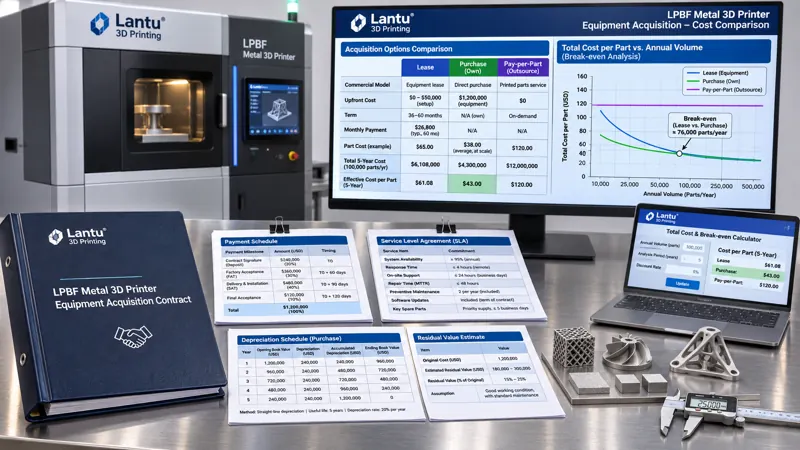
Once capacity acquisition is viewed as a contract-structure decision, there are at least four options, each with a fundamentally different cash-flow profile.
Type 1: Direct purchase. This involves a one-time capital expenditure, recognition of the asset on the balance sheet, depreciation over its useful life, and assumption of residual-value and disposal risks. The advantages are that unit cost declines rapidly as output rises, capacity scheduling remains fully autonomous, and process data stays in-house. The trade-off is front-loaded cash outflow and self-assumed technology-obsolescence risk: when a new-generation machine improves optical-path efficiency by 30%, the economics of the older machine can deteriorate immediately.
Type 2: Operating lease. The lessee pays periodic rent for the right to use the machine, typically over 24 to 60 months, while ownership and residual-value risk remain with the lessor. Under current lease accounting standards, except for short-term and low-value leases, lessees must still recognize a right-of-use asset and lease liability. Therefore, the old concept of “off-balance-sheet financing” must be revised. Nevertheless, the cash-flow profile remains smoother and more predictable as an operating expense.
Type 3: Finance lease or lease-to-own arrangement. The down payment is commonly 20% to 30%, with the remaining principal and interest repaid in installments; ownership transfers at the end of the term for a nominal or agreed price. This solves a cash-flow timing issue rather than a risk-allocation issue: technology-obsolescence and residual-value risks remain with the lessee, a point frequently overlooked in contract negotiations.
Type 4: Per-part pricing and capacity subscriptions. The customer does not pay for the machine, only for conforming parts. The unit price includes equipment depreciation, maintenance, gas, electricity, and operating labor, fully converting fixed costs into variable costs. A capacity subscription, by contrast, prepays a defined amount of machine-time capacity in exchange for priority production scheduling. It is suitable for applications with volatile demand but firm delivery commitments.
II. Quantifying Cost Boundaries: Finding the Switching Threshold
The advantages and disadvantages of the four models are not merely qualitative; they can be calculated using a unified framework. Let annual demand be Q parts. The annual total cost for each model is as follows.
Purchase: Annual total cost = annual depreciation + annual maintenance + annual energy and gas + allocated facility cost. For a RMB 3 million machine depreciated over five years with a 5% residual value, annual depreciation is RMB 570,000; maintenance is RMB 200,000; electricity and gas total RMB 160,000; and facility allocation is RMB 80,000. The fixed portion therefore totals RMB 1.01 million, plus variable costs of approximately RMB 3,500 per part for powder, post-processing, and labor. At an annual output of 200 parts, unit cost is approximately RMB 8,600; at 600 parts, it falls to RMB 5,200.
Operating lease: Annual total cost = monthly rent × 12 + excess-capacity charges + variable cost. Assume monthly rent of RMB 65,000, or RMB 780,000 annually, including basic maintenance and an annual capacity allowance of 400 parts; output above that level incurs an additional RMB 1,800 per part. At Q = 200, unit cost is RMB 7,400; at Q = 600, it is RMB 5,900.
Per-part pricing: Assume an all-inclusive unit price of RMB 6,800, regardless of volume.
When these three curves are plotted on the same chart, the intersections are clear: below annual demand of approximately 260 parts, per-part pricing is the most economical; between 260 and 480 parts, leasing is preferable; above 480 parts, purchasing has the lowest total cost. This 480-part threshold corresponds to equipment utilization of approximately 62%. In other words, only when a company can reliably maintain equipment utilization above 60% does owning the machine become more economical than simply using capacity. Below that threshold, any savings from purchasing are consumed by idle capacity.
III. Risk Allocation Checklist: The Contract Must Specify Who Bears What
Cost comparison solves only half the problem; the other half is risk. An executable contract should explicitly allocate the following six categories of risk.
Technology-obsolescence risk. Under a purchase model, this is borne by the buyer. Under an operating lease, it can be partly transferred through an “upgrade right” clause that permits replacement with a new-generation machine, subject to a price adjustment, after the lease term has reached its midpoint. This is among the most valuable and most frequently omitted provisions in lease negotiations.
Downtime risk. Planned maintenance must be distinguished from unplanned downtime. An acceptable provision is that the lessor guarantees annual availability of no less than 92% and compensates excess downtime at 1.5 to 2 times the daily rental rate. The contract should also specify whether consumable wear items—protective lenses, recoater blades, filter cartridges, and sealing rings—are included in maintenance coverage. Annual replacement costs for these four items can total RMB 30,000 to RMB 60,000, and unclear boundaries directly create disputes.
Capacity-shortfall and idle-capacity risk. Under a purchase model, both are borne internally. Under a per-part model, both are eliminated in exchange for a higher unit price. Under a lease model, they should be balanced through “reserved capacity plus flexible allowance” provisions, such as locking in a base allowance of 300 parts while allowing volume to fluctuate by ±20% without triggering a rate adjustment.
Process and data risk. Regardless of the model, ownership and portability of process parameter sets, material batch records, and inspection data must be specified. This is particularly important in per-part pricing models, where the processor accumulates all process know-how. The customer may face process-requalification costs when changing suppliers, so the contract should define the scope and format of process-document delivery.
Residual-value and disposal risk. These risks are borne by the user under purchase and finance-lease models, and by the lessor under an operating lease. This is also the economic basis for the lease premium and should not simply be viewed as “extra cost.”
Compliance and waste-disposal risk. Responsibility for hazardous waste, including powder, waste liquids, and filter cartridges, must be assigned to specific stages in the contract to avoid a responsibility gap at the disposal end.
IV. A Verifiable Checklist of Contract Terms
Translating the above risks into verifiable provisions, a complete equipment-acquisition contract should include at least the following fields: machine model and configuration list, including laser power, build chamber dimensions, and closed-loop powder system; capacity allowance and adjustment range; availability commitment and downtime-compensation formula; maintenance scope and list of consumable wear items; response times, such as four hours for remote support and 48 hours for on-site support; upgrade rights and triggering conditions; scope and format of process-data delivery; exit mechanisms and early-termination costs; and residual-value treatment. Every item should be written as a measurable and verifiable provision, rather than an unenforceable statement such as “best efforts to ensure.”
V. Decision Process and Implementation Priorities
A four-step approach is recommended. First, use actual shipment data from the previous 12 months to establish a demand distribution and separate the stable baseline from fluctuating demand. The baseline determines the scale of internal capacity, while fluctuations should be handled externally. Second, calculate the 480-part-style threshold for the baseline volume to determine whether internal ownership is justified. Third, procure the variable portion through per-part pricing or capacity subscriptions to secure priority commitments. Fourth, review actual utilization and unit costs quarterly; if they deviate from the model by more than 15% for two consecutive quarters, recalibrate the contract structure. This combination of “owned baseline capacity plus external flexibility” is often closer to cost optimality than a single buy-or-lease approach.
Conclusion
The second half of equipment investment decisions concerns contract structure rather than technical specifications. By separating acquisition into direct purchase, operating lease, finance lease, and per-part pricing; calculating unit-cost curves using a unified framework and identifying the utilization threshold, approximately 62% in this example; clarifying the allocation of six risks involving technology obsolescence, downtime, capacity, data, residual value, and compliance; and finally converting them into a verifiable term sheet, organizations can turn the difficult question of “Should we buy?” into a structured decision that can be calculated, negotiated, and reviewed. For most additive manufacturing applications with significant demand volatility, keeping fixed costs variable is often closer to true cost optimization than pursuing asset ownership.
Submit a model, drawing, image or written notes. Engineers will review material, process, finishing and delivery based on actual use.