Introduction: The Importance of Customer Needs Analysis
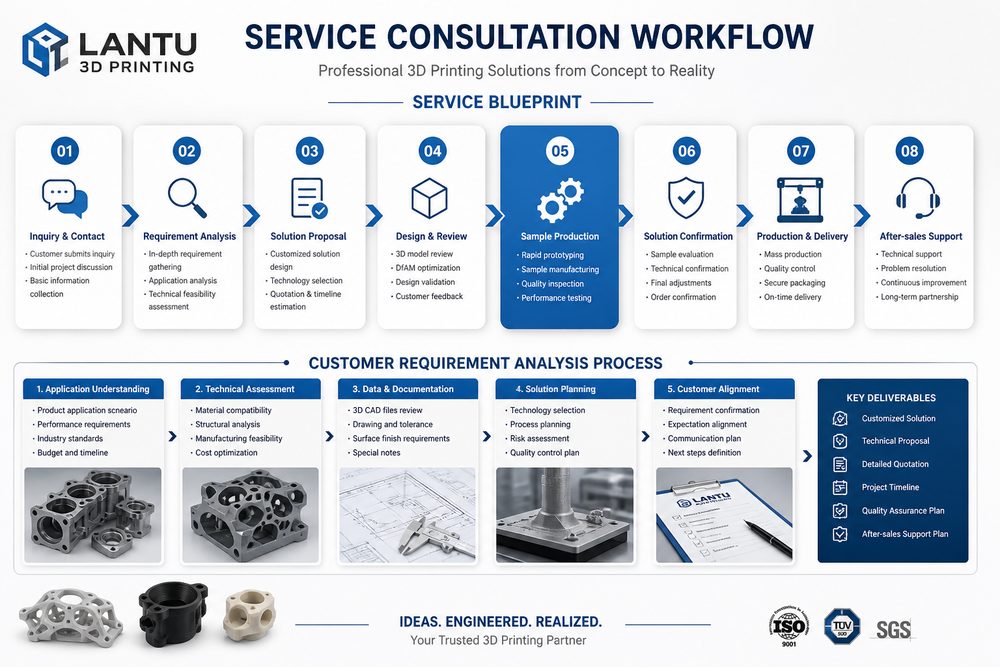
In the field of 3D printing services, customer needs analysis is the cornerstone of project success. Accurately understanding the customer’s true needs not only avoids rework and wasted costs later on, but also improves customer satisfaction and loyalty. The root cause of many service failures often lies in misinterpreting requirements—behind seemingly clear statements of need may lie deeper expectations about functionality, budget constraints, or time requirements. A systematic methodology for needs analysis can help service teams extract core requirements from disorganized information, build a clear needs profile, and provide a reliable basis for subsequent solution design.
1. Needs Research and Information Gathering
Effective needs research should be conducted from multiple dimensions and through multiple channels. Structured interviews are the most direct method, guiding customers to express their core needs through a preset list of questions. Interview questions should cover key dimensions such as application scenarios (part usage, operating environment), technical requirements (accuracy, strength, heat resistance), quantity scale (single prototype or mass production), timelines (delivery cycle, urgency), and budget range. In addition to direct questioning, observational research is equally important—examining the original drawings, samples, or reference items provided by the customer can reveal technical details that the customer may have overlooked.
Information gathering must also focus on uncovering implicit needs. Many customers have limited understanding of 3D printing technology and may only express surface-level requirements while overlooking deeper constraints. For example, when a customer says, “I need a high-strength material,” the underlying need may be for a load-bearing structure; when they say, “The surface should be smooth,” it may indicate a cosmetic part or one that requires post-print painting. By asking “Why is this feature needed?”, you can reveal the real application scenario and avoid solutions that deviate from actual use.
Needs information should be organized into three categories: functional needs (technical specifications that must be met), constraint needs (time, cost, and process limitations), and desired needs (nice-to-have features, but not essential). This classification helps with later prioritization and trade-off decisions.
2. Needs Analysis and Priority Ranking
Raw needs information often contains contradictions or conflicts that need to be sorted out through analytical tools. The Kano model is a practical framework for priority analysis, dividing needs into basic needs (must be satisfied, or the customer will be completely dissatisfied), performance needs (satisfaction increases in proportion to fulfillment), and excitement needs (delighting the customer by exceeding expectations). In 3D printing scenarios, dimensional accuracy and material performance usually fall under basic needs, surface quality and delivery time under performance needs, while design optimization suggestions or innovative process solutions may become excitement needs.
The weighted scoring matrix is another commonly used tool. List all needs as rows and set evaluation dimensions such as importance, urgency, and implementation difficulty as columns, then invite the customer to participate in scoring. Through quantitative calculation, a comprehensive priority score is obtained for each need, clarifying which requirements are core and which can be negotiated. This method is especially suitable for complex projects, as it can transform subjective impressions into objective indicators.
Requirement conflicts are a common challenge. For example, a customer may simultaneously demand high strength, lightweight, and low cost, which often conflicts in material selection. At this point, it is necessary to guide the customer in making trade-off decisions: which indicator is most critical, and which ones can be relaxed. The MoSCoW rule (Must have/Should have/Could have/Won't have) provides a clear decision-making framework, helping the customer define priority and enabling the service team to focus on core goals.
3. Solution Design and Validation
Based on the results of needs analysis, solution design should follow the principles of feasibility, reliability, and cost-effectiveness. First, screen technical solutions: based on the part’s geometric features, accuracy requirements, and material performance needs, initially determine the suitable process route (SLA, SLS, SLM, etc.) and material type. Each process has its own applicable scenarios—SLA is suitable for high-precision complex curved surfaces, SLS for functional nylon parts, and SLM for metal structural parts. Solution selection should comprehensively consider technical fit and cost-effectiveness.
Validation of the design solution is a critical step. For important projects, prototype validation is recommended—print test pieces in small batches to verify whether key performance indicators meet the requirements. Trial validation can identify design flaws or process risks early and avoid problems in mass production. Validation includes dimensional accuracy measurement, surface quality evaluation, mechanical performance testing (if needed), and assembly fit checks.
Cost-benefit analysis is an important part of solution validation. Provide customers with multiple solution options (such as different materials, different processes, and different post-processing methods), and clearly explain the cost differences, performance differences, and risk differences among them. Transparent presentation of information not only helps customers make informed decisions, but also demonstrates a professional level of service.
4. Customer Communication and Needs Management
Continuous customer communication runs throughout the entire needs analysis process. The needs confirmation document is the core communication medium and should turn the understood key requirements, technical parameters, delivery standards, timelines, and other information into a written record for the customer’s signature and confirmation. This not only avoids ambiguity in verbal communication, but also provides a baseline reference for possible future requirement changes.
Requirement changes are common and require a standardized change management process. When a customer raises new requirements or modifies existing ones, first assess the impact of the change on cost, schedule, and the solution, then explain the consequences to the customer (such as increased cost or extended lead time), and proceed with adjustments only after obtaining confirmation. Avoid accepting all changes unconditionally, as this will put the project out of control.
Communication skills are equally important. Avoid using too much technical jargon; explain technical issues in language the customer can understand. For unreasonable customer expectations, do not reject them directly; instead, explain the constraints and alternative solutions, and guide the customer to adjust expectations. For example, if a customer requests extremely high precision but has a limited budget, you can explain “the level of accuracy achievable under the current budget, and the additional cost required to improve accuracy,” allowing the customer to
Submit a model, drawing, image or written notes. Engineers will review material, process, finishing and delivery based on actual use.