Introduction
Against the backdrop of increasingly fierce competition in the 3D printing industry, customer relationship management has become a core capability for sustainable business development. Unlike traditional manufacturing, 3D printing companies serve highly diverse customer groups, ranging from individual makers to large enterprises, and from prototype design to mass production, with vastly different customer needs. How to establish a scientific customer segmentation system and implement differentiated service strategies has become a key issue for 3D printing companies to improve their competitiveness.
Building a Customer Segmentation System
Multidimensional Segmentation Model
Scientific customer segmentation is the foundation of precise service. 3D printing companies should establish a multidimensional customer segmentation system:
By application field: Industrial manufacturing customers account for about 35%, covering high-value-added sectors such as aerospace, automotive, and medical; consumer product design customers account for about 25%, including creative industries such as jewelry, fashion, and home furnishings; education and R&D customers account for about 20%, mainly universities and research institutions; and individual maker and small-batch customization customers account for about 20%.
By business scale: Large enterprise customers (annual order value > 500,000 yuan) contribute about 60% of revenue; medium enterprise customers (annual order value of 100,000–500,000 yuan) account for about 25%; small enterprises and individual customers (annual order value < 100,000 yuan) account for about 15%.
By demand characteristics: Prototype-validation customers pursue rapid response and design iteration capabilities; small-batch production customers focus on cost control and quality stability; customized service customers value personalized solutions and value-added services.
Customer Value Assessment Matrix
Establish an evaluation system that combines the RFM model with industry characteristics: Recency reflects customer activity, Frequency reflects demand continuity, and Monetary indicates value contribution. At the same time, introduce a technical complexity coefficient and a service depth index to build a comprehensive evaluation model.
Differentiated Service Strategies
Tiered Service System
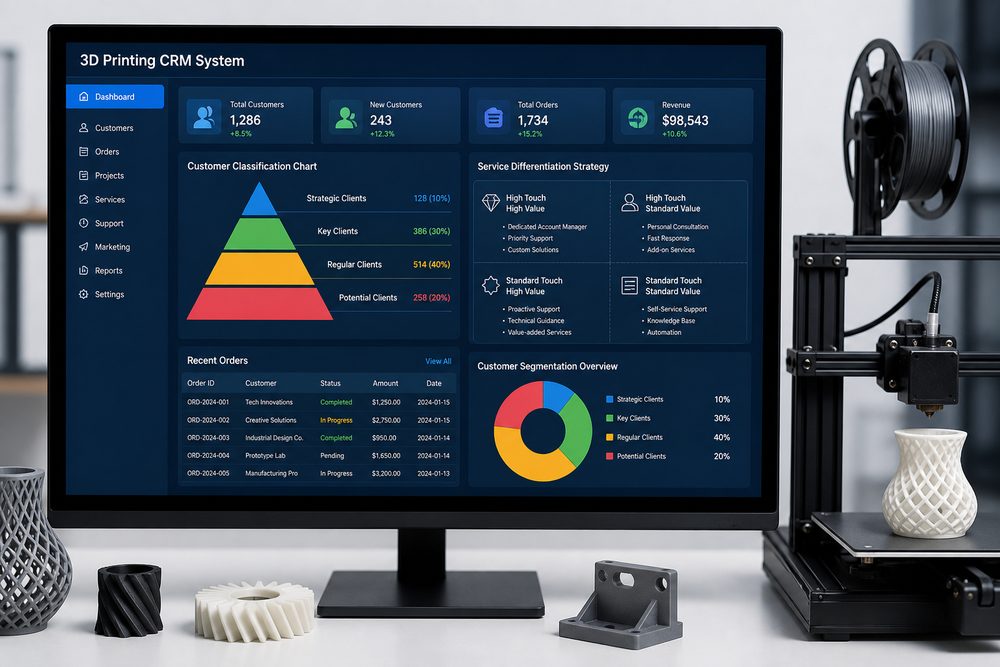
Based on customer segmentation, establish a four-tier service system:
VIP service tier: Dedicated account managers, 24/7 response, priority production scheduling and expedited services, customized technical solutions, and annual technical training and consulting services. Through VIP service, one aerospace customer reduced prototype delivery time from an average of 7 days to 3 days, improving project iteration efficiency by 40%.
Key account service tier: Dedicated customer service coordination, response within 12 hours, regular production progress updates, and monthly technical exchange meetings. With key account service support, one medical device customer shortened its new product development cycle by 30%, and annual order volume increased by 65%.
Standard service tier: Standard customer service channel, response within 24 hours, online technical support, and quarterly product update notifications. Suitable for most medium-sized enterprise customers, balancing service costs and customer experience.
Basic service tier: Self-service platform, response within 48 hours, standardized product catalog, and online knowledge base support. Suitable for individual makers and small-order customers, reducing operating costs through automated services.
Technical Capability Matching
Match service capabilities to customer technical needs: for entry-level customers, provide guidance on material selection and design optimization suggestions; for intermediate customers, provide process route planning and cost analysis services; for advanced customers, provide full technical solutions, including structural optimization, material development, and post-processing process design.
Deep Customer Operations
Full Lifecycle Management
Establish a customer full lifecycle management mechanism:
Introduction stage: Attract potential customers through free sample trials, technical lectures, and case sharing. Through quarterly open-day events, one company achieved a 25% new customer conversion rate and increased first-order closing rates to 40%.
Growth stage: Provide value-added services such as technical training, design support, and quality diagnostics to deepen customer dependence. Data shows that customers who receive systematic training have an average 35% increase in repeat purchase rates the following year.
Maturity stage: Establish strategic partnerships and provide services such as priority capacity assurance, joint R&D, and supply chain integration. The average annual contribution profit margin of mature customers reaches 28%, significantly higher than the 12% of new customers.
Decline stage: Analyze the reasons for churn and win back customers through pricing strategies, service upgrades, or product innovation. Through a customer win-back program, one company successfully recovered 45% of lost customers.
Data-Driven Operations
Establish a customer data platform that integrates order data, service records, communication history, and other information. Use data analysis to identify customer demand trends, predict service needs, and optimize resource allocation. One company found through data analysis that Friday afternoons were peak order periods; by adjusting production scheduling accordingly, capacity utilization increased by 15%.
Relationship Maintenance Mechanism
Regular Communication
Establish a multi-level communication mechanism: daily communication maintains high-frequency interaction through WeChat, email, and phone; regular visits arrange quarterly or monthly customer follow-ups to understand changing needs; annual meetings host customer appreciation events, technical seminars, and other large-scale activities.
Value Co-Creation
Promote the shift from service provider to value co-creator: jointly develop new materials and new processes; share the market
Submit a model, drawing, image or written notes. Engineers will review material, process, finishing and delivery based on actual use.