Introduction: The Rights Gap Beyond a Purchase Order
A consumer electronics company provides an industrial design draft to a 3D printing service provider for prototyping. After the sample passes acceptance, the provider adds the model to its public case-study portfolio for promotion. The client believes it owns the design rights, while the provider argues, "We carried out process adaptation and structural modifications, so we should be entitled to showcase it." The dispute never reached litigation, but the parties ended their cooperation. Similar situations are common in the industry: order contracts clearly state prices, delivery schedules, and acceptance criteria, yet rarely specify who owns the model files, modified versions, process parameters, and delivered products, or who may use them and within what scope. Patents and trade secrets are often key focuses of corporate intellectual property management, but the issues that most frequently lead to disputes are the boundaries of copyright ownership, open-source license compliance, and secondary development.
I. Four Types of Protectable Subject Matter in the 3D Printing Chain
When a 3D printing project is broken down, there are generally four categories of subject matter for which rights may be claimed. The first is 3D model files and design drawings, which are usually protected by copyright and automatically receive protection upon creation; registration facilitates evidence but is not a prerequisite for rights. The second is process parameters and material formulations, such as laser power, scanning strategies, layer thickness, post-processing temperature curves, and powder blending ratios. These are more akin to trade secrets, for which the key to protection is the demonstrability of confidentiality measures rather than public registration. The third is equipment improvements, fixture structures, and original process devices, which may fall within the scope of patent protection. The fourth is the delivered physical part itself, whose legal status depends on the legitimacy of the upstream model and whether it possesses originality. The protection logic for these four categories is entirely different, and attempting to cover all of them with a single "non-disclosure agreement" is one of the most common management mistakes.
II. Copyright: Determining Ownership from Model Files to Modified Versions
The primary rule for copyright ownership is that "for commissioned works, the agreement governs; absent an agreement, rights belong to the commissioned party." This means that when a client commissions a service provider to modify, repair, or structurally optimize a design, the copyright in the resulting new version may belong to the party that actually completed the modifications if the contract does not clearly provide otherwise. In practice, three levels should be distinguished: where the original design draft is provided by the client, copyright always belongs to the client; repairs, hollowing, support additions, wall-thickness adjustments, and other changes made by the service provider for printability are modifications to the original work, and the contract should specify that "copyright in the modified portions shall belong to the client together with the original work, while the service provider retains the right to store technical methods for internal process reuse"; where the service provider independently completes a structural redesign, the parties may agree on joint ownership or a license to use. Clearly defining ownership of "modified versions" can prevent most subsequent disputes.
III. Open-Source Licenses: An Underestimated Compliance Risk
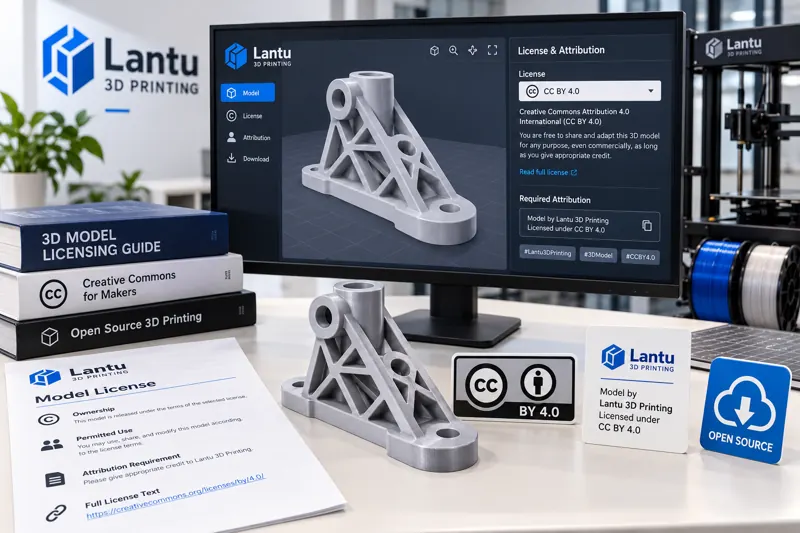
More and more companies obtain design files from open-source model communities and then submit them to service providers for printing. The issue is that open source does not mean unrestricted use. Under common Creative Commons licenses, Attribution (BY) requires retention of the original author's information; NonCommercial (NC) prohibits commercial use; ShareAlike (SA) requires derivative works to use the same license; and NoDerivatives (ND) directly conflicts with modifications made for printability. This means that for a model marked ND, a client has no right to require the service provider to alter wall thickness or split the structure. A responsible service process should verify three matters before accepting an order: the model source and license type, whether the license permits commercial purposes, and whether it permits modification and distribution of finished products. The verification results should be recorded in the project file rather than left in an engineer's browser history.
IV. The Boundary Between Secondary Development and Derivative Design
Disputes over secondary development usually center on the question of "how much modification makes it a new work." From an engineering perspective, an operational standard can be applied: changes that only affect manufacturing-related parameters, such as supports, orientation, shrinkage compensation, and wall-thickness equalization, without changing the design intent or visual characteristics, do not constitute a new work, and rights remain with the original design; changes to structural topology, functional layout, or visually identifying features constitute derivative works, whose ownership should be handled according to the contract. Service providers should produce two lists upon delivery for every project: one for process-adaptation changes and another for design-related changes. The former follows the original copyright, while the latter should be separately assigned rights. This practice protects both the client and the service provider by providing a clear basis for showcasing project cases.
V. Trademarks and Industrial Designs: Additional Risks in Printed Objects
Beyond the model file itself, printed content may also implicate trademarks and industrial design rights. Parts bearing another party's registered trademark, product housings that imitate protected designs, and unauthorized character designs may expose the service provider to risks of joint infringement even if the client supplied the model file. A practical approach is to establish a pre-order use inquiry process: require clients to confirm that the model does not infringe third-party rights, explain whether the intended end use is internal validation or external sales, and provide authorization evidence where markings are involved. For orders that clearly involve third-party brand identifiers or protected designs, require written authorization from the client or decline the order, while retaining records in the system.
VI. An Actionable Management Checklist
Companies should bring intellectual property provisions down from legal documents into operational processes. First, include three standard provisions in contract templates: ownership of model files and modified versions, the scope of authorization and withdrawal mechanism for a service provider's promotional use of client designs, and allocation of compliance responsibilities for open-source models. Second, maintain four fixed records in project files: the model source and license type, a modification list, a deliverables list and destruction/retention agreement, and promotional authorization status. Third, implement two technical measures for file circulation: encrypted model transmission with access tracking, and archival or destruction of files after project completion as agreed, with the ability to provide certification. Fourth, establish one non-negotiable rule in internal training: every publicly displayed case must be traceable to a clear authorization record; without a record, it must not be displayed.
Conclusion
The focus of intellectual property management in 3D printing is not the number of patent applications, but clearly defining the rights boundaries for model files, modified versions, process parameters, and deliverables in every project. Copyright ownership relies on contractual agreements, open-source licenses require verification before order acceptance, secondary development is classified through modification lists, and trademark and industrial design issues require documented use inquiries. By making these four practices standard procedures, companies can protect their design assets while providing verifiable compliance evidence in collaborations and avoiding disputes in which each party tells a different story.
Submit a model, drawing, image or written notes. Engineers will review material, process, finishing and delivery based on actual use.