Introduction: Winning Approval for a Quote Does Not Mean a Project Will Close Safely
In additive manufacturing business scenarios, many teams focus their efforts on quotation calculations and technical feasibility reviews, while investing too little in two areas that have a greater impact on cash flow and delivery quality: first, how to turn a technical proposal into a response document that evaluation experts can understand and score highly; second, how to divide the delivery process into verifiable payment milestones to prevent advance funding, rework, and payment delays from occurring simultaneously. lantu3D, a management and implementation platform covering the full lifecycle from blueprint design to physical delivery, has repeatedly observed the same phenomenon in project practice: reasonable prices but low evaluation scores, and qualified deliveries but blocked payment collection. The common root cause of both issues is the failure to break down commercial terms through an engineering-based approach.
I. Evaluation Logic: Analyze the Scoring Schedule Before Writing the Technical Proposal
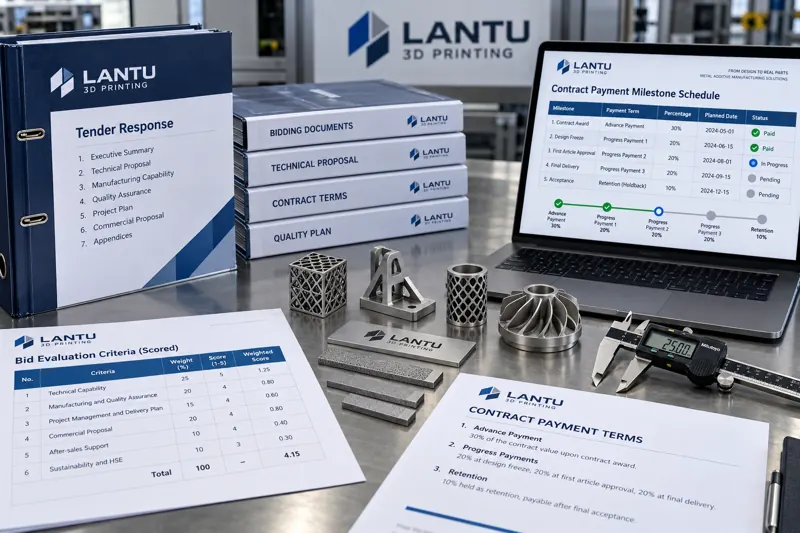
Bidding is not about reformatting a company profile and technical specifications; it is about responding to each scoring criterion individually. In a typical additive manufacturing procurement document, scoring weights are generally distributed across five dimensions: technical proposal, delivery assurance, quality system, project references, and price. Price often accounts for only 30% to 40% of the total score. If a team spends all of its time reducing prices while overlooking scoring opportunities in the technical proposal and delivery assurance sections, it may still lose the bid even with the lowest quotation.
The proper approach is to establish a scoring-criteria response matrix: number every scoring item in the tender document and identify the corresponding response section, supporting evidence, and expected score. For example, where material batch consistency must be explained, the response should specify the relationship among powder batch numbers, oxygen-content testing frequency, and witness coupons produced in the same build; where process traceability is required, the response should describe a one-part, one-file structure covering build records, heat-treatment curves, and inspection reports. Only evidence that can be verified constitutes an effective response.
II. Handling Technical Deviations: Acceptable Deviations Must Be Stated as Contractual Terms
Responses to additive manufacturing projects are rarely free of deviations. Material grade substitutions, surface roughness requirements, inspection sampling ratios, and delivery batch definitions may all differ from tender requirements. A common mistake is to conceal deviations vaguely in the main proposal text. During bid evaluation, they may be treated as non-responses; during contract performance, they may become acceptance disputes.
An engineering-based approach is to use a deviation schedule: list the tender clause, bid response, nature of deviation (positive/negative), and mitigation measures for each item. For roughness requirements that cannot genuinely be met, clearly state the achievable value through the original process and the value achievable after post-processing, along with the secondary finishing process and its impact on lead time. Clearly disclosing deviations is usually more likely to gain acceptance than claiming full compliance, while also preventing a later determination of misrepresentation.
III. Performance Milestones: Divide Delivery into Verifiable Payment Milestones
The contract payment structure determines the position of both parties when risks arise. For additive manufacturing orders with long lead times and large volumes, a phased structure comprising advance payment, progress payment, acceptance payment, and retention should be used. Each phase should be tied to a verifiable deliverable: the advance payment corresponds to contract effectiveness and confirmation of drawing freeze; the progress payment corresponds to a first-article inspection report or batch build record; the acceptance payment corresponds to full-dimensional inspection reports, material certificates, and a delivery list of conforming parts; and the retention corresponds to the expiration of the agreed warranty period without material quality objections.
The key to milestone design is not the percentage assigned, but whether each milestone has an objective document that can confirm completion. Descriptions that cannot be verified, such as “goods have been shipped,” can leave progress payments outstanding for extended periods.
IV. Changes and Additional Work: Set the Price Before Execution
Even after drawings are frozen, additive manufacturing projects may require model revisions due to assembly interference or performance validation. Every change can affect build time, support strategies, post-processing operations, and inspection requirements, thereby affecting costs and lead times. Without change management, this additional work is often absorbed into the original contract, ultimately eroding gross margin.
It is advisable to establish a change-order mechanism in the contract, defining the party initiating the change, impact assessment items (cost increases or reductions, schedule extensions, and disposition of completed parts), conditions for effectiveness, and confirmation deadlines. A monetary or labor-hour threshold may be set: changes below the threshold can be approved by the project manager, while changes above it require written confirmation from both parties. Pricing before execution is a basic rule for protecting both delivery schedules and commercial relationships.
V. Quantified Monitoring of Payment Collection and Risk Control
Commercial management requires visibility. An order-level ledger should be established to record contract value, invoiced amount, payments received, payment terms in days, overdue days, and work-in-progress value. This enables the calculation of two key indicators: days sales outstanding and the scale of work-in-progress funding. The former reflects the customer’s payment discipline, while the latter reflects the company’s capital tied up in production.
Overdue receivables should be handled in tiers based on the number of overdue days: for short-term overdue amounts, commercial personnel should follow up to confirm document status; for medium-term cases, the project manager should verify whether delivery and acceptance documents are complete; for long-term cases, written collection notices and the contractually agreed dispute-resolution process should be initiated. Most overdue payments are not caused by a customer’s refusal to pay, but by workflow interruptions resulting from missing invoice information, acceptance signatures, or inspection reports. Completing the documentation is often more effective than repeated reminders.
VI. Implementation Checklist: Six Actions from Bid Response to Payment Collection
First, establish a scoring-criteria response matrix and provide numbered responses item by item. Second, use a deviation schedule to disclose deviations and provide mitigation measures. Third, tie payment milestones to verifiable documents. Fourth, define the assessment scope and effectiveness thresholds for change orders. Fifth, establish an order-level ledger and calculate collection days and advance-funding exposure. Sixth, handle cases by overdue-day tiers and prioritize completing missing documentation. These six actions do not require a complex system; they can be launched with a single spreadsheet and a single template.
Conclusion
Competition in additive manufacturing projects is shifting from price and equipment capability alone toward certainty in commercial delivery. Breaking scoring criteria into verifiable evidence, dividing contract performance into verifiable milestones, and incorporating changes and payment collection into quantified ledgers can significantly improve project controllability. lantu3D follows this methodology in project delivery: technical capability determines whether a part can be made, while commercial engineering determines whether the business can be sustained reliably.
Submit a model, drawing, image or written notes. Engineers will review material, process, finishing and delivery based on actual use.