
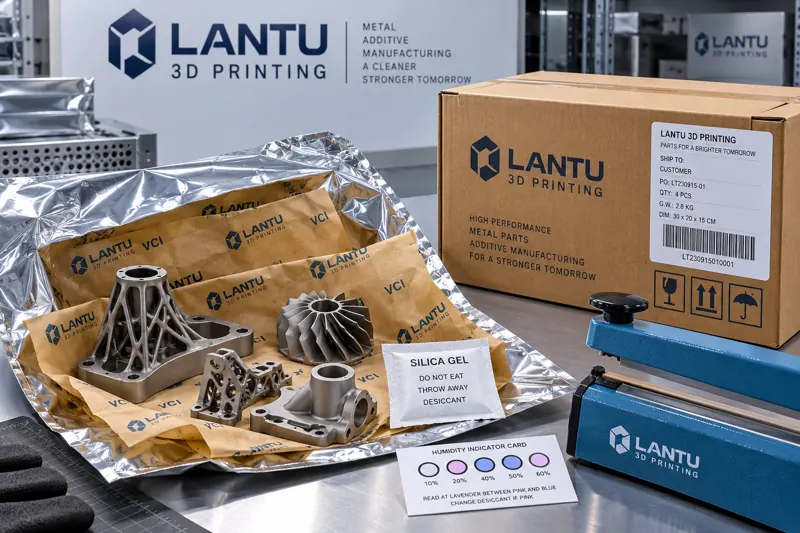
Introduction: A Qualified Part Does Not Automatically Mean a Qualified Delivery
In the delivery chain for metal additive manufacturing, the most underestimated failures occur after printing is completed but before the customer signs for receipt. A 316L stainless steel part that has undergone hot isostatic pressing, passed full dimensional inspection on a coordinate measuring machine, and achieved a surface roughness of Ra 3.2 μm may develop speckled yellow-brown rust stains after seven days of sea freight in an ordinary carton. The customer's first reaction will not be “a transportation issue,” but “your quality is unacceptable.” The costs of rework, claims, and lost trust often exceed the total printing and post-processing cost of the product.
Industry attention to packaging generally remains at the experiential level of “adding EPE foam and bubble wrap,” without a calculable, verifiable engineering methodology. Delivery integrity is actually determined by three quantifiable variables: corrosion reaction rate, water vapor transmission rate, and the accuracy of correspondence between packaging identification and the physical product. This article examines these three variables separately and provides practical design rules.
I. Corrosion Mechanisms and the Rust-Prevention Protection Window for Metal Parts
Metal additive manufacturing parts are more corrosion-sensitive than wrought parts of the same grade for three reasons. First, LPBF surfaces contain partially melted particles and balling protrusions that create numerous microscopic crevices. The oxygen concentration inside these crevices is lower than outside, forming typical crevice-corrosion cells. Tests on 316L specimens from the same batch show that the as-printed surface has a free corrosion potential 60–90 mV lower than that of a polished surface. Second, unmelted powder and oxide inclusions remaining in the as-printed surface layer provide additional cathodic phases for electrochemical corrosion. Third, if neutralization and passivation after post-processing pickling or electropolishing are inadequate, residual chloride ions can directly induce pitting corrosion when humidity exceeds 55% RH.
Rust-prevention design must therefore define a protection window. Domestic overland transport of less than 15 days, sea freight of 15–45 days, and overseas storage exceeding 45 days require entirely different protection levels. For 45-day sea freight, for example, the day-night temperature difference inside a container can reach 30 °C. High daytime temperatures saturate the internal air with water vapor, while nighttime cooling causes condensation on metal surfaces—commonly known as “container rain.” During a single voyage, 20–50 g/m² of condensate may form on part surfaces, sufficient to produce white rust on unprotected aluminum alloy parts within 72 hours.
II. Quantitative Selection of Volatile Corrosion Inhibitors (VCI) and Desiccants
Vapor-phase corrosion protection works by allowing inhibitors to volatilize in an enclosed space and adsorb onto metal surfaces, forming a monomolecular protective layer. Common VCI paper should have an inhibitor basis weight of no less than 6 g/m², while VCI film should contain no less than 8 g/m² of inhibitor. Three conditions must be met: the distance between the part and VCI material must not exceed 300 mm; the packaging system must be sealed, with a water vapor transmission rate below 1 g/(m²·24h); and the part surface must be clean and dry before packaging, with moisture and residual salt levels meeting requirements.
Desiccant quantity must not be determined by simply adding a handful based on experience. Engineering calculations should be based on packaging volume and target humidity. For montmorillonite or silica-gel desiccants, under conditions of 40% RH target humidity, a packaging volume of 0.05 m³, an aluminum-foil barrier bag with a water vapor transmission rate of 0.6 g/(m²·24h), and 45 days of storage, approximately 12–16 desiccant units are required. One unit is defined as the capacity to adsorb at least 6 g of water vapor at 25 °C and 40% RH. Hygroscopic materials inside the package, such as paper inserts and wood shavings, must also be included as moisture sources; otherwise, the actual dosage may be underestimated by more than 30%.
For aluminum and copper alloys, neutral or mildly alkaline VCI products should be preferred. Nitrite-containing formulations should be avoided, as they may accelerate corrosion of copper and copper alloys. Titanium alloys and cobalt-chromium-molybdenum alloys are inherently corrosion-resistant; for these materials, the principal role of VCI is to prevent galvanic corrosion caused by contact with dissimilar metals. Isolation, rather than corrosion inhibition, should therefore receive greater attention.
III. Barrier-Layer Construction and Sealing Processes
A standard multilayer barrier structure, from inside to outside, consists of a VCI paper liner, the part, desiccant sachets, an aluminum-foil composite barrier bag—typically PET 12 μm / Al 7 μm / PE 60 μm—and an outer carton. The aluminum foil layer blocks water vapor and oxygen. A 7 μm aluminum foil layer can achieve a water vapor transmission rate as low as approximately 0.01 g/(m²·24h), far superior to the 5–20 g/(m²·24h) of a single-layer PE film. All contact surfaces between dissimilar metals must be separated with VCI paper or nonwoven fabric to prevent galvanic couples.
Sealing is the most common point of failure. Heat-sealing temperature should be controlled at 160–180 °C, pressure at 0.2–0.3 MPa, and dwell time at 1.5–2.5 s, with a seal width of no less than 10 mm. After sealing, visual inspection is required to confirm continuity and the absence of wrinkles or scorching. For batch deliveries, conduct sampling-based seal peel-strength tests by lot; peel force should be no less than 15 N/15 mm. Vacuum packaging is not always necessary. For parts with thin walls or lattice structures, negative pressure may cause deformation. In such cases, use a “evacuate—backfill with dry nitrogen—seal” process to reduce oxygen content while avoiding pressure differentials.
IV. Consistency Between Packing Lists, Shipping Marks, and Physical Goods
The other half of packaging engineering is information engineering. The most common delivery incident on site is not part damage but “the goods arrived, but they do not match.” A practical minimum identification system includes three layers: inner-package labels, outer-carton shipping marks, and a packing list accompanying the shipment.
Inner-package labels should include, at minimum, the part number, batch number, material, quantity, and order number. Barcodes or QR codes are recommended to enable customers to scan items directly into inventory upon receipt. Outer-carton shipping marks should include the consignee abbreviation, port of destination or destination, carton number—for example, C/NO. 1-3—gross and net weight, outer carton dimensions, and required handling symbols such as this side up, keep dry, and fragile. The packing list must correspond item by item with the actual contents of the carton, including line number, description, quantity, and batch number for every item, and must be signed by both the packer and verifier at the end.
For export shipments, phytosanitary requirements for wooden packaging must also be considered. Solid wood packaging materials generally require heat treatment or fumigation in accordance with ISPM 15, with an IPPC mark applied. Fumigation-free plywood and OSB can be used as alternatives. When wooden crates are used, stacking strength must be calculated so that deformation of the bottom crate under load does not affect the parts inside.
V. Verification and Release Checklist
A packaging solution is not complete once it has been designed; it must be validated. Three types of validation are recommended. First, accelerated damp-heat testing: place packaged samples in an environment of 40 °C and 93% RH for 96 hours. After unpacking, metal surfaces should show no visible corrosion or water stains. Second, drop and vibration testing: perform testing in accordance with ISTA 2A or customer-specified standards, then re-inspect part dimensions and appearance for compliance. Third, unpacking verification: for batch deliveries, retain unpacking photos and humidity indicator card readings from the first and last cartons as evidence defining responsibility boundaries.
Before release, confirm each item: part surfaces are clean and dry and have been passivated; VCI materials are within their validity period and have not exceeded storage limits; the desiccant type and quantity meet calculated requirements; barrier-bag seal peel strength is acceptable; the three sets of information on labels and the packing list are consistent; and the initial humidity indicator card reading is blue, indicating a dry condition. If any of these six requirements is not met, the shipment should be considered not released.
Conclusion
Packaging is not an ancillary delivery activity; it is the final link in the quality system. When corrosion mechanisms, water vapor transmission rates, and identification consistency are converted into calculable engineering parameters, delivery integrity becomes a capability rather than a matter of luck. For additive manufacturing companies, a reusable packaging engineering specification can be as valuable as a new machine: it directly determines whether customers see a qualified product when they open the box, or a problem requiring explanation.
Submit a model, drawing, image or written notes. Engineers will review material, process, finishing and delivery based on actual use.