
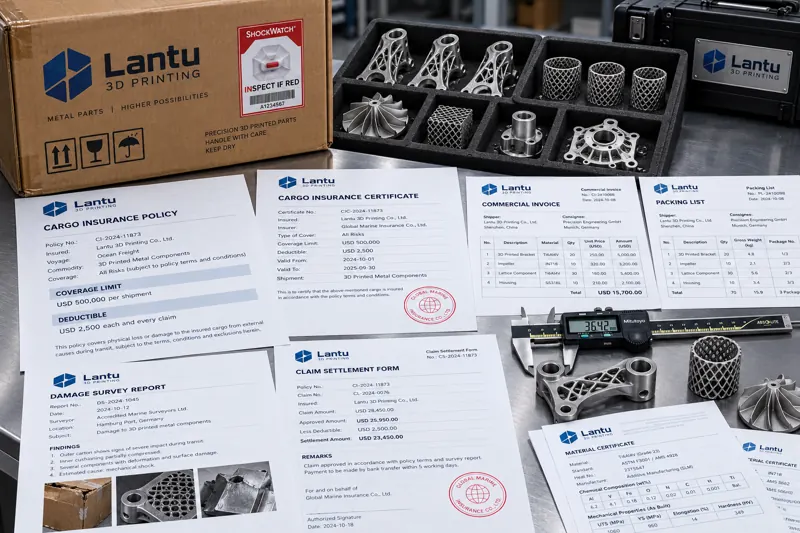
Introduction: A Transportation Incident Involving a Precision Part Is Not a Matter of Luck
A batch of titanium alloy aerospace brackets worth hundreds of thousands of yuan completed printing, heat treatment, and inspection before being shipped by road to the customer site. During transit, the carrier vehicle was involved in a rear-end collision and the wooden shipping crate tipped over. The exterior of the crate showed only localized damage, but upon opening, thin-wall ribs on three brackets were found to have plastically deformed, resulting in dimensional nonconformance and scrapping. Because the shipment had been insured only as ordinary cargo, the combined policy deductible and compensation limit left the actual payout far below the cost of remanufacturing and contractual losses from delayed delivery. Meanwhile, the liable party and insurer disputed whether the packaging was adequate and whether the deformation was a pre-existing defect, extending the claims process for several months.
Such incidents are not uncommon in deliveries of precision additive manufacturing parts. The issue is often not whether insurance was purchased, but whether the coverage reflects the actual risks, the declared policy details match the shipped goods, and the claims evidence can support a determination of liability. Without any one of these elements, insurance remains merely a paper document.
I. First Distinguish the Types of Insurance: Cargo Insurance and Liability Insurance Are Not the Same
Transportation of precision parts involves two basic types of insurance, and confusing them is the primary cause of inadequate coverage.
Cargo transit insurance insures the goods themselves and covers physical loss caused by natural disasters or accidental events during transportation. Common policy structures are divided into three levels: Free of Particular Average (FPA) covers only total loss and general average; With Particular Average (WPA) adds partial loss coverage; and All Risks provides the broadest protection, covering collision, breakage, moisture damage, theft, and other losses caused by external events. However, it generally does not cover war, strikes, nuclear risks, inherent defects, or natural wear and tear of the goods. For high-value precision parts, All Risks coverage is generally necessary.
Carrier liability insurance, by contrast, covers the carrier's legal liability to the cargo owner. Payment requires that the carrier be legally liable, and is subject to liability limits in the waybill terms. Compensation calculated by weight is often far below the actual value of high-value, low-weight goods. Relying on carrier liability insurance to protect cargo is one of the most common misconceptions in precision-part delivery.
A sound engineering approach is to use All Risks cargo insurance as the primary protection, supplemented by carrier liability insurance: the former provides direct compensation without depending on a prior liability determination, while the latter can shorten the recovery chain where liability is clear.
II. Engineering-Based Completion of Policy Details: Insured Value, Deductibles, and Packaging Declarations
How several fields on an insurance application are completed directly determines the claims outcome.
The insured amount is typically based on the cargo value plus a certain percentage, commonly 110% of the invoice value. This additional percentage is intended to cover freight, insurance premiums, and reasonable anticipated profit. For additive manufacturing parts, the declared value should include material costs, printing and post-processing labor, heat-treatment costs, and inspection expenses, rather than being calculated solely from raw-material weight. Declaring the value of metal parts by weight will almost inevitably result in serious underinsurance, with losses proportionately reduced at settlement.
Deductibles and deductible percentages should be balanced against part value. A high deductible can reduce premiums, but for high-unit-value, low-volume precision parts, a single incident may exceed the deductible threshold; in such cases, a lower deductible may be more economical. Before purchasing coverage, it is advisable to conduct a simple expected-value calculation using historical cargo-damage rates and replacement costs per part rather than accepting the standard deductible by default.
Packaging and loading declarations are critical but easily overlooked. Policies often implicitly require goods to be packaged in a manner suitable for transportation; if packaging is deemed inadequate, the insurer may use this as a defense. Before shipment, retain records of cushioning design rationale, moisture-barrier and sealing procedures, as well as photographs of shipping marks and packing lists. These records serve both as evidence of packaging compliance and as a basis for subsequent liability determinations.
In addition, precision parts often require special endorsements: whether concealed damage caused by vibration and shock is covered, whether loading and unloading are included, and whether coverage extends to temporary storage periods. These items must be expressly stated in an endorsement when coverage is purchased and cannot rely on default interpretations of the policy wording.
III. The Claims Chain: From Incident Reporting and Inspection to Evidence Organization
Whether a claim can be established depends on whether the evidence chain is complete. A comprehensive process should include the following steps.
Promptly report the incident and preserve the scene. Upon discovering cargo damage, notify the insurer immediately within the time limit specified in the policy and simultaneously request a freight incident report from the carrier. Before opening the package, photograph all six sides of the external packaging, the condition of seals, and the status of shock and tilt indicators. The unpacking process should be continuously documented to avoid an evidentiary gap caused by opening the package before photographing it.
Arrange an inspection and determine liability. The insurer will typically appoint an independent surveyor. At this stage, the shipper should provide the packing list, shipment records, packaging design, product conformity documentation, and inspection reports. Disputes usually focus on the cause of damage: whether it resulted from transportation shock, inadequate packaging, inherent defects, or improper handling. Decisive evidence includes the activation status of shock indicators, the crushing pattern of cushioning structures, the correlation between deformation direction and load direction, and comparison with undamaged parts from the same batch.
Quantify the loss. Losses involving precision parts should not be limited to the remanufacturing cost of scrapped parts. They should also include repair-feasibility assessments, reinspection costs, contractual penalties resulting from delayed delivery, and expediting costs. These items must be listed separately in the claim submission with supporting calculation bases; broadly stated quotations are highly susceptible to reduction.
IV. Subrogation and Allocation of Liability: Payment Does Not Mean the Matter Is Over
After making payment, the insurer obtains the right of subrogation, meaning it may seek recovery from the third party responsible for the loss in the name of the insured. This means that, even after receiving compensation, the insured remains obligated to cooperate: it must not voluntarily waive its right to claim against the carrier or reach a liability-release settlement with the responsible party without notifying the insurer. Such actions may impair subrogation rights and affect subsequent payment.
In practice, liability allocation often involves multiple parties: the carrier is responsible for the transportation process, the packaging provider is responsible for packaging suitability, the insurer is responsible for covered risks, and the cargo owner may share responsibility for inaccurate declarations or improper packaging instructions. Clearly defining the legal relationships among all parties and specifying liability limits and claim deadlines in contracts are prerequisites for shortening the dispute cycle.
V. Move Risk Management Upstream: An Actionable Pre-Shipment Inspection Program
Rather than pursuing compensation after an incident, risk management should begin before shipment. The following routine mechanisms are recommended:
First, establish a cargo-value and coverage matching matrix: classify insurance strategies by part value and fragility, requiring All Risks coverage and a special vibration-damage endorsement for high-value, fragile parts. Second, archive packaging plans: retain batch-by-batch records of cushioning thickness and layout, moisture protection and sealing processes, and wooden-crate treatment markings to create traceable documentation. Third, implement in-transit monitoring: ship shock, tilt, temperature, and humidity data loggers with each crate; the data serves both as a preventive measure and claims evidence. Fourth, standardize unpacking acceptance: define documentation steps during unpacking and the basis for rejection to avoid evidence gaps caused by inconsistent operations. Fifth, conduct an annual claims review: track cargo-damage rates, average compensation rates, and claim-cycle duration, then use the results to adjust deductibles, approved carrier lists, and packaging standards.
Conclusion
Delivery risks for precision additive manufacturing parts cannot be automatically resolved simply by purchasing insurance. An effective approach requires three layers: using appropriate coverage and adequate insured values to cover actual losses, using engineered packaging and in-transit monitoring to reduce the probability of incidents, and using standardized unpacking documentation and liability allocation to shorten claims disputes. When policy details, packaging evidence, and acceptance records form a closed loop, insurance becomes a realizable risk-hedging tool rather than a paper credential, and delivery certainty evolves from a verbal commitment into a verifiable engineering fact.
Submit a model, drawing, image or written notes. Engineers will review material, process, finishing and delivery based on actual use.