Introduction: Delivery Problems Are Often Not Caused by a Single Department
The customer cannot clearly define the requirement, sales rushes to quote, design does not review wall thickness in time, production finds the supports are difficult to remove, and post-processing only then realizes that the appearance surface has been affected by support marks. These kinds of problems are very common in 3D printing services. At their core, they result from a lack of closed-loop information flow across departments. Because the path from model to physical part is short in 3D printing, early communication errors quickly propagate to the shop floor.
1. Clearly Define the Inputs and Outputs of Each Role
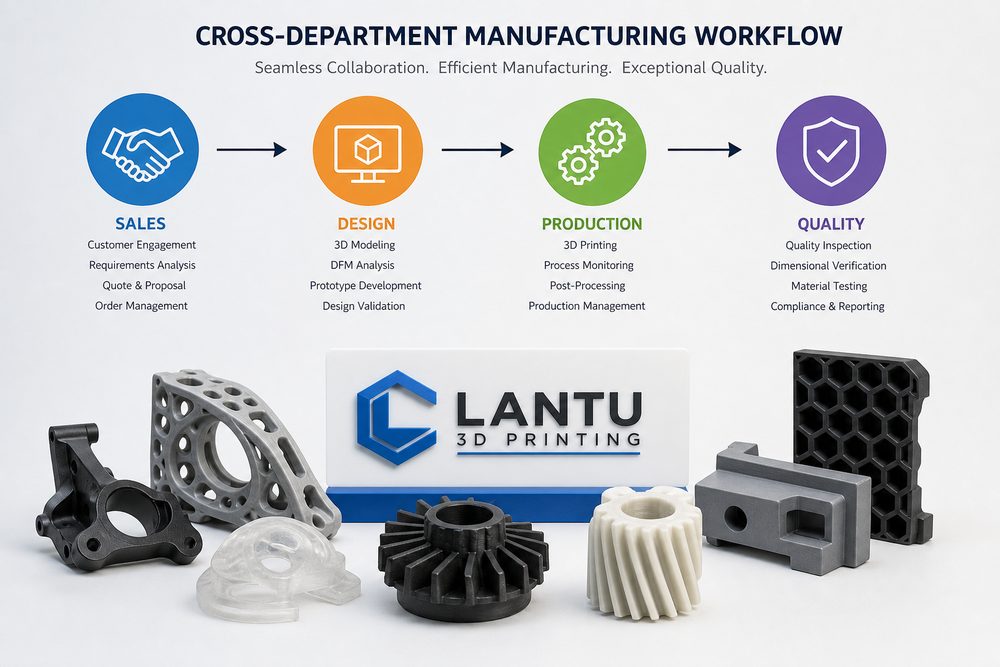
Sales is responsible for identifying the customer's objectives, lead time, budget, and acceptance preferences; design or engineering is responsible for model checking, DFM recommendations, and risk warnings; production is responsible for process feasibility, scheduling, and process records; post-processing is responsible for surface finish and packaging requirements; quality is responsible for inspection standards and exception determination. Each role should have a clearly defined output document to avoid vague handoffs such as "we already said it verbally."
2. DFM Review Is a Key Collaboration Milestone
DFM review should be completed before quoting or order placement, and should at least check wall thickness, hole diameter, assembly clearance, support surfaces, material compatibility, post-processing impact, and transportation risk. The review results should be fed back to both the customer and the internal team. For designs with risks that the customer still insists on, the confirmation should be documented to avoid unclear responsibility later. Blueprint3D emphasizes continuous management from design to manufacturing in its services, and DFM is precisely the connection point.
3. Exception Escalation Must Follow Rules, Not Emotions
When model errors, equipment failures, material abnormalities, or delivery risks arise during production, there must be clear rules for when to escalate, who to escalate to, and what evidence is required. For example, if a delay is expected to exceed 12 hours, the project manager should be notified; if key dimensions fail inspection, quality personnel must make the determination; and any design change must be re-confirmed for quote and lead time. Rule-based escalation can reduce on-site waiting and interdepartmental blame shifting.
4. Retrospectives Keep the Collaboration Mechanism Continuously Improving
After a project is completed, the team should review whether the requirements were clear, whether the review was sufficient, whether scheduling was accurate, and whether customer feedback was timely. The focus of the retrospective is not to assign blame, but to improve the process. For example, frequently missed items can be added to the quotation checklist, common design risks can be added to automatic prompts, and packaging requirements can be confirmed earlier at the order stage.
Conclusion
The core of cross-department collaboration in 3D printing is ensuring that information reaches the right role at the right time. Clear responsibilities, DFM milestones, exception rules, and retrospective mechanisms can significantly improve delivery quality. As a platform that turns blueprints into physical parts, Blueprint3D needs exactly this kind of process-driven organization of multidisciplinary capabilities.
Submit a model, drawing, image or written notes. Engineers will review material, process, finishing and delivery based on actual use.