Introduction: The value of risk management in 3D printing projects
As 3D printing technology extends from prototype manufacturing to mass production, project complexity and delivery risks have increased significantly. According to industry data, about 35% of 3D printing projects face delayed delivery, 20% of projects have quality problems leading to customer complaints, and 15% of project costs exceed budget by more than 20%. These risks not only affect the profitability of service providers, but may also damage customer trust and brand reputation.
Effective risk management can reduce project failure rates by more than 50% and increase customer satisfaction to more than 95%. For professional 3D printing service providers such as lantu3D, establishing a systematic risk management system has become an important part of core competitiveness. This article will build a complete framework for 3D printing project risk management from the four dimensions of risk identification, assessment, response, and monitoring.
1. Risk identification and classification
Risk identification is the first step in risk management, which requires a systematic combing of possible risk factors throughout the life cycle of a 3D printing project. According to project practice, the main risks can be divided into the following five types:
1. Technical risks
Risk of equipment failure: Equipment problems such as printer nozzle clogging, platform offset, temperature control failure, etc. may lead to printing interruptions or quality defects. According to statistics, equipment failure accounts for 45% of technical risks.
Material compatibility risk: Different materials have greatly different requirements for printing parameters. For example, improper temperature, speed, and support settings for PLA, ABS, nylon, TPU and other materials will lead to printing failure. Material issues account for 30% of technical risks.
Model design risks: Design problems such as STL file errors, insufficient wall thickness, unreasonable suspended structure design, and dimensional accuracy deviations account for 25% of technical risks.
2. Supply chain risks
Delay in material supply: The import cycle of special materials, such as ULTEM, PEEK and other high-performance materials, may be as long as 4-8 weeks. Among supply chain risks, material delays account for 60%.
Material quality fluctuation: Differences in material performance between different batches may cause printing parameters to be re-adjusted, affecting delivery progress.
Equipment parts supply: The replacement cycle of printer core parts (nozzles, hot beds, motors) is long, and when equipment fails, the waiting time for repairs may exceed the project construction period.
3. Quality risk
Dimensional accuracy risk: The dimensional deviation of printed parts exceeds the tolerance range and affects assembly or function. Dimensional issues account for 40% of quality risks.
Surface quality risk: Appearance defects such as obvious layering, rough surface, residual support, warping and deformation, account for 35% of the quality risk.
Mechanical performance risks: Insufficient bonding strength between layers and excessive internal voids lead to substandard strength of parts, accounting for 25% of quality risks.
4. Project management risks
Risk of construction delay: Changes in customer requirements, design modifications, printing failure and rework, etc., lead to project delays. Schedule issues account for 50% of project management risks.
Risk of communication failure: deviations in understanding requirements, untimely confirmation of technical parameters, and unclear delivery standards, accounting for 30% of project management risks.
Resource allocation risk: When multiple projects are running in parallel, equipment, personnel, and material resource conflicts account for 20% of project management risks.
5. External environmental risks
Customer demand changes: Customers modify the design or requirements midway, which is the most common external risk, accounting for 70%.
Changes in the market environment: fluctuations in raw material prices, cyclical changes in industry demand, etc.
Policy and regulatory risks: export control of special materials, changes in environmental protection requirements, etc.
Risk identification method: It is recommended to use the combination of checklist method + brainstorming + review of historical projects. Before starting each project, check each project against the risk checklist, organize the project team to brainstorm, and refer to the historical project risk case library to ensure comprehensive risk identification.
2. Risk assessment and quantification
After risk identification, various risks need to be evaluated and quantified, risk priorities determined, and resource allocation and response strategy formulation guided.
1. Risk assessment matrix
Use Probability-Impact Matrix for risk assessment:
| Risk level | Occurrence probability | Impact level | Priority |
|---|---|---|---|
| High | >50% | Project failure/significant loss | Process immediately |
| Medium | 20%-50% | Project delays/cost overruns | Develop response plans |
| Low | 200 needs to be improved immediately
3. Risk response strategiesBased on the risk assessment results, formulate targeted risk response strategies, including four methods: avoidance, transfer, mitigation, and acceptance. 1. Technical risk responseEquipment failure avoidance:
Material Compatibility Mitigation:
Model design risk control:
2. Supply chain risk responseTransfer of material supply risk:
Equipment accessories risk response:
3. Quality risk responseDimensional accuracy control:
Surface quality improvement:
Mechanical performance guarantee:
4. Project management risk responseAvoiding construction delays:
Communicate Risk Mitigation:
Resource allocation optimization:
5. Risk response to customer demand changes
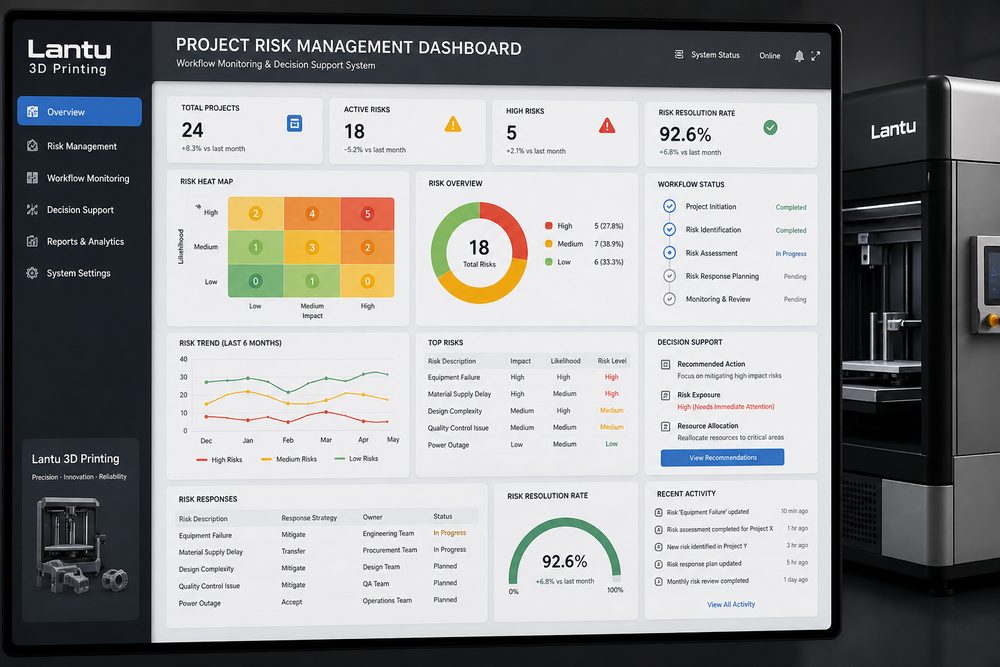
4. Risk monitoring and emergency responseAfter the risk response strategy is formulated, a continuous monitoring mechanism and emergency response plan need to be established to ensure the effective implementation of risk management measures. 1. Risk monitoring mechanismRisk Kanban Management:
Periodic Risk Assessment:
Risk Register:
2. Emergency response planEquipment Failure Emergency Plan:
Emergency plan for quality issues:
Contingency plan for project delays:
Material shortage emergency plan:
3. Crisis management mechanismFor major risk events (such as large-scale equipment failure, major quality problems, major customer complaints), activate the crisis management mechanism:
Summary3D printing project risk management is a systematic project that requires the establishment of a complete management closed loop from the four links of risk identification, assessment, response, and monitoring. Core points include: 1. Comprehensive identification of risks: Systematically identify risks from five dimensions: technology, supply chain, quality, project management, and external environment, and establish a risk checklist and historical case library. 2. Scientifically assess risks: Use tools such as probability-impact matrix, Monte Carlo simulation, FMEA, etc. to quantify risk priorities and guide resource allocation. 3. Respond to risks accurately: Choose avoidance, transfer, mitigation, and acceptance strategies according to risk types, and formulate specific and executable response measures. 4. Dynamically monitor risks: Establish monitoring mechanisms such as risk dashboards, regular assessments, and risk registers to ensure that risks are controllable. 5. Rapid emergency response: Develop hierarchical emergency plans and establish a crisis management mechanism to ensure rapid and effective handling of risks when they occur. By establishing a systematic risk management system, 3D printing service providers can increase the project success rate to more than 95% and customer satisfaction to more than 90%, laying a solid foundation for sustainable business development. For professional service providers such as lantu3D, risk management capabilities have become the core advantage of differentiated competition.
Next Step
Is this close to what you need?
Submit a model, drawing, image or written notes. Engineers will review material, process, finishing and delivery based on actual use. |