Introduction: Quoting Efficiency Determines Service Competitiveness
In the 3D printing service industry, quotation response speed directly affects customer decisions. According to industry research data, the traditional quotation process takes an average of 3-5 days, during which customer attrition can be as high as 25%. A fast and accurate quotation system has become a key factor in improving service competitiveness.
1. Pain Point Analysis of Traditional Quotation Processes
1.1 High Time Cost
The traditional quotation process requires multiple steps, including model evaluation, material selection, process confirmation, cost calculation, and price approval. Each step relies on manual judgment, and the overall process takes 3-5 days. For urgent projects, customers often choose competitors who respond faster.
1.2 Insufficient Accuracy
Manual quoting relies on experience-based judgment, and quotation differences between evaluators can reach 20%-30%. This uncertainty reduces customer trust and can even lead to cost overrun disputes during project execution.
1.3 Heavy Repetitive Workload
Quoting for similar projects requires repeated evaluation and calculation, causing engineers to spend a large amount of time on low-value repetitive work and preventing them from focusing on technical optimization and innovation.
2. Core Architecture of a Fast Quotation System
2.1 Intelligent Evaluation Model
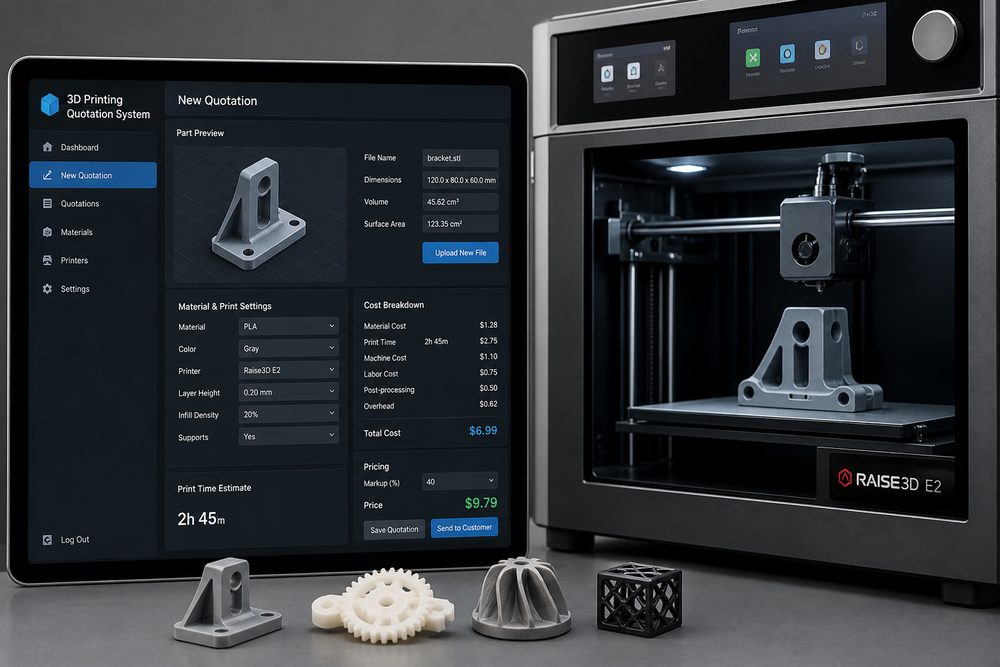
The intelligent evaluation model is the core of the fast quotation system, automatically identifying model features through algorithms:
- Geometric Feature Extraction: Automatically identifies key parameters such as model volume, surface area, overhang structures, and minimum wall thickness
- Process Feasibility Analysis: Determines applicable process types based on features (FDM/SLA/SLS/SLM, etc.)
- Material Recommendation Matching: Recommends the optimal material combination based on the application scenario
2.2 Automatic Cost Calculation Engine
The cost calculation engine transforms traditional manual accounting into automated calculation:
| Cost Item | Calculation Method | Data Source |
|---|---|---|
| Material Cost | Volume × Material Density × Material Unit Price × Utilization Coefficient | System Parameter Database |
| Equipment Labor Time | Printing Time × Equipment Labor Rate | Process Parameter Database |
| Post-processing | Support Removal + Surface Treatment + Heat Treatment, etc. | Process Standard Database |
| Indirect Costs | Direct Cost × Indirect Cost Coefficient | Enterprise Cost Database |
2.3 Real-time Pricing Engine
The real-time pricing engine dynamically adjusts prices based on market factors:
- Market Benchmark Pricing: Regularly updates market price ranges for each process and material
- Competitive Strategy Pricing: Adjusts prices based on project scale, customer tier, and competitive landscape
- Dynamic Discount Management: Sets discount rules and approval authority
2.4 Quotation Template Management
Establish standardized quotation templates for common application scenarios:
- Prototype validation project template
- Small-batch production project template
- Functional test sample template
- Display model production template
3. Key Steps in System Implementation
3.1 Data Infrastructure Development
The accuracy of a fast quotation system depends on a robust data foundation:
- Process Parameter Database: Establish parameters such as printing speed, material utilization rate, and waste rate for each process
- Material Cost Database: Update market prices for each material in real time
- Historical Project Database: Accumulate project quotation and actual cost data to continuously optimize algorithms
3.2 Algorithm Model Training
Optimize quotation accuracy through machine learning technology:
- Collect data from 1,000+ historical projects
- Train a price prediction model with a target error controlled within ±10%
- Establish anomaly detection rules to flag projects requiring manual review
3.3 System Integration and Deployment
Integrate the quotation system with existing business systems:
- Customer Portal Integration: Automatically generate an initial quotation after the customer uploads a model
- Order System Integration: Automatically create an order after quotation confirmation
- Production System Integration: Automatically pass quotation parameters to production scheduling
4. Practical Application Results
4.1 Improved Response Efficiency
After a medium-sized 3D printing service provider implemented the fast quotation system:
- Quotation response time was reduced from an average of 3.5 days to 2 hours
- Customers
Submit a model, drawing, image or written notes. Engineers will review material, process, finishing and delivery based on actual use.