Introduction: The Importance of Requirements Analysis
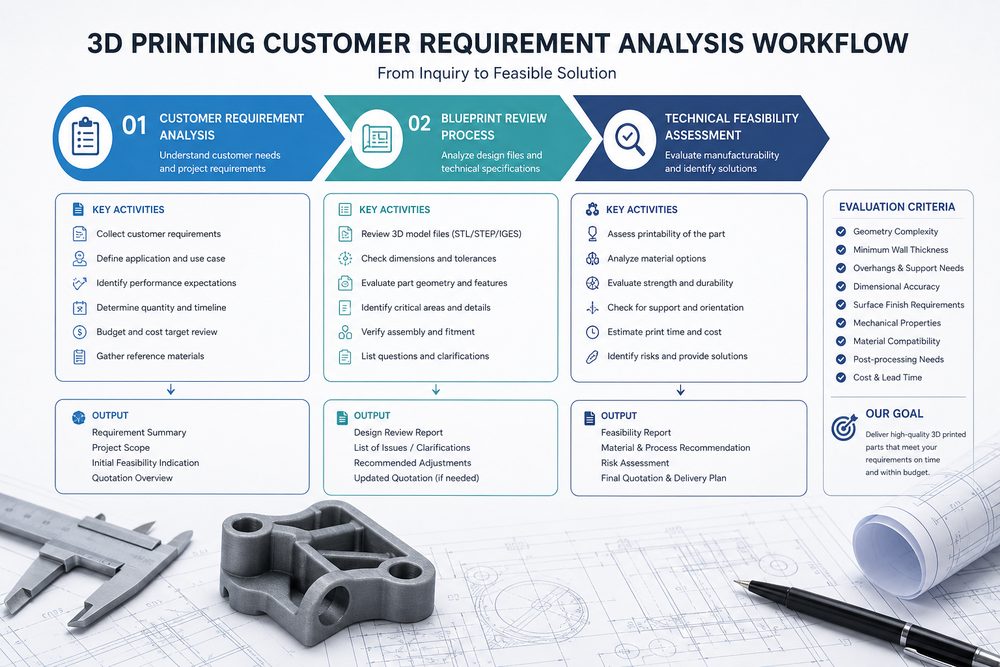
In 3D printing services, customer requirements analysis directly determines the direction and success or failure of a project. According to industry statistics, about 40% of project delays and cost overruns stem from misunderstandings of requirements. A systematic requirements analysis process can effectively reduce communication costs, minimize rework, and improve customer satisfaction, making it a core capability of professionalized 3D printing services.
1. Requirements Information Collection Stage
1.1 Key Points for Initial Communication
When first contacting a customer, the following key information should be collected:
- Application scenario: prototype validation, functional testing, small-batch production, or final product?
- Technical requirements: dimensional accuracy, surface quality, mechanical properties, material characteristics?
- Timeline: delivery date, milestone requirements, project schedule?
- Budget range: cost expectations, price sensitivity, payment method?
1.2 Design File Review
After receiving the customer's design files, the following checks should be performed:
- File format compatibility (STL, STEP, IGES, OBJ, etc.)
- Geometric integrity (watertightness, manifoldness, normal direction)
- Reasonableness of dimensions and process feasibility
- Process constraints such as wall thickness, overhangs, and minimum feature size
1.3 Material and Process Matching
Recommend suitable materials and processes based on application requirements:
| Application Requirement | Recommended Process | Recommended Material |
|---|---|---|
| Appearance prototype | SLA | Standard resin, tough resin |
| Functional testing | SLS/SLM | PA12, aluminum alloy, stainless steel |
| Small-batch production | SLS/MJF | PA12, PA11 |
| High-performance parts | SLM/EBM | Titanium alloy, high-temperature alloy |
2. Technical Feasibility Assessment
2.1 Matching Process Capabilities
Assess whether the company's equipment capabilities can meet customer requirements:
- Size range: match between equipment build size and part size
- Accuracy requirements: equipment precision capability and tolerance requirements
- Material capability: match between available materials and performance requirements
- Capacity match: feasibility of delivery time and production scheduling
2.2 Risk Identification and Prevention
Identify potential risks and formulate preventive measures:
- Design risk: geometric features do not meet process requirements
- Material risk: material performance does not meet standards
- Quality risk: dimensional accuracy or surface quality is unstable
- Delivery risk: production cycle or logistics delays
2.3 Cost Estimation and Quotation
Calculate costs based on the results of the requirements analysis:
- Material cost (calculated by volume or weight)
- Equipment operating time cost
- Post-processing cost (support removal, sanding, polishing, etc.)
- Quality inspection cost
- Logistics and packaging cost
3. Requirements Confirmation Process
3.1 Preparation of Requirements Documents
Prepare the "Customer Requirements Confirmation Form," including:
- Basic part information (name, quantity, purpose)
- Technical requirements (dimensions, accuracy, material, performance)
- Process plan (process type, equipment model, parameter range)
- Quality standards (inspection items, acceptance criteria)
- Delivery requirements (time, method, packaging)
3.2 Customer Confirmation Mechanism
Ensure consistent understanding of requirements:
- Written confirmation: signature or seal on the requirements confirmation form
- Sample confirmation: inspection and confirmation of the first article sample
- Technical briefing: communication and confirmation of key process points
3.3 Requirements Change Management
Establish a requirements change control process:
- Change request: the customer submits a written change request
- Impact assessment: assess the change
Submit a model, drawing, image or written notes. Engineers will review material, process, finishing and delivery based on actual use.