Introduction
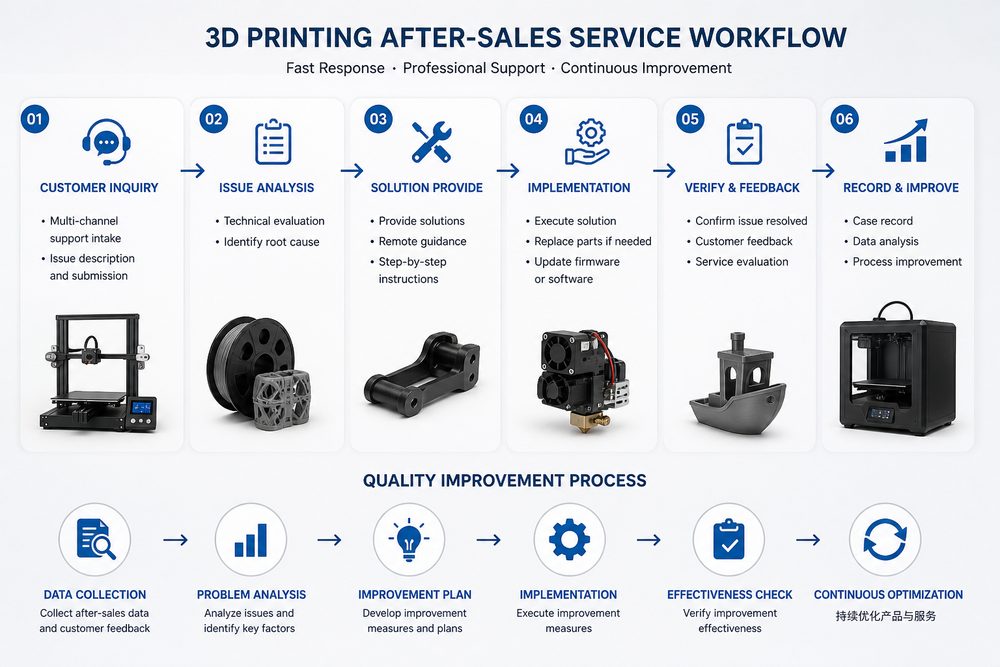
In the 3D printing services industry, after-sales service is not only an extension of product delivery, but also a key link in building customer trust and enabling long-term cooperation. As market competition intensifies and customer expectations rise, building a comprehensive after-sales service system has become one of the core competitive advantages of 3D printing service enterprises. According to statistics, companies with a well-developed after-sales service system can increase customer repurchase rates by 40-60% and customer satisfaction by more than 35%.
I. Service Commitment Development: Defining Service Boundaries and Standards
1.1 Core Elements of Service Commitment
A comprehensive service commitment should include the following core elements:
- Response time commitment: respond to routine issues within 2 hours and urgent issues within 30 minutes
- Resolution time commitment: resolve general issues within 24 hours and provide a solution for complex issues within 48 hours
- Quality assurance commitment: warranty period for delivered products, free rework for quality issues, and material performance guarantee
- Compensation standard commitment: compensation ratio for delayed delivery and remedial measures for quality issues
1.2 Principles for Developing Commitments
The formulation of service commitments should follow the SMART principles: Specific, Measurable, Achievable, Relevant, and Time-bound. For example, a 3D printing service company may promise that for dimensional accuracy issues, it will provide an initial analysis report within 4 hours after receiving customer feedback, give a solution within 24 hours, and complete issue handling or re-delivery through rework within 72 hours.
II. Issue Response Mechanism: Tiered Handling and Rapid Response
2.1 Issue Classification System
Establishing an issue classification system is the foundation for efficient response:
| Level | Definition | Response Time | Resolution Time |
|---|---|---|---|
| P1-Urgent | Product unusable, safety hazard present | 30 minutes | 4 hours |
| P2-Important | Function impaired, affects user experience | 2 hours | 24 hours |
| P3-General | Minor defects, does not affect use | 4 hours | 48 hours |
| P4-Inquiry | Usage consultation, suggestion feedback | 8 hours | 72 hours |
2.2 Multi-Channel Response System
Modern 3D printing services should establish a multi-channel response system:
- Online customer service system: 7x12 hours of online service, average response time under 2 minutes
- Telephone hotline: professional technical support team, on duty 24 hours a day
- Work order system: systematic issue tracking, visual progress inquiries throughout the process
- On-site service: provide on-site service for key customers or complex issues
Case: A customer manufacturing aerospace parts discovered within 48 hours after delivery that the dimensional deviation exceeded national standard requirements. After contacting the emergency hotline, the service team responded within 30 minutes, completed issue localization within 2 hours, reproduced the product within 24 hours and delivered it via expedited logistics, avoiding production line downtime losses for the customer.
III. Quality Traceability Process: Closed-Loop Management with Full-Process Traceability
3.1 Traceability System Architecture
A complete quality traceability system should include the following levels:
- Order level: order number, customer information, delivery requirements
- Batch level: material batch, equipment number, process parameters, operator
- Process level: printing parameters, post-processing records, inspection data, environmental conditions
- Delivery level: logistics information, receipt records, customer feedback
3.2 Traceability Data Management
Traceability data is automatically collected through MES systems and IoT technologies:
- Material traceability: inspection reports for each batch of incoming materials, usage records, and remaining inventory statistics
- Equipment traceability: real-time recording of equipment operating parameters, maintenance records, and fault logs
- Process traceability: full-process tracking of key parameters such as print layer thickness, scanning speed, and energy density
Submit a model, drawing, image or written notes. Engineers will review material, process, finishing and delivery based on actual use.